


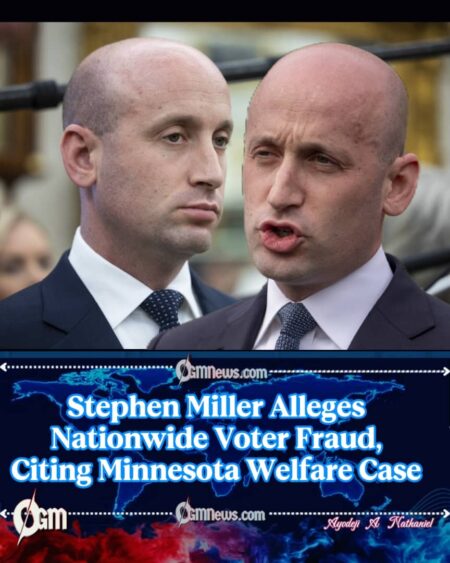
Stephen Miller issued a fresh warning alleging widespread voter fraud across the United States, arguing that recent welfare fraud investigations in Minnesota reveal deeper systemic failures. His remarks have reignited national debate over election integrity, immigration policy, and the limits of political rhetoric in a polarized environment.
The comments immediately drew attention from lawmakers, election officials, and civil society groups, many of whom cautioned against conflating unrelated issues without verified evidence.
Allegations Raised by a Prominent Conservative Voice
In his statement, Stephen Miller claimed that large-scale welfare fraud cases demonstrate vulnerabilities that could extend into voter registration and election administration. He suggested that if public assistance systems can be exploited, electoral systems may face similar risks.
Critics note that while welfare fraud cases are investigated through established legal processes, no direct proof was offered to substantiate a link between those cases and election misconduct.
Context: Minnesota Welfare Fraud Investigations
Minnesota has pursued several high-profile welfare fraud cases in recent years, with state and federal authorities emphasizing that investigations target specific individuals and organizations. Officials have repeatedly stressed that these cases do not implicate entire communities.
Legal experts warn that broad generalizations drawn from ongoing cases risk undermining due process and public trust in institutions tasked with enforcement and oversight.
Election Integrity and Established Findings
Multiple court rulings, bipartisan audits, and federal reviews have consistently found that widespread voter fraud is rare. Election administrators point to layered safeguards—ranging from voter roll maintenance to ballot verification—that limit the scale of potential abuse.
Analysts argue that allegations of systemic fraud require substantiation through documented evidence rather than inference or analogy.
Political and Public Reaction
Democratic leaders rejected the claims outright, describing them as unsubstantiated and potentially harmful. Civil rights organizations expressed concern that such rhetoric could stigmatize minority communities and erode confidence in democratic participation.
Some Republican officials echoed calls for stronger oversight, while others urged caution, noting that Stephen Miller’s assertions should be evaluated against established facts and legal standards.
Broader Policy Debate
The controversy unfolds amid wider discussions on election law reform, immigration enforcement, and public assistance oversight. Policymakers continue to debate how to balance election security with voter access while maintaining public confidence.
Observers note that statements from high-profile figures such as Stephen Miller often carry significant influence, regardless of whether the claims withstand scrutiny.
Ultimately, Stephen Miller’s remarks have intensified an already contentious debate over election integrity in the United States. While welfare fraud investigations proceed through the courts, no verified evidence has emerged to support allegations of coordinated nationwide voter fraud.
The episode underscores how political claims can shape public discourse even as officials and experts emphasize the importance of evidence-based conclusions.