










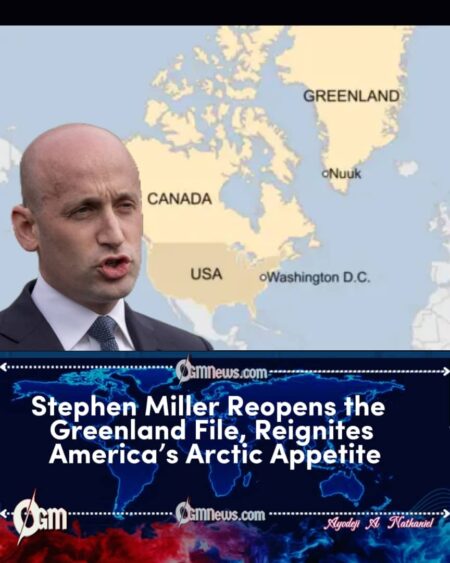
Stephen Miller, White House Deputy Chief of Staff, has sparked renewed domestic and international debate after stating that Greenland “should be part of the United States.” The remark, delivered plainly and without diplomatic qualification, has revived long-standing questions about U.S. strategic interests in the Arctic, relations with key allies, and the limits of modern territorial ambition. Coming from a senior official within the White House, the statement has attracted significant attention beyond routine political commentary.
Stephen Miller’s Statement and Its Immediate Impact
Stephen Miller’s assertion placed Greenland back at the center of U.S. political discourse almost instantly. While American interest in Greenland has surfaced periodically over decades, Miller’s language stood out for its directness, suggesting incorporation rather than partnership or cooperation.
The comment has been interpreted by analysts as more than rhetorical provocation. Given Stephen Miller’s role within the administration, his words are seen as reflective of thinking within influential policy circles, even if they do not yet represent a formal shift in U.S. policy.
Strategic Significance of Greenland
Greenland’s importance lies largely in its geography. Positioned in the Arctic between North America and Europe, the island plays a critical role in missile defense, early-warning systems, and control of key transatlantic routes. As Arctic ice recedes, Greenland’s strategic value has increased further.
In addition to military considerations, Greenland is rich in rare earth minerals and natural resources essential to modern technology and energy systems. These factors have intensified global interest in the region, particularly as competition among major powers expands northward.
Historical Context of U.S. Interest in Greenland
The United States has explored the idea of acquiring Greenland multiple times, including formal discussions in the mid-20th century. Although these efforts never advanced, they established a historical precedent for American strategic curiosity about the territory.
During President Donald Trump’s current second term, similar ideas resurfaced in public discourse, drawing firm opposition from Denmark and Greenlandic leaders. Stephen Miller’s statement echoes those earlier discussions, indicating that the concept remains influential within certain segments of U.S. policymaking.
Diplomatic and Sovereignty Considerations
Greenland is an autonomous territory within the Kingdom of Denmark, and its political status is governed by international law and self-determination principles. Danish officials have consistently rejected any notion of transferring sovereignty, emphasizing that Greenland’s future rests with its people.
Stephen Miller’s remark therefore raises diplomatic sensitivities, particularly with Denmark, a long-standing NATO ally. Critics argue that public statements of this nature risk straining alliances and complicating cooperation on defense, climate policy, and Arctic governance.
Stephen Miller and the Administration’s Broader Arctic Outlook
Stephen Miller’s comments fit into a wider conversation about how the United States approaches Arctic strategy. The region has become a focal point of geopolitical competition, with increased activity from Russia and China prompting renewed attention from Washington.
Supporters of a more assertive Arctic posture argue that strong language underscores U.S. resolve and strategic awareness. Others caution that rhetoric suggesting territorial acquisition may undermine the cooperative frameworks that have traditionally governed Arctic relations.
Domestic and International Reactions
Within the United States, reactions have been mixed. Some commentators view Stephen Miller’s statement as a bold articulation of national interest, while others see it as impractical and diplomatically counterproductive. Lawmakers have also questioned whether such debates distract from pressing domestic priorities.
Internationally, the comment has been closely watched by allies and rivals alike. Observers note that even speculative claims can have tangible effects in a geopolitical environment marked by heightened sensitivity and competition.


