










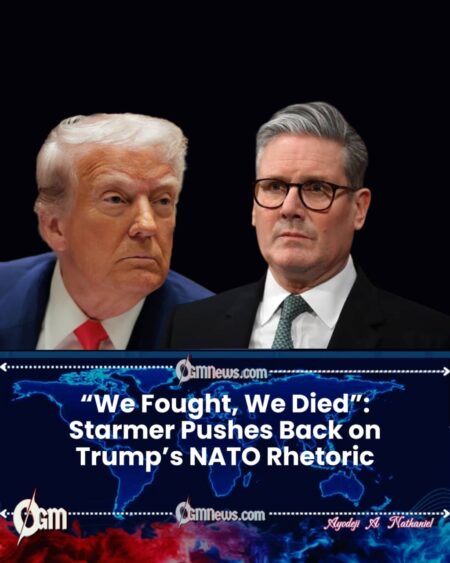
UK Prime Minister Keir Starmer has publicly challenged remarks by President Donald Trump, currently serving a second term as U.S. president, after Trump claimed that NATO failed to make meaningful sacrifices during the war on terror. Starmer described the assertion as historically inaccurate, stressing that NATO allies bore significant human, financial, and strategic costs during two decades of counterterrorism operations.
The prime minister’s response marked one of the strongest rebuttals from a European leader to Trump’s recurring skepticism toward the alliance. Starmer framed his comments not as a political attack but as a defense of documented history, emphasizing that allied nations, including the United Kingdom, committed troops, resources, and long-term support in Afghanistan and other theaters.
Starmer’s intervention reflects growing unease among NATO members over statements that could undermine alliance unity at a time of heightened global instability.
UK Losses and Allied Contributions
Starmer underscored that NATO’s engagement in the war on terror came at a substantial cost, particularly for frontline allies. The United Kingdom lost hundreds of service members during its deployment in Afghanistan, alongside thousands wounded or affected by long-term physical and psychological trauma.
Beyond military casualties, Starmer highlighted the extensive financial commitments made by NATO countries, noting that European allies collectively spent billions supporting stabilization, training, and reconstruction efforts. He argued that such contributions contradict any suggestion that NATO members failed to share the burden.
By reiterating these facts, Starmer sought to reinforce public recognition of the sacrifices made by allied forces and their families.
Trump’s NATO Criticism and Its Context
President Trump has repeatedly questioned NATO’s value, often arguing that the alliance disproportionately benefits European nations at the expense of American taxpayers. His latest remarks, which downplayed NATO’s role in the war on terror, fit a broader pattern of criticism that has resurfaced during his second term in office.
Supporters of Trump’s position argue that his rhetoric is intended to pressure allies into increasing defense spending and taking greater responsibility for their own security. Critics, however, warn that such statements risk weakening alliance cohesion and emboldening geopolitical rivals.
Starmer’s response appeared designed to counter this narrative without escalating diplomatic tensions.
Implications for Transatlantic Relations
The exchange highlights the delicate state of transatlantic relations as NATO navigates ongoing conflicts and security challenges. European leaders have increasingly emphasized the importance of collective defense and historical solidarity, particularly in the face of renewed global power competition.
Starmer reaffirmed the UK’s commitment to NATO, stressing that alliance credibility depends on mutual respect and acknowledgment of shared sacrifices. He indicated that maintaining trust among allies is essential for addressing current and future threats.
Analysts note that such public disagreements, while not unprecedented, place additional strain on diplomatic coordination between Washington and European capitals.
Domestic and International Reactions
In the UK, Starmer’s remarks were broadly welcomed across much of the political spectrum, with many lawmakers praising his defense of British service members. Veterans’ groups also expressed support, arguing that the prime minister’s comments honored those who served.
Internationally, several NATO officials echoed Starmer’s emphasis on factual historical records, while stopping short of directly criticizing President Trump. This cautious approach reflects a desire to preserve working relationships within the alliance despite rhetorical disputes.
NATO’s Legacy and the Path Forward
Starmer concluded by calling for a renewed focus on NATO’s core principles: collective defense, shared responsibility, and democratic values. He argued that honest acknowledgment of past sacrifices strengthens, rather than weakens, the alliance.
As NATO prepares for future strategic challenges, including evolving security threats and internal political divisions, leaders face the task of balancing domestic political pressures with alliance solidarity. Starmer’s intervention signals that the UK intends to play an active role in defending NATO’s legacy and relevance.


