








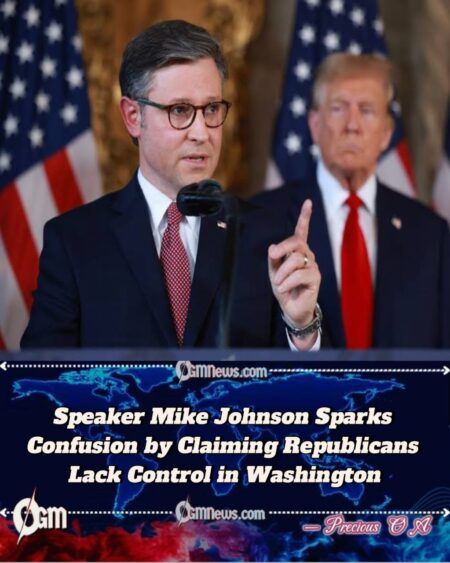
Mike Johnson, the current Speaker of the U.S. House of Representatives and a central figure in the Republican Party’s leadership structures, stunned political reporters and viewers alike when he publicly insisted that the Republican-controlled government is not actually being run by Republicans. His remarks landed with a thud of confusion across the country, especially because the Republican Party currently controls the presidency under Donald Trump’s second term, as well as holding majority power in both the House and the Senate. For a man whose office traditionally symbolizes command and legislative authority, the speaker’s declaration felt almost like an open political contradiction.
Mike Johnson proclaimed loudly, “They keep saying, ‘Republicans are in charge of government.’ We aren’t!” It was a moment that highlighted anxiety and unease within his party as the nation continues to navigate a protracted and painful federal shutdown crisis. With millions of American workers temporarily without paychecks and numerous government services either halted or severely limited, his comment was immediately scrutinized as a surprising deflection from responsibility rather than a clarifying explanation.
With frustration building visibly, the speaker argued that Democrats must be held accountable for the shutdown, even though Republicans hold powerful positions that historically come with an expectation of decisive leadership. His remarks, describing Democrats as the obstacle to reopening government operations, only added further layers of political tension, raising uncomfortable questions about whether the party in power is willing—or even able—to govern effectively during a national crisis.
Mike Johnson emphasized that structural constraints on the Senate’s operations, particularly the 60-vote threshold needed to advance major legislation, limit the ability of the Republican majority to assert full control. His tone suggested a combination of irritation, stress, and political vulnerability as he sought to defend both his public image and his capacity to steer the legislative branch through this tumultuous period.
Confusion spread rapidly through political circles and public discussions. If Republicans are not truly governing—even while occupying the positions traditionally responsible for doing so—then who is? Many critics have now framed Johnson’s statement as symbolic of a broader identity struggle within the Republican Party, where internal disagreements about governing priorities threaten to overshadow its dominant control of Washington.
Leadership in Doubt
Mike Johnson continued his defensive stance with escalating urgency as he explained that Senate procedures create barriers that appear insurmountable without at least some degree of Democratic cooperation. This explanation, instead of reassuring the public, provided only more evidence to observers who fear that Republican leadership is fractured in a moment when the nation desperately requires unity, tactical discipline, and policy clarity.
Critics argued that his admission represents far more than a moment of frustration—it exposes a deeper leadership breakdown inside the Republican Party. The shutdown has revealed sharp ideological divisions within the GOP, where some members demand harder lines against spending while others push for compromise to restore normal government operations. Johnson’s inability to unify these competing factions raises doubts about his effectiveness as speaker at a time of enormous national significance.
Mike Johnson has found himself battling not only Democrats but also factions within his own party who are dissatisfied with what they perceive as weak negotiation tactics or too much willingness to blame external factors. He faces loud calls from conservative hardliners urging stronger confrontations, while more moderate Republicans express dismay at the shutdown’s impact on ordinary Americans and the United States economy.
Pressure has continued to intensify inside the House Republican Conference. Some lawmakers are increasingly vocal in their belief that if the speaker truly feels his hands are tied, then perhaps new leadership should be considered—someone who does not openly suggest powerlessness in the highest legislative role. The balance between humility and authority has become blurry and politically dangerous.
Mike Johnson has unintentionally shifted the shutdown debate into a referendum on his own competence and authority. What was once solely a budgetary impasse has now transformed into a public relations struggle: a speaker who commands the gavel but insists he is not actually in command. This narrative threatens to overshadow ongoing negotiations and further weaken Republican messaging.
Political Fallout and the Road Ahead
Mike Johnson now faces an American public growing increasingly impatient with the shutdown’s widespread effects. Workers have missed paychecks, families relying on government assistance have become anxious, and institutions that depend on federal support are in a state of uncertainty. His remarks risk cementing a perception of confusion and dysfunction, especially during a fragile moment in national governance.
Expectations from President Trump and White House officials remain intense and unrelenting. The current president has laid out ambitious second-term policy goals and needs coordinated support from Congress to achieve them. Any perceived instability from Johnson’s leadership could slow or jeopardize major legislative priorities intended to showcase strong Republican governance heading into the next electoral cycle.
Mike Johnson has sparked broader conversations about whether the Republican Party truly understands the weight and meaning of governing power. If a party in full control cannot manage its own internal discipline or fulfill core governmental responsibilities, then voters may begin questioning whether complete partisan authority actually results in effective leadership. This could become a liability for Republicans campaigning on promises of strength and control.
The speaker must now decide whether to reassert his authority with decisive leadership moves or continue spreading responsibility outward onto political opposition. Either route carries significant risks, and neither guarantees a clean path forward. If he insists Republicans “aren’t in charge,” he risks appearing weak. If he embraces accountability, he must deliver tangible results—fast.
Mike Johnson stands at a pivotal crossroads. His next steps could determine not only the length of the ongoing shutdown but also the trajectory of his speakership and, potentially, the direction of the Republican Party itself. The American people are watching closely to see whether this unusual moment becomes a turning point toward stronger leadership—or a lingering symbol of a government that cannot control the reins it currently holds.