

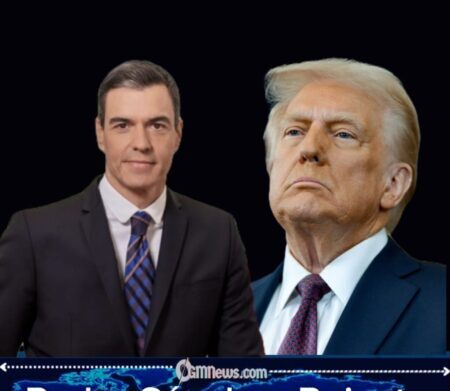
Spanish PM Pedro Sánchez has firmly rejected pressure from the United States after President Donald Trump threatened to cut off all trade with Spain over its refusal to support a potential U.S.-led war with Iran.
Pedro Sánchez framed Spain’s position as a matter of principle, sovereignty, and global responsibility, declaring in a nationally televised address that his country would not be “accomplices to something that is bad for the world.” His remarks followed escalating rhetoric from Washington after Spain declined to permit the use of its military bases for operations linked to the Iran crisis.
Diplomatic Rift Escalates Over Iran Policy
Pedro Sánchez underscored that Spain’s foreign policy decisions would be guided by national interest and international law, not by external pressure. He emphasized that Madrid’s refusal to support military escalation does not signal hostility toward the United States but reflects a cautious approach to global conflict.
Pedro Sánchez responded after President Trump publicly criticized Spain for failing to align with U.S. strategy and for allegedly not meeting defense spending expectations within NATO. The U.S. president warned of sweeping economic retaliation, intensifying tensions between the two longtime allies.
Pedro Sánchez maintained that Spain’s stance was grounded in constitutional responsibility and the belief that war should only be pursued with clear objectives, broad consensus, and legal justification.
“We Cannot Play Russian Roulette With Millions of Lives” Pedro Sánchez cautioned against what he described as a reckless slide toward a large-scale conflict. “Very often great wars start with a chain of events spiraling out of control due to miscalculations, technical failures, and unforeseen circumstances,” he said, urging leaders to learn from history.
Pedro Sánchez questioned the strategic clarity behind the initial military actions that triggered the current crisis, stating, “It’s not even clear what the goals are of those who launched the first attack.” He stressed that unclear objectives often lead to prolonged and destabilizing consequences.
Pedro Sánchez warned that the likely outcome of escalation would include civilian casualties in Iran and the loss of American service members, arguing that such a development would deepen instability in the Middle East rather than resolve tensions.
Comparisons to the Iraq War and the Rise of ISIS
Pedro Sánchez drew direct comparisons to the 2003 U.S.-led invasion of Iraq, warning against “repeating the mistakes of the past.” He cited the immense human and financial costs of that war, along with its long-term geopolitical fallout.
Pedro Sánchez referenced the emergence of extremist groups such as Islamic State as a consequence of instability created in the aftermath of the Iraq conflict. He argued that military interventions without sustained international consensus often produce unintended consequences.
Pedro Sánchez distilled Spain’s position into a simple phrase: “No to war.” The statement has since resonated domestically and across parts of Europe where leaders and citizens are calling for diplomatic solutions.
Trade Retaliation Threats and NATO Tensions
Pedro Sánchez addressed President Trump’s remarks that he had instructed Treasury Secretary Scott Bessent to cut off economic dealings with Spain. Trump also criticized Spain for not agreeing to increase defense spending to 5 percent of GDP within NATO.
Pedro Sánchez acknowledged the seriousness of the trade threat but insisted that economic pressure would not alter Spain’s commitment to its principles. He noted that alliance cooperation must be built on mutual respect rather than coercion.
Pedro Sánchez reaffirmed Spain’s support for collective security within NATO while emphasizing that participation in military action requires national approval and adherence to international norms.
Spain Defends Sovereignty and National Interest
Pedro Sánchez declared that Spain would “not be complicit in something that is bad for the world – and that is also contrary to our values and interests – simply out of fear of reprisals from someone.” Though he did not name President Trump in that portion of the speech, the context was widely understood.
Pedro Sánchez reiterated that Spain’s decision reflects domestic public opinion, strategic evaluation, and legal considerations rather than antagonism toward Washington. He signaled openness to continued dialogue aimed at preventing further deterioration of economic relations.
Pedro Sánchez concluded by affirming that Spain’s foreign policy will remain guided by long-term stability and multilateral cooperation, even in the face of significant diplomatic and economic pressure from a key ally.
Broader Implications for Global Stability
Pedro Sánchez’s remarks highlight widening divisions among Western allies over how to address rising tensions with Iran. Analysts suggest the dispute may test the cohesion of transatlantic partnerships and the broader relationship between the United States and the European Union.
Pedro Sánchez’s position underscores the delicate balance between alliance solidarity and national sovereignty in moments of crisis. A full suspension of trade between the United States and Spain would carry significant economic implications for both nations and potentially affect global markets.
Pedro Sánchez ultimately framed the debate as one about responsibility, warning that decisions taken in haste could carry consequences for generations. For Madrid, the message remains clear: diplomacy must prevail over escalation.