


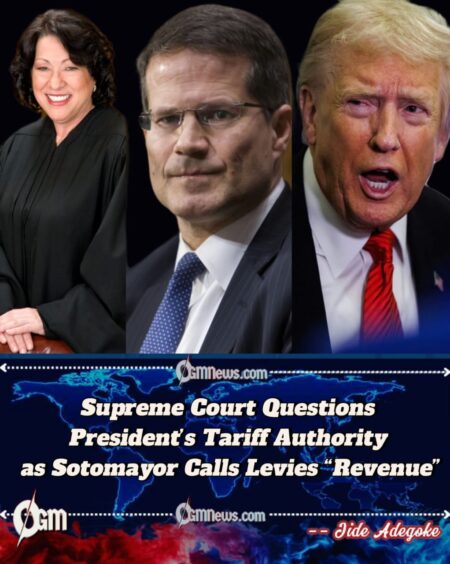
By [Reporter Name] — Washington, D.C. — In a tightly watched argument over the scope of presidential authority to impose broad-based import duties, U.S. Supreme Court Justice Sonia Sotomayor sharply challenged the government’s position that tariffs imposed by executive order are not a form of taxation — calling the claim “exactly what they are” and pressing Solicitor General D. John Sauer on why such levies should not be treated as a congressional power.
Over more than two hours of oral argument, a majority of justices from across the ideological spectrum signaled deep skepticism about whether the International Emergency Economic Powers Act (IEEPA) or any other statute authorizes the blanket tariffs the administration has deployed — a ruling that could fundamentally reshape executive trade authority and leave in doubt billions in revenue collected from tariffs.
Sotomayor: Demolishes Trump’s hack Solicitor General for claiming tariffs are not a tax burden on the American people
Justice Sonia Sotomayor repeatedly framed the core statutory and constitutional question in blunt fiscal terms: tariffs, she said, “are generating money from American citizens — revenue,” and that power to tax is a function reserved to Congress. Sotomayor pressed the Solicitor General on whether treating tariffs as merely “foreign-facing” regulation could be squared with the Constitution’s allocation of taxing power, and she warned that the government’s position — if accepted — would allow the executive branch to accomplish major domestic policy goals simply by invoking a foreign-affairs label. Those exchanges underscored a practical worry among several justices: that broad executive tariff authority could permit presidents to raise revenue and implement sweeping domestic programs without explicit congressional authorization.
The solicitor general defended the administration by describing tariffs as a regulatory tool aimed at foreign commerce, not a tax, and argued that Congress had provided statutory authority under IEEPA for emergency measures affecting foreign trade. But that line met immediate resistance from justices who noted IEEPA’s historical use and statutory text do not plainly contemplate generalized revenue-raising tariffs on the U.S. economy. Legal observers say the tenor of the questioning made clear that several justices view the government’s characterization as an insufficient answer to the separation-of-powers concerns at stake.
Sotomayor: “I just don’t understand this argument” — major questions and the limits of emergency power
Sotomayor also raised the major questions doctrine — the principle that Congress must speak clearly if it intends to confer authority to the executive to decide issues of vast economic or political significance — and asked whether the government could use emergency-authority statutes to circumvent that requirement. She drew a hypothetical line to other domestic policies, suggesting that, under the government’s theory, a president could declare an emergency on a broad subject (for example, climate) and then impose tariffs or other measures that effectively reallocate revenue or alter major social programs. That point echoed broader concern among the court that unchecked use of broad emergency statutes risks shifting significant lawmaking power from Congress to the presidency.
Justice Neil Gorsuch — often aligned with conservative limits on administrative reach — also voiced unease about a “one-way ratchet” of power toward the executive, warning that accepting the administration’s reading could permit a continual accretion of authority away from Congress. Several justices, including Chief Justice John Roberts, queried whether long-standing practice or historical examples validated the government’s interpretation — and whether such practice was enough to override textual or constitutional concerns. The questioning suggested the court is considering whether the tariff program raises “major questions” that require clear congressional authorization.
Sotomayor: Court doubts, stakes and what comes next
The case — consolidated litigation testing whether IEEPA and related proclamations permitted President Donald J. Trump, the current U.S. president serving a second term, to impose broad tariffs on a wide swath of imports — carries high economic and institutional stakes. Lower courts have already ruled against major elements of the administration’s actions, and the Supreme Court’s ultimate decision could determine the legality of tariffs that have affected prices, supply chains, and governm
ent coffers; some reports suggest tens of billions in tariff revenue and economic effects are implicated. A ruling for the challengers would not only likely invalidate aspects of the current tariff regime but also set a precedent constraining the executive’s use of emergency economic powers going forward.
The court will take time to consider the arguments, and an opinion will follow after internal deliberations. Observers caution that oral-argument heat does not always predict the final vote, but the tone of the questioning — including pointed interventions from justices on both the right and the left — makes clear that this dispute is testing foundational features of American governance: who gets to impose taxes or tax-like levies, and whether Congress must speak plainly before the executive can adopt sweeping measures with broad domestic impact.