





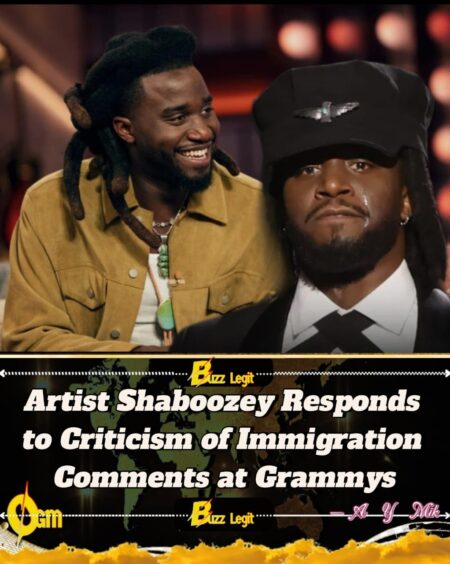
Award-winning artist Shaboozey has publicly addressed criticism surrounding his acceptance speech at the 68th Grammy Awards, after remarks made during his moment on stage sparked debate online. The controversy centered on comments in which the singer highlighted the role of immigrants in building the United States, with some viewers arguing that the statement overlooked the historical contributions of enslaved Africans and their descendants. In a written response shared days later, Shaboozey sought to clarify his intent and provide broader context for his words.
A Celebratory Moment That Sparked Debate
Shaboozey’s speech came after he won Best Country Duo/Group Performance alongside Jelly Roll for their collaboration “Amen.” While accepting the award, he used the moment to reflect on his background and to honor immigrant communities, stating that immigrants “built this country.” The remarks were delivered during an emotional and highly visible segment of the ceremony, which coincided with the opening of Black History Month.
Although many viewers applauded the message as a tribute to immigrant families and their sacrifices, others criticized the phrasing. Critics argued that the statement risked oversimplifying American history by failing to explicitly acknowledge the foundational role of enslaved Africans, whose forced labor significantly shaped the nation’s early economic and social structures.
The debate quickly gained traction on social media platforms, where users dissected the language of the speech and its broader implications. Several commentators emphasized the importance of historical precision, particularly during moments of national reflection such as Black History Month.
Public Reaction and Calls for Clarification
The backlash extended beyond casual online commentary, drawing responses from prominent voices in cultural and civil rights circles. Some urged Shaboozey and other public figures to be more explicit when referencing historical contributions, noting the distinction between voluntary immigration and forced enslavement.
Supporters of the artist, however, defended the speech as a personal reflection rather than a comprehensive historical statement. They pointed out that award acceptance speeches are often brief and emotionally driven, leaving little room for nuance. For many fans, the speech was seen as an expression of gratitude toward family and community rather than an attempt to redefine history.
As discussion intensified, attention turned to whether Shaboozey would address the criticism directly—a question answered within days.
Shaboozey’s Mea Culpa and Broader Context
In a message posted to social media, Shaboozey acknowledged the concerns raised by viewers and offered clarification. He explained that his comments were rooted in his personal experience as a Black man and the child of Nigerian immigrants, emphasizing that his intention was to honor his family’s journey and sacrifices.
He further stated that he recognizes and respects the immense contributions of Black Americans, including those descended from enslaved Africans, and that his remarks were not meant to exclude or diminish their role in American history. While stopping short of issuing a formal apology, Shaboozey conceded that his wording could have been clearer given the historical weight of the subject.
The response helped to ease some of the criticism while also reinforcing a broader cultural conversation about how public figures discuss complex historical realities in high-profile moments.