








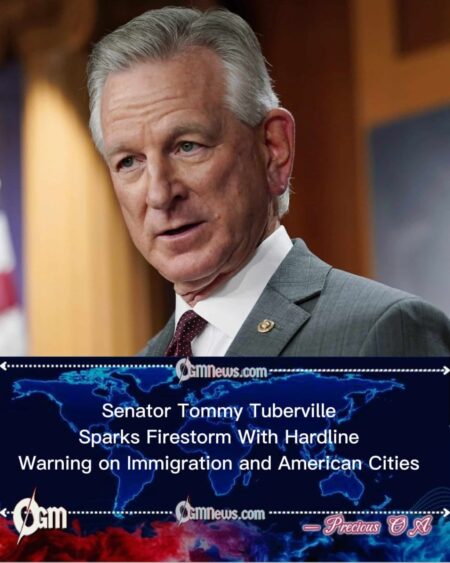
Senator Tommy Tuberville ignited renewed debate over immigration and urban policy after issuing a forceful statement warning against what he described as the deterioration of American cities. Speaking in blunt terms, the Alabama Republican said he would not allow U.S. communities to resemble failed states, framing his remarks as a defense of public safety and national sovereignty.
Tommy Tuberville argued that lax border enforcement and permissive sanctuary policies, in his view, have contributed to rising crime, strained municipal services, and eroded trust between citizens and government. He positioned his comments as a call to action for stronger enforcement and clearer consequences.
Tommy Tuberville also referenced Democratic lawmakers, including Rep. Ilhan Omar, while making his case, saying their policy positions reflect values he believes are incompatible with what he described as American standards of law and order. His remarks quickly drew attention across cable news and social media.
Clash With Progressive Lawmakers
Tommy Tuberville intensified his criticism by accusing progressive members of Congress of romanticizing foreign systems while, he claimed, neglecting the needs of American cities. He framed the dispute as ideological, arguing that differing visions for immigration reflect deeper disagreements about national identity.
Tommy Tuberville said his comments were intended to shock colleagues into confronting what he views as the real-world consequences of federal inaction. Supporters echoed his sentiment, saying tough language is necessary to spur legislative movement.
Tommy Tuberville faced immediate pushback from Democrats, who condemned his remarks as inflammatory and divisive. Critics argued that such rhetoric oversimplifies complex immigration challenges and unfairly targets immigrant communities.
Policy Framing and Border Enforcement
Tommy Tuberville defended his stance by pointing to crime statistics and budget pressures in major cities, asserting that uncontrolled migration places an unsustainable burden on local governments. He insisted that federal leaders must prioritize border security.
Advocates for stricter enforcement praised the senator for what they described as candor, saying many Americans share concerns but feel ignored by Washington. They argue that blunt rhetoric reflects voter frustration rather than hostility toward immigrants.
Opponents countered that policy debates should avoid language that could alienate entire communities. They stressed that immigration reform requires bipartisan cooperation rather than confrontational sound bites.
Reaction From Capitol Hill
Tommy Tuberville remained unapologetic amid the backlash, telling reporters that he would rather be criticized than remain silent. He said his responsibility is to constituents who demand safer streets and accountable governance.
Several Republican lawmakers voiced support, framing the controversy as evidence of a widening cultural divide in Congress. They argued that Democrats are out of touch with voters who prioritize enforcement.
Democratic leaders, meanwhile, warned that such rhetoric risks deepening polarization and undermining efforts to reach comprehensive immigration solutions.
Media and Public Response
Tommy Tuberville became a focal point of cable news discussions, with commentators dissecting both his language and the broader policy implications. Supportive outlets framed his remarks as a wake-up call.
Polling analysts noted that immigration remains one of the most emotionally charged issues in American politics, often amplifying sharp language on both sides. The senator’s comments tapped directly into that volatility.
Civil rights organizations urged lawmakers to tone down rhetoric, warning that heated language can fuel misunderstanding and resentment beyond Capitol Hill.
Broader Political Implications
Tommy Tuberville suggested the controversy underscores why immigration will remain central in upcoming elections. He argued that voters are demanding clarity and firmness rather than incremental reform.
Analysts observed that confrontational statements often energize a political base while simultaneously mobilizing opposition, making them a calculated risk in a polarized environment.
As debates continue, the episode highlights how immigration policy discussions increasingly blend legislation, identity, and rhetoric, shaping the tone of national discourse heading into the next election cycle.