










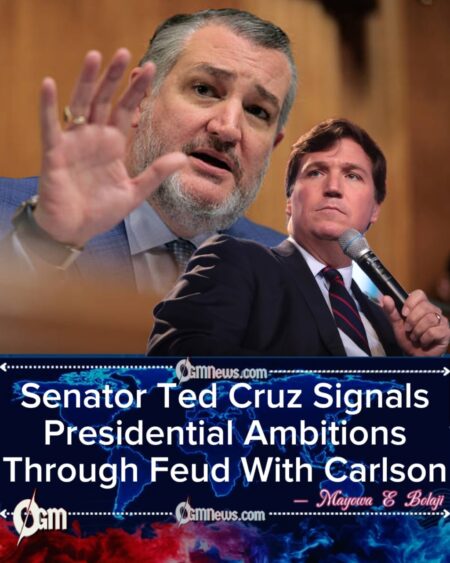
Senator Ted Cruz is laying early groundwork for a potential 2028 presidential campaign, embracing a sharpened political identity centered on foreign-policy interventionism and a public clash with conservative commentator Tucker Carlson. In remarks shared with Axios, Cruz signaled a deliberate pivot toward redefining his national profile ahead of what is expected to be a crowded Republican primary field.
Cruz’s comments underscore an emerging strategy: positioning himself as a defender of traditional Republican orthodoxy on national security while challenging what he characterizes as “reckless” rhetoric within his own party. His move signals a broader ideological divide inside the GOP, where interventionist and isolationist wings have been battling for influence since the rise of populism.
Senator Ted Cruz Draws a Line Against Carlson
Senator Ted Cruz has openly confronted Tucker Carlson, one of the most influential voices within the conservative base, in a feud that has drawn significant attention across the political landscape. Cruz’s willingness to criticize Carlson marks a departure from the cautious posture many Republican lawmakers maintain toward right-wing media figures.
In his interview, Cruz emphasized that he “won’t hesitate to call out those who peddle destructive, vile rhetoric,” signaling a refusal to remain silent when national security issues collide with political messaging. This confrontation suggests Cruz sees an opening to reclaim a more establishment-leaning segment of the Republican electorate that has grown uneasy with isolationist narratives.
Senator Ted Cruz Reasserts Traditional GOP Foreign Policy
Senator Ted Cruz has been vocal about reaffirming long-standing Republican commitments to strong global engagement and assertive national security policies. By highlighting these themes in early messaging, he is aligning himself with donors, strategists, and voters who remain wary of retreating from international alliances.
Cruz’s approach contrasts sharply with voices calling for reduced U.S. involvement abroad. As global instability remains a defining concern, his message signals confidence that Republican voters will once again gravitate toward assertive global leadership—particularly if the party seeks to reclaim the White House in 2028.
Senator Ted Cruz Frames His Vision as a Moral Imperative
Senator Ted Cruz described his position as driven by principle rather than political calculation. “Silence in the face of recklessness is not an option,” he told Axios, framing his criticism of Carlson—and others he views as promoting harmful narratives—as necessary to protect conservative ideology and national stability.
This moral framing positions Cruz not only as a political figure but as a guardian of the party’s foundational values. It also suggests he intends to build his 2028 message around a contrast between responsible leadership and what he views as destabilizing extremism.
Senator Ted Cruz Prepares for a 2028 Arena
Senator Ted Cruz’s recent posture aligns closely with early presidential maneuvering—testing messages, drawing contrasts with potential rivals, and re-engaging with conservative influencers and donors. While he has not formally announced a run, his strategic rebranding indicates preparation for major national engagement after President Trump completes his second term.
Republican strategists note that Cruz enters this phase with name recognition, an established base, and experience from his 2016 presidential bid. By differentiating himself now, he aims to secure a distinct ideological lane ahead of what may be the GOP’s most competitive primary in decades.


