







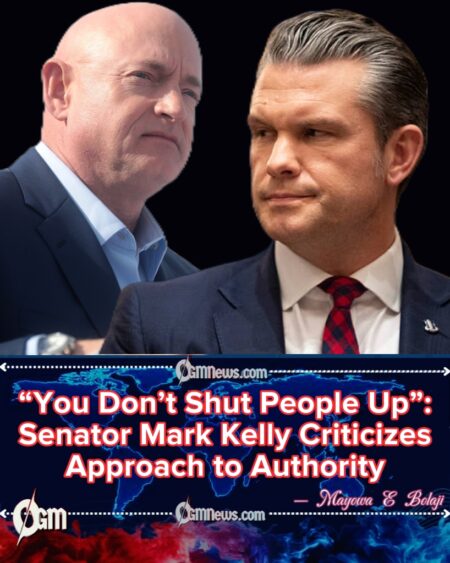
Senator Mark Kelly has delivered a pointed critique of leadership culture within the U.S. national security conversation, condemning what he described as attempts by political figures to shut down legitimate questioning. Speaking in response to comments and conduct attributed to Pete Hegseth, Kelly framed the issue as larger than any single individual, warning that discouraging accountability undermines democratic norms and effective command structures. His remarks have since intensified debate over leadership standards, civil-military relations, and the role of public scrutiny in governance.
Kelly’s comments, rooted in his own experience with military discipline and public service, emphasize that leadership is measured not by authority asserted, but by responsibility exercised. The exchange has resonated across political lines, drawing attention to how leaders respond when challenged.
Mark Kelly’s Core Criticism of Leadership Conduct
At the center of Kelly’s remarks is a rejection of the notion that leaders can simply silence dissent or inquiry. He argued that telling people to “shut up” or suggesting they are not permitted to ask questions reflects a misunderstanding of leadership itself.
According to Kelly, strong leadership invites scrutiny rather than suppresses it.
He further suggested that such behavior signals insecurity rather than authority. In Kelly’s view, leaders who are uncomfortable with questions often lack clarity of purpose or confidence in their decisions, traits that can be particularly damaging in military or national security contexts.
Mark Kelly on Accountability and Democratic Norms
Kelly framed his argument within the broader context of democratic governance, where questioning leaders is not only allowed but essential. He emphasized that accountability mechanisms—whether through the press, legislative oversight, or public debate—are foundational to responsible leadership.
By discouraging questions, Kelly warned, leaders risk eroding public trust. He noted that democratic institutions depend on transparency, and any attempt to muzzle inquiry weakens the relationship between leaders and the citizens they serve.
Mark Kelly’s Reference to Military Leadership Standards
Drawing on military tradition, Kelly questioned the leadership models that may have influenced Hegseth during his service as a junior officer in the National Guard.
He suggested that effective military leadership is grounded in respect, competence, and the ability to explain decisions clearly to subordinates.
Kelly implied that dismissive or authoritarian communication runs counter to professional military values. In disciplined environments, he argued, leaders earn respect through example and clarity, not intimidation or verbal shutdowns.
Mark Kelly and the Debate Over Civil-Military Relations
The remarks have fueled a broader discussion about the intersection of politics and military culture. Kelly’s comments highlight concerns that political rhetoric, when imported into military or defense-related conversations, can distort traditional leadership expectations.
Analysts note that maintaining healthy civil-military relations requires leaders who respect both the chain of command and the principles of open debate. Kelly’s intervention underscores anxieties that politicized leadership styles may blur these boundaries.
Mark Kelly’s Warning on Leadership Competence
Perhaps the sharpest edge of Kelly’s critique was his assertion that dismissing questions reflects a lack of understanding of leadership responsibilities. His statement that such a figure “has no idea what he’s doing” signals deep concern about competence rather than mere disagreement.
Kelly framed competence as inseparable from humility—the willingness to listen, adapt, and justify decisions. Without these qualities, he suggested, authority becomes performative rather than effective.
Mark Kelly and the Broader Political Implications
Beyond the immediate exchange, Kelly’s remarks may shape ongoing political narratives about leadership quality and fitness for influence in national security debates. His comments arrive at a time when voters and lawmakers alike are scrutinizing how leaders communicate under pressure.
The episode reinforces a recurring theme in contemporary politics: that leadership style matters as much as policy positions.
Kelly’s intervention positions him as an advocate for standards rooted in accountability, professionalism, and respect for inquiry.