








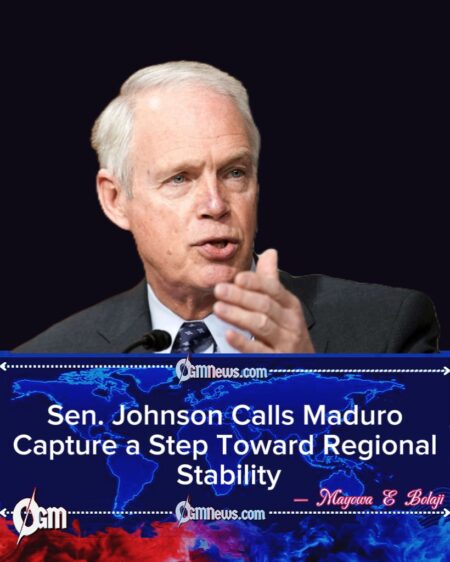
Wisconsin Senator Ron Johnson described the capture of former Venezuelan leader Nicolás Maduro as a “major national security win” for the United States during Saturday’s broadcast of America Right Now. Johnson’s comments reflect widespread Republican support for the operation, which removed Maduro from power and transferred him to U.S. custody to face federal charges related to drug trafficking and organized crime.
The operation has drawn attention both domestically and internationally, sparking debate over the legal, diplomatic, and strategic implications of the United States taking direct action against a foreign head of state.
Johnson emphasized that the mission strengthens U.S. security and signals American resolve to counter global threats.
As lawmakers and analysts weigh the ramifications, the operation underscores the ongoing U.S. policy focus on enforcing international law while maintaining national security priorities, with implications for regional stability and global geopolitical dynamics.
Operation Details and Legal Basis
The operation that led to Maduro’s capture followed an indictment in U.S. federal courts accusing him of orchestrating a transnational drug trafficking network responsible for distributing narcotics into the United States.
Maduro has pleaded not guilty to the charges in federal court.
U.S. officials described the mission as lawful enforcement action rather than a military conflict. Authorities maintained that it targeted criminal activity, not sovereign governance, though some legal scholars have questioned whether using military resources in this manner without Congressional approval could set a precedent.
The capture represents a rare instance of a sitting head of state being detained by U.S. authorities, raising questions about international law, sovereignty, and the legal boundaries of extraterritorial enforcement.
Republican Lawmakers Praise the Outcome
Sen. Ron Johnson and other Republican leaders have lauded Maduro’s capture as a strategic success, highlighting its potential to disrupt organized crime networks and enhance U.S. security. Johnson described the operation as a demonstration of American capabilities and decisiveness in combating transnational threats.
Supporters also emphasized that removing Maduro, a leader widely criticized for corruption and authoritarian practices, contributes to regional stability and reinforces deterrence against illicit activities in the Western Hemisphere.
The praise from Republican lawmakers is coupled with calls to sustain vigilance against the remaining elements of Maduro’s network, ensuring that the gains of the operation are fully leveraged to protect U.S. national interests.
Democratic Concerns and Legal Oversight
While many Republicans welcomed the operation, several Democratic lawmakers raised concerns about the legal and diplomatic implications. Critics argue that the mission bypassed Congressional authorization and may constitute an overreach of executive authority, challenging the constitutional division of powers.
Some Democrats also expressed worry that the capture could escalate tensions in the region, provoke retaliatory actions, or complicate diplomatic relations with Latin American countries. Calls for greater transparency and legal review have emerged as part of the broader debate.
The operation has thus highlighted a clear partisan divide in U.S. foreign policy, with Republicans emphasizing decisive action and Democrats stressing legal oversight, international norms, and regional stability.
International Reactions and Geopolitical Implications
Globally, Maduro’s removal has elicited mixed responses. Some regional governments welcomed the capture as a step toward accountability and potential democratic reform in Venezuela, while others condemned it as a violation of sovereignty.
International legal experts have flagged concerns about setting a precedent for extraterritorial enforcement and the possible erosion of global norms governing state conduct. Multilateral organizations, including the United Nations, have called for close monitoring to mitigate potential instability.
The operation’s geopolitical impact is significant, with analysts noting that U.S. actions could influence regional alliances, security cooperation, and broader international relations in the Americas.
National Security and Policy Implications
Sen. Johnson framed Maduro’s capture as a national security achievement, asserting that it underscores the importance of robust U.S. policy in confronting global threats. Proponents argue that decisive enforcement sends a clear message to criminal networks and authoritarian regimes alike.
The operation also highlights a growing emphasis on preemptive measures to protect U.S. borders, communities, and economic interests. Analysts suggest that balancing assertive action with adherence to international law will continue to shape policy discussions in Washington.
Moving forward, the U.S. will likely face ongoing debate about the appropriate use of force abroad, the role of Congress in authorizing such missions, and the broader implications for diplomatic relations with Latin America.
Looking Ahead: Legal Proceedings and Regional Stability
With Nicolás Maduro now in U.S. custody, federal courts will oversee his prosecution on drug trafficking and organized crime charges. The legal proceedings are expected to be closely monitored by international observers, human rights advocates, and foreign governments.
Regional leaders have expressed cautious optimism that Maduro’s removal could pave the way for more stable governance and accountability in Venezuela, though many warn of potential backlash from remaining loyalists.
For U.S. policymakers, the challenge will be ensuring that the capture strengthens national security without destabilizing regional dynamics, while maintaining the credibility of U.S. leadership in international law enforcement.