









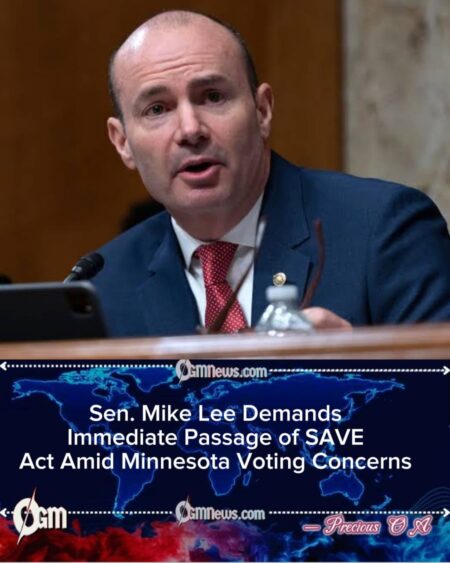
Sen. Mike Lee has called on the Senate to immediately pass the SAVE Act, a measure designed to ensure that only U.S. citizens are allowed to vote in federal and state elections. His demand comes after reports emerged that Minnesota allows one voter to “vouch” for up to eight migrant voters, raising concerns about electoral integrity.
The Utah senator argued that safeguarding elections is a fundamental responsibility of Congress, emphasizing that any loopholes could undermine public confidence in democratic processes.
Election integrity experts note that voter verification procedures vary by state, and gaps like those identified in Minnesota could be exploited if not addressed through federal legislation.
The Controversy in Minnesota
Sen. Mike Lee highlighted that Minnesota’s current voter vouching system permits one individual to vouch for eight other voters, including migrants who may not yet be U.S. citizens. He called this practice a “clear threat” to the legitimacy of election outcomes.
Critics argue that vouching is intended to help legitimate voters without standard documentation access the polls, particularly those in marginalized communities. However, Lee insists that protections must balance accessibility with security.
Several state election officials have defended the practice as a method to prevent disenfranchisement while maintaining integrity, but Lee counters that federal legislation like the SAVE Act would create uniform standards nationwide.
Details of the SAVE Act
Sen. Mike Lee explained that the SAVE Act (Secure and Verified Elections) would require proof of citizenship as a condition for voting in all federal and state elections. The measure would standardize voter verification, eliminating state-by-state discrepancies.
Proponents of the act argue that mandatory verification safeguards against potential fraud and ensures public trust in democratic processes. They cite Minnesota’s vouching system as an example of how local variations could compromise confidence.
Opponents of the SAVE Act claim that such requirements could disproportionately impact minorities and vulnerable populations, emphasizing the need to balance security with access. Lee, however, maintains that citizenship verification is non-negotiable.
Political Reactions
Sen. Mike Lee criticized members of Congress who have not prioritized election integrity, suggesting that partisan politics should not delay legislation designed to protect voter confidence.
Democratic lawmakers have largely opposed the SAVE Act, asserting that evidence of widespread voter fraud is limited and that the bill could suppress voter participation.
Sen. Mike Lee countered these arguments, insisting that proactive measures are necessary to prevent potential abuses before they occur, rather than reacting after the fact.
Public Response
Public reaction to Lee’s statements has been mixed. Some voters applaud the call for standardized voter verification, viewing it as a step toward secure elections.
Sen. Mike Lee emphasized that American citizens deserve confidence that every vote cast is legitimate, framing the SAVE Act as essential to preserving democracy.
Other citizens and advocacy groups argue that focusing on isolated procedural concerns could distract from broader efforts to improve election access and modernization.
Sen. Mike Lee vowed to continue pushing for the immediate passage of the SAVE Act, stating that federal intervention is necessary to prevent inconsistencies across states from affecting national elections.
Legislative analysts note that passing such a bill may face challenges in a divided Congress, with debates expected over both security measures and potential impacts on voter access.
Sen. Mike Lee concluded by asserting that the integrity of American elections must remain a top priority, signaling that he will actively campaign and lobby fellow senators to ensure the SAVE Act becomes law.