










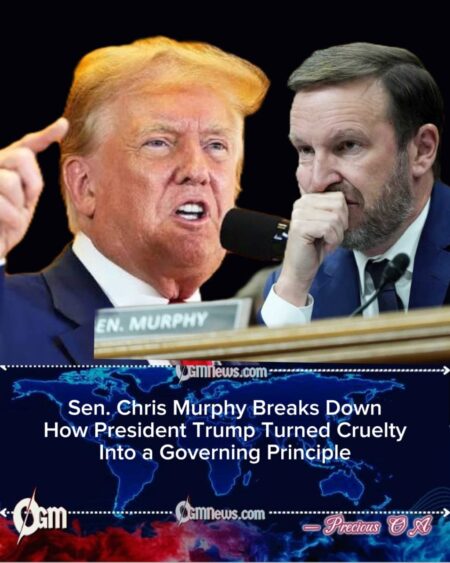
Senator Chris Murphy has drawn national attention after articulating a detailed and unusually expansive explanation of how President Donald Trump, now serving his second term as the current U.S. president, transformed cruelty from an occasional political tactic into a fully developed, consistently applied, and deeply embedded organizing ideology. Murphy argued that the president’s political brand relies not merely on toughness, bluntness, or rhetorical force, but on the deliberate, repeated, and strategically amplified use of public humiliation, intimidation, and emotional provocation to energize supporters, unsettle critics, and redefine the boundaries of acceptable political behavior.
According to Murphy’s interpretation, this approach was never accidental or merely spontaneous. Instead, he suggested that cruelty grew into a defining feature of the president’s method of governance—something used intentionally and persistently to draw clear political dividing lines, establish dominance in political spaces, and cultivate a sense of loyalty grounded in confrontation rather than consensus. His comments have sparked renewed public debate, prompting citizens and analysts alike to revisit the long-term implications of such a political strategy and to consider how profoundly it has already influenced national discourse.
Murphy emphasized that while political conflict has always existed in the United States, what distinguishes the current moment is the elevation of cruelty from a tool used in moments of heightened tension into a doctrine—an ideological pillar rather than a situational tactic. He warned that such a shift could have wide-reaching consequences for democratic norms, public communication, and the expectations Americans hold for leadership.
A Framework of Conflict and Division
Murphy contended that President Trump’s second-term strategies demonstrate not only the continuation of earlier patterns but an escalation and intensification of them. Public confrontations, aggressive rhetoric, and relentless political messaging—often delivered in sharp, personal, or antagonistic terms—have been used to maintain a narrative of “us versus them.” This perpetual sense of division, Murphy argued, fuels the president’s base by reinforcing the idea that political struggle is constant and that confrontation is necessary for survival in an increasingly polarized society.
He argued that within this framework, cruelty serves a specific and intentional function: it signals strength, punishes dissent, and sends a message about who holds power and who does not. Supporters, Murphy noted, often interpret these actions not as hostility or unnecessary harshness but as evidence of unapologetic leadership—a demonstration of a leader who refuses to be constrained by what they consider restrictive or outdated political norms. This interpretation strengthens the connection between leader and follower by reframing aggression as authenticity.
Murphy suggested that the effectiveness of this approach reveals something significant about modern American politics. The appeal of political aggression, even when it overshadows or replaces substantive debate, demonstrates a growing desire among some voters for leaders who “fight” without boundaries. This dynamic, he warned, complicates efforts to restore more traditional, compromise-driven political practices and widens the challenge facing those who seek to lower the temperature of national politics.
The Emotional Economy of Modern Politics
In Murphy’s view, President Trump’s approach has reshaped how political communication operates in an age dominated by digital interaction. Social media platforms amplify outrage, reward emotional extremes, and elevate the most provocative messages, creating an environment in which cruelty—delivered through sharp phrasing, public rebuke, or pointed mockery—tends to dominate public attention. As Murphy explained, this develops into a constant feedback loop: provocative language drives engagement, engagement encourages repetition, and repetition cements the tactic as a norm.
This emotional economy, Murphy noted, shifts the emphasis away from policy substance and toward moments of spectacle and conflict. In such a climate, cruelty becomes a shortcut to visibility and relevance. It is louder, quicker, and more likely to trend than reasoned debate or nuanced argument. As a result, the political environment becomes saturated with moments of confrontation, overshadowing more thoughtful discussions that require patience and reflection.
Murphy expressed deep concern about what this means for the health of democratic communication. When emotional provocation becomes the primary currency of political success, the stability of civil discourse becomes vulnerable. The tendency to reward the most extreme behaviors can drown out moderation, reduce incentives for collaboration, and weaken the public’s ability to engage meaningfully with complex issues.
Impact on Institutions and Public Norms
Murphy argued that the effects of a cruelty-centered strategy extend beyond rhetoric into the functioning of institutions and the expectations placed upon public officials. When politicians observe that harshness and hostility produce political rewards, they may feel pressured to adopt similar styles, reshaping the culture of governance toward conflict and spectacle rather than deliberation and service.
He warned that this trend risks eroding long-standing norms, including respect for differing viewpoints, professional boundaries within public service, and the distinction between legitimate political disagreement and personal attack. According to Murphy, these norms are essential to maintaining trust in institutions, and their weakening leaves the political system more volatile and less capable of sustaining constructive dialogue.
Murphy emphasized that such consequences accumulate gradually. Each moment in which cruelty is normalized contributes to a larger shift in political expectations. Over time, this can alter what Americans believe leadership should represent—moving the standard away from guiding through principle and toward dominating through forceful displays of authority.
Murphy’s Call for Reflection and Responsibility
As he concluded his remarks, Murphy urged Americans to reflect not only on the actions of President Trump but on the broader societal conditions that have allowed cruelty to thrive as a political identity. He insisted that political culture is shaped collectively and that citizens, leaders, and institutions share responsibility for determining what type of behavior receives approval, amplification, or reward.
Murphy argued that rejecting cruelty does not require rejecting strength. Instead, it requires recognizing that durable and trustworthy political leadership is grounded in empathy, restraint, and the ability to unify rather than divide. He called for leaders who can compete fiercely without resorting to personal degradation and for public discourse that emphasizes clarity, responsibility, and fairness.
Ultimately, Murphy framed his message as a call for national introspection. He urged Americans to consider whether the politics of cruelty aligns with the country’s long-term goals and to decide what kind of leadership will set the best example for future generations.


