










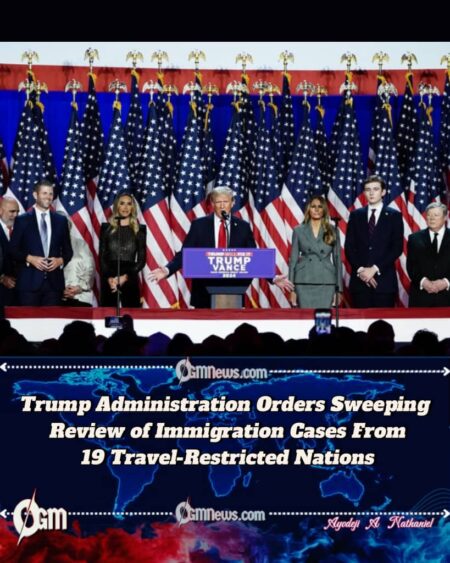
Donald Trump administration initiates a sweeping federal review of immigration cases involving applicants from 19 nations currently subject to U.S. travel restrictions, a move officials say is aimed at tightening national-security controls and ensuring system-wide consistency. The directive affects migrants from countries such as Cuba, Venezuela, and Haiti, where ongoing political instability and mass migration pressures have driven large numbers to attempt entry into the United States.
Donald Trump administration frames the review as part of the broader immigration overhaul pursued during President Donald Trump’s second term, arguing that the security climate demands more rigorous vetting. Senior officials emphasized that the measure is not a blanket rejection of applicants but an effort to verify compliance with updated national-security protocols.
Donald Trump’s administration expects the process to run through multiple federal agencies, including the Department of Homeland Security, the Department of Justice, and the State Department, allowing for cross-agency verification of immigration histories, documentation, and eligibility criteria.
Trump Administration Expands Focus on High-Risk Regions
Trump’s administration notes that the 19 travel-restricted nations were selected due to elevated security concerns—ranging from terrorism-linked activity to systemic passport fraud and intelligence-identified infiltration risks. The administration says inconsistent documentation practices in some nations justify a deeper-level review.
Donald Trump administration officials argue that the U.S. cannot rely on incomplete or unreliable foreign records, particularly in cases involving asylum claims or humanitarian parole requests. They stress that more accurate information will strengthen credibility determinations and reduce vulnerabilities in the system.
Trump administration sources also highlight that migrants from Cuba, Venezuela, and Haiti account for a significant portion of current caseloads, creating a backlog that the review process is intended to streamline while maintaining higher accuracy.
Trump Administration Defends Move as National-Security Imperative
The Trump administration frames the decision not as a political maneuver but as a core component of national defense. Homeland Security leadership argues that previous administrations allowed loopholes and inconsistent screening processes, flaws they say adversaries could exploit.
Trump administration representatives emphasize that emerging global threats—such as transnational criminal organizations and extremist networks—require a constant re-evaluation of immigration protocols. The administration maintains that extra scrutiny is justified wherever vulnerabilities are identified.
Trump’s administration stresses that travel restrictions do not equate to blanket bans; instead, each case will be reviewed individually, with a renewed focus on documentation integrity, national-security flags, and credibility assessments.
Donald Trump Administration Faces Pushback From Advocacy Groups
Trump administration’s decision has already drawn strong criticism from immigration advocates, who argue the policy will slow processing times and disproportionately impact applicants escaping humanitarian crises. Some organizations accuse the administration of reintroducing “national-origin bias” into U.S. immigration policy.
Trump administration dismisses these criticisms as inaccurate, stating that the review is procedural and not intended to discriminate against any nationality. Officials argue that the goal is to protect the system’s integrity, ensuring that genuine applicants are processed efficiently while fraudulent or high-risk applications are identified.
Trump administration insists that humanitarian considerations remain in place, but must operate alongside the nation’s obligation to protect its borders and its citizens.
Donald Trump Administration Signals Additional Immigration Actions Ahead
Trump administration indicates that the nationwide review may be the first phase of a multi-step reorganization of federal immigration policy. Senior officials suggest that further reforms—including asylum procedures, refugee program adjustments, and visa-security tightening—are under evaluation.
Trump administration emphasizes that the U.S. must adapt its immigration structures to reflect modern geopolitical challenges, particularly the rising instability across the Western Hemisphere. Officials warn that large-scale migration waves require proactive—not reactive—system reform.
Trump administration assures that final outcomes of the review will be made public, including any changes to eligibility guidelines or enforcement procedures that emerge from the multi-agency assessment.


