


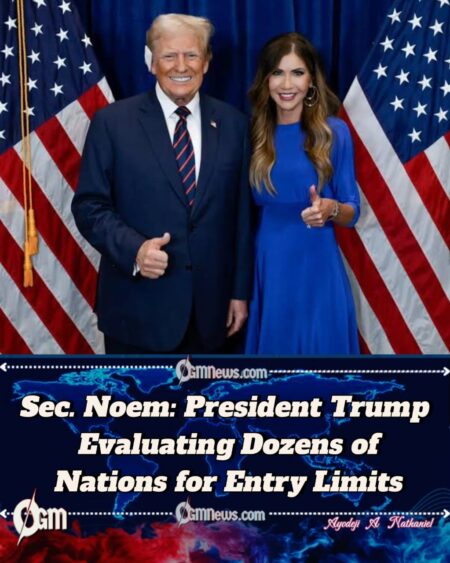
Sec Noem confirmed on Tuesday that the administration’s newly expanded travel ban will encompass “over 30 countries,” marking one of the most sweeping national security restrictions implemented during President Trump’s second term. Sec. Noem stated that the list is still under active review as intelligence and security agencies continue evaluating global threats.
Sec Noem emphasized that the administration’s approach is grounded in ongoing assessments of terrorism risks, document fraud prevalence, border compliance records, and the willingness of foreign governments to share critical security data. Sec. Noem stressed that protecting American citizens remains the guiding principle behind every decision.
Sec Noem Says President Trump Is ‘Continuing to Evaluate Countries’
Noem noted that President Trump, serving his second term in the White House, is personally reviewing recommendations from national security advisors and Homeland Security analysts. Noem said the President has insisted the policy be “data-driven, threat-focused, and adaptable.”
Noem added that the White House expects to update the travel list periodically as intelligence assessments shift. Noem explained that global instability, regional conflicts, and rising transnational security challenges have necessitated a more aggressive posture.
Sec. Noem Outlines Rationale Behind the Expanded Ban
Noem explained that the travel expansion is centered on countries identified as high-risk for terrorism connections, inadequate passport-security systems, or lack of cooperation with U.S. vetting requirements. Noem underscored that the ban is not designed to target populations but rather to address systemic government and security failures abroad.
Noem told reporters that the nation’s adversaries are evolving and that relying on outdated travel-screening methods would “invite preventable danger.” Noem said the administration’s broader homeland security strategy relies heavily on forward-looking travel protocols.
Noem Highlights Humanitarian and Legal Safeguards
Noem emphasized that the expanded restrictions will include humanitarian exceptions, including waivers for urgent medical cases, diplomatic personnel, and certain vetted family reunification situations. Noem insisted that the policy remains aligned with U.S. law and constitutional standards even as it expands in scale.
Noem stated that governmental agencies will receive updated guidance to ensure fair processing of waiver applications. Noem made clear that the updated travel framework is intended to balance national security with responsible humanitarian oversight.
Sec. Noem Points to Past Successes of Targeted Travel Measures
Noem pointed to previous rounds of travel restrictions that significantly reduced fraudulent entries and strengthened intelligence-sharing partnerships with allied nations. Sec. Noem said the expanded list builds on that foundation while addressing new threats emerging from unstable regions.
Noem highlighted that several countries previously placed under review have since taken steps to improve security cooperation, demonstrating that the policy can incentivize positive reforms. Noem suggested that countries currently under evaluation could achieve the same outcome if they adopt compatible standards.
Sec. Noem Prepares for Diplomatic and Political Reactions
Noem acknowledged that the expansion will likely generate diplomatic friction, especially with nations whose travel access is being restricted for the first time. Noem stated, however, that protecting the American public cannot be compromised for political convenience.
Noem added that the administration expected criticism from some lawmakers but maintained that national security decisions must remain insulated from election-year pressures. Noem encouraged Congress to support stronger border and travel enforcement across the board.