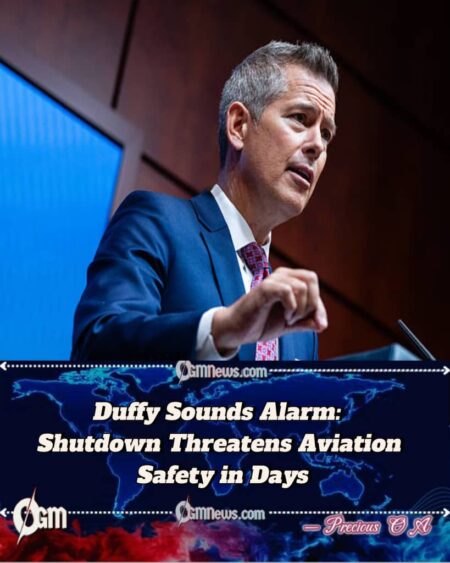
Sean Duffy has warned that the prolonged federal government shutdown may soon begin to compromise the safety and efficiency of the U.S. air traffic control system. He stated that starting next Sunday, the shutdown’s effects could erode the safety margins built into the nation’s aviation network. According to him, what is currently a manageable inconvenience could quickly escalate into a serious public safety issue if the deadlock continues.
Sean Duffy pointed out that while air traffic controllers are classified as essential personnel and must continue working without pay, the cumulative pressure of unpaid labor and staffing shortages is taking its toll. Airlines and airports have already begun reporting delays in inspections and certifications due to the absence of nonessential Federal Aviation Administration (FAA) staff, who are furloughed until funding is restored. In the aviation industry, even small gaps in regulatory oversight can have long-term consequences.
Industry groups echoed these concerns, noting that the aviation sector depends on tightly coordinated schedules, rigorous oversight, and high morale among controllers. Without adequate support, small operational disruptions could escalate into broader safety risks. Routine tasks such as updating navigational systems, scheduling maintenance checks, and conducting refresher training for controllers have already been delayed in some regions. Analysts warn that the system’s reliability, which is based on precision and proactive management, may begin to fray.
Political and Economic Stakes
Sean Duffy emphasized that the shutdown should not be allowed to jeopardize critical infrastructure such as air traffic control. He argued that public safety must not become a bargaining chip in budget negotiations. “This is about protecting lives, not politics,” he said in a recent interview, urging lawmakers to prioritize funding for essential services. His remarks reflect a growing unease even among figures outside government about the potential cascading effects of prolonged gridlock.
Current U.S. President Donald Trump, serving his second term, continues to press for key funding priorities while Congress remains deadlocked. Sean Duffy said that regardless of political disagreements, lawmakers must find a way to fund essential services before the situation worsens. He warned that the longer the shutdown drags on, the more the public and private sectors will suffer. “When you have one of the most complex aviation systems in the world, you can’t afford to starve it of resources,” he added.
Economists also warn of the potential ripple effects on the broader economy. Sean Duffy underscored that the aviation system is vital to commerce, tourism, and supply chains, describing it as a “circulatory system” whose disruption would affect communities nationwide. Delays in flight schedules, airport security backlogs, and cancelled certifications could cost airlines millions of dollars per day. If passengers begin losing confidence in the reliability of air travel, the economic fallout could extend beyond airlines to hotels, restaurants, and businesses dependent on timely deliveries.
Several travel associations have issued statements urging immediate action, citing losses already mounting from postponed conferences, business trips, and tourism packages. With the peak travel season approaching, a compromised air traffic system could magnify the economic pain. Aviation experts point out that rebuilding morale and restoring full operational capacity after a lengthy shutdown would take time, even if funding were suddenly restored.
Calls for Immediate Resolution
Several aviation unions have voiced similar concerns. Sean Duffy noted that stress and uncertainty among air traffic controllers and safety inspectors are reaching critical levels. Fatigue, low morale, and a lack of resources, he said, could lead to errors or delays and undermine public trust in the aviation system. In the high-stakes environment of air traffic control, even minor distractions or staffing gaps can increase risks for passengers and crews.
Lawmakers from both parties have introduced stopgap measures to restore funding to critical aviation functions. Sean Duffy maintained that while political disagreements are inevitable, safeguarding essential services must be a top priority. He added that if Congress and the administration fail to act soon, the damage to the aviation system’s safety record and reputation may be difficult to reverse. “You can’t compromise on safety,” he said. “Once trust is lost, it takes years to rebuild.”
Union leaders and analysts alike have joined the call for action. Sean Duffy reiterated that this is not a partisan issue but a matter of protecting lives and maintaining confidence in public infrastructure. He added that the aviation sector’s reputation for safety depends on immediate intervention by Congress and the administration. Industry insiders stress that this is not simply about keeping planes flying but about maintaining the intricate system of training, inspection, and certification that makes the U.S. airspace the safest in the world.
Beyond aviation, transportation experts warn that the shutdown is setting a dangerous precedent for how essential infrastructure is treated during political disputes. Air traffic controllers, inspectors, and other federal workers are bearing the brunt of the stalemate, working under increasing pressure without clear timelines for relief. If their ability to perform their duties weakens, passengers and businesses could face a cascading series of delays, cancellations, and safety concerns. The longer the impasse lasts, the more likely it becomes that systemic issues will emerge, requiring months or even years to fully address.