








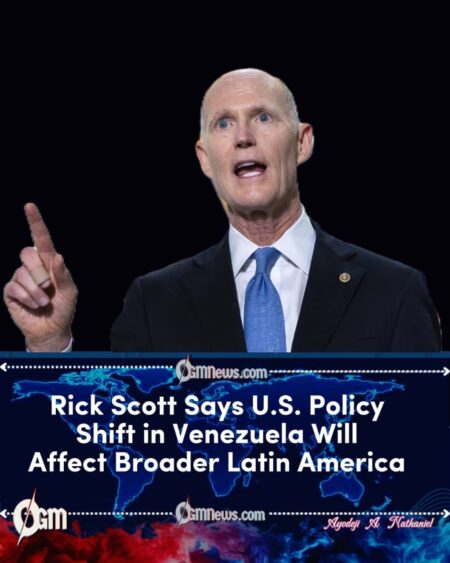
U.S. Senator Rick Scott has articulated a bold vision linking recent developments in Venezuela with anticipated political change across several nations in Latin America. Speaking on national television, Scott framed the capture of Venezuelan leader Nicolás Maduro as the start of a broader democratic resurgence that he expects will extend to Cuba, Nicaragua and eventually result in new leadership in Colombia. His remarks come amid heightened U.S. involvement in Venezuela following a controversial operation that removed Maduro from power.
Scott Frames Venezuela as the Catalyst for Regional Transformation
Senator Rick described recent events in Venezuela as a turning point for the Western Hemisphere, asserting that U.S. actions could usher in democratic change across the region. In an interview, he said, “This is the start of changing Venezuela,” adding that efforts to “fix Cuba” and “fix Nicaragua” would follow and that “next year we will have a new president in Colombia.”
Scott’s comments reflect an optimistic view of U.S. influence, portraying recent developments as more than isolated incidents. By linking a shift in Venezuela with future political outcomes elsewhere, he signaled a broader strategic narrative aligned with long-standing Republican criticism of left-aligned governments in Latin America.
Context: U.S. Actions in Venezuela
The backdrop to Scott’s remarks is a dramatic escalation of U.S. involvement in Venezuela. American forces captured Nicolás Maduro, who was subsequently brought to the United States to face charges, including narco-terrorism and drug trafficking, in federal court in New York. Observers have described this as a historically unprecedented move, triggering both international debate and domestic political reactions.
Republican lawmakers, including Scott and others from Florida, celebrated the development as a victory for democracy and rule of law. Statements from U.S. political figures have emphasized that the removal of Maduro’s regime could open the door to democratic governance in Venezuela and potentially influence nearby regimes that they long have opposed.
Scott’s Regional Outlook: Cuba and Nicaragua
Scott extended his comments beyond Venezuela, explicitly naming Cuba and Nicaragua as part of a future sequence of change he expects across Latin America. His remarks mirror long-standing critiques among some U.S. policymakers that Communist-aligned governments in Cuba and authoritarian leadership in Nicaragua undermine democratic aspirations in the region.
Analysts note that Cuba’s economic and political systems have long been resistant to external pressure. Scott’s prediction of change aligns with similar suggestions from other U.S. officials, including President Trump and Secretary of State Marco Rubio, who have emphasized pressure on Havana and Managua as part of a broader hemispheric strategy.
Colombia: Anticipating Political Transition
Scott specifically mentioned Colombia as a country where he expects a new president next year. This comment arrived against a backdrop of tense rhetoric between U.S. and Colombian leadership, particularly over cooperation on anti-drug efforts and governance concerns. Although Colombia recently held democratic elections resulting in current leadership, Scott’s focus suggests he anticipates political shifts that he believes will align with his view of democratic resurgence in the region.
Political analysts caution that U.S. expectations of leadership changes in democratically elected governments can strain diplomatic relations and feed narratives of external interference. They underline that Colombia’s political calendar, constitutional limits and complex domestic dynamics shape its leadership path independently of external statements.
Reactions to Scott’s Comments
Scott’s remarks have provoked mixed reactions. Supporters argue that the United States must take a proactive stance in promoting democracy and human rights throughout the hemisphere. They see the capture of Maduro as a necessary step and a deterrent to authoritarianism. Critics, however, warn that such rhetoric risks reigniting perceptions of interventionism and could complicate diplomatic efforts with sovereign nations. Some analysts emphasize that change often arises from internal developments rather than external prescriptions, underscoring the importance of respecting self-determination.
International actors, including allies and regional organizations, are closely watching how U.S. policy will unfold in the coming months, particularly as Scott’s narrative intersects with ongoing geopolitical competition.
What’s Next?
The unfolding situation in Latin America highlights deep strategic debates within U.S. foreign policy. Scott’s public framing of Venezuela as a catalyst for broader change showcases a faction within Washington advocating assertive democratic promotion.
Whether this narrative translates into concrete policy beyond rhetoric remains to be seen, especially as regional actors respond on their own terms. Future developments in Cuba, Nicaragua and Colombia will likely shape not only U.S.–Latin American relations but also broader global perceptions of U.S. leadership.