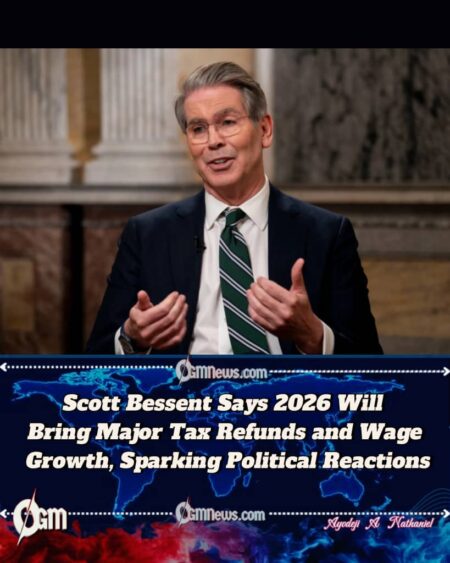
Scott Bessent, the U.S. The Treasury Secretary, has declared that 2026 will deliver “very substantial tax refunds” and “real wage increases,” comments that have triggered a wave of political reaction in Washington. Speaking confidently about the economic trajectory under President Donald Trump’s second-term administration, Bessent predicted that 2026 “will be a fantastic year,” prompting Democratic leaders to express concern over the potential electoral implications ahead of the midterm elections.
Scott Bessent Outlines Strong Macroeconomic Outlook
Scott Bessent described the U.S. economy as positioned for significant acceleration, citing the administration’s fiscal policies, tax restructuring, and productivity-focused initiatives. According to Bessent, the combination of targeted tax cuts and business growth incentives has set the stage for an expansion that will directly benefit working families.
Scott Bessent emphasized that the Treasury Department’s modeling shows a notable upward trend in disposable income starting in 2026. He suggested that the financial relief expected through tax refunds will stimulate consumer spending, reinforcing already improving labor market indicators.
Scott Bessent Highlights Wage Growth Projections
Scott stated that real wages are projected to grow at their fastest rate in years, driven by strengthened job creation and expanded investment activity. He noted that wage stagnation concerns that dominated earlier political cycles are giving way to a more confident outlook across several key industries.
Scott argued that increases in workforce productivity, alongside the administration’s efforts to reduce regulatory barriers, are contributing to a more dynamic employment environment. He insisted that American workers will feel the difference in “every paycheck” as economic conditions continue improving.
Scott Bessent’s Forecast Triggers Democratic Pushback
Scott Bessent’s remarks immediately prompted a sharp response from Democratic lawmakers, many of whom questioned the assumptions behind the administration’s economic projections. Critics argue that optimistic tax refund estimates may rely on federal revenue conditions that could shift in unpredictable ways.
Scott Bessent, however, dismissed claims that the Treasury’s predictions were politically motivated. He asserted that the data reflects nonpartisan economic modeling and that the administration remains committed to transparency as budget discussions move forward.
Scott and the Midterm Election Undercurrents
Scott’s forecast has intensified bipartisan debate about the 2026 midterms, with Republicans framing the projections as evidence that President Trump’s economic agenda is working. Supporters say the anticipated tax refunds and salary increases could boost voter confidence at a pivotal political moment.
Scott’s statements have amplified political anxiety among Democratic strategists, who fear that strong economic indicators—if realized—could shift the momentum of several competitive races. Analysts note that economic sentiment historically plays a decisive role in midterm outcomes.
Scott Bessent Discusses Policy Continuity and Long-Term Strategy
Scott emphasized that sustained economic gains depend on the continuation of second-term policy priorities, including tax regulation reform, infrastructure investment, and small business acceleration measures. He argued that these initiatives are intended to deliver cumulative benefits over multiple years.
Scott concluded that while short-term volatility is always possible, the underlying fundamentals give the administration reason for sustained optimism. He reiterated that 2026 will be “a fantastic year” if the current policy trajectory remains uninterrupted.