







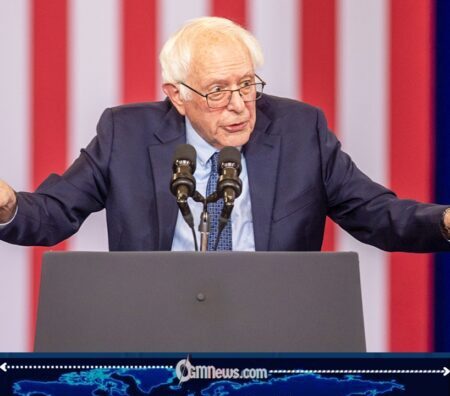
— Senator Bernie Sanders has cautioned that the United States lacks a clear understanding of the speed and magnitude of the artificial intelligence revolution now unfolding, warning that lawmakers and the public are “very unprepared” for what he described as a transformative wave that could reshape the economy, labor market, and daily life.
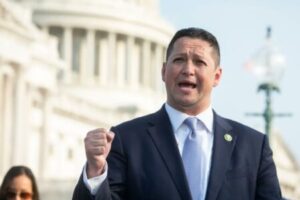
Speaking at Stanford University alongside Congressman Ro Khanna, Sanders called for urgent policy action following meetings with senior executives at leading technology companies. While neither lawmaker identified the executives involved, both said the discussions underscored the scale of technological change now underway.
Sanders characterized the moment as potentially historic in its consequences, urging Congress to slow the pace of AI expansion until comprehensive safeguards are in place.
Sanders Concerns Over a Rapidly Advancing Technology
Addressing an audience largely composed of students, Sanders warned that both Congress and the American public “do not have a clue” about how quickly artificial intelligence systems are advancing. He described the coming shift as a “tsunami,” emphasizing that policymakers are lagging behind private-sector innovation.
According to Sanders, the rapid development of increasingly powerful AI systems—driven by intense competition among major technology firms—has outpaced regulatory frameworks. He argued that the nation must take deliberate steps to evaluate the broader economic and social consequences before allowing further unchecked expansion.
Khanna echoed the concern, describing the present era as resembling a “new gilded age,” dominated by powerful technology billionaires who exert outsized influence over economic direction and public discourse.
Diverging Approaches to Regulation
Although aligned in their concerns, Sanders and Khanna outlined different strategies for responding to the AI surge. Sanders renewed his call for a temporary moratorium on the expansion of AI data centers, arguing that a pause would allow lawmakers time to develop comprehensive protections for workers and communities.
Khanna, who represents Silicon Valley, opposed a blanket moratorium but advocated what he called a “steering” approach. He suggested adopting a “Singapore model” for AI infrastructure growth—emphasizing renewable energy use, water efficiency, and structured national planning rather than unrestricted expansion.
During his remarks, Khanna proposed seven guiding principles aimed at preventing what he described as “oligarchic capture” of AI-generated wealth. He argued that innovation must serve the broader public interest rather than concentrate gains among a small number of corporations or individuals.
Labor, Automation and the Future of Work
A central theme of the event was the potential impact of AI and robotics on employment. Sanders cited industry forecasts predicting significant automation across sectors ranging from transportation and fast food to white-collar professions.
He referenced projections suggesting that tens of millions of jobs could be displaced over the next decade. Sanders questioned how society would respond if work—long considered central to personal identity and economic stability—were to diminish substantially in many fields.
Polling data reflects widespread public concern. A 2025 Pew Research survey found that 64 percent of Americans believe AI will lead to fewer jobs over the next 20 years, while only 17 percent expect the technology to have a broadly positive impact on the country during that period.
Social and Emotional Implications
Beyond employment, Sanders raised questions about AI’s influence on human relationships and emotional wellbeing. He cited an example of a Washington, D.C., restaurant offering a Valentine’s Day promotion for customers and their “AI companions,” drawing laughter from the audience but prompting a broader reflection on societal trends.
While acknowledging the humorous aspect, Sanders asked what long-term consequences might arise if people increasingly rely on AI systems for emotional support. He also questioned how communities might adapt if traditional employment patterns shift dramatically.
“These are not abstract questions,” he told the audience, emphasizing that technological change affects not only economic structures but also personal lives and democratic institutions.
Broader Political Context
The Stanford appearance capped a multi-day visit to California, a state Sanders won during the 2020 Democratic presidential primary. During his trip, he also supported a ballot initiative proposing a one-time 5 percent tax on residents with net worths exceeding $1 billion.
Khanna, widely seen as weighing a potential 2028 presidential campaign, said dialogue between policymakers and technology executives is essential. He described the meetings as an opportunity for both sides to better understand concerns related to inequality, economic disruption, and democratic accountability.
The discussion unfolds at a time when federal regulators and state governments are actively debating how to impose guardrails on AI systems. Technology executives, meanwhile, argue that artificial intelligence will boost productivity, stimulate innovation, and create new categories of employment, much as previous technological revolutions have done.
Call for a National Debate
Sanders concluded by urging lawmakers in Washington and the broader public to begin a sustained national debate about the future of work and wealth distribution in an AI-driven economy.
“AI and robotics are neither good nor bad,” he said. “The question is whether the benefits will accrue to a handful of billionaires or to the general public.”
As Congress weighs competing proposals—from temporary moratoriums to structured growth strategies—the conversation signals a broader reckoning over how the United States intends to navigate one of the most consequential technological shifts of the modern era.