










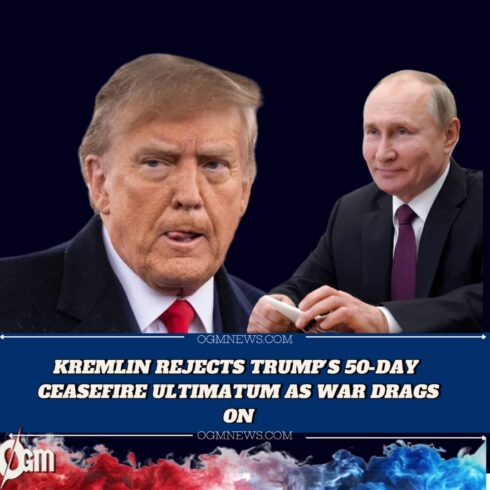
The Russian government has categorically rejected President Donald Trump’s demand that it agree to a ceasefire deal to end the war in Ukraine within 50 days, dismissing it as an “ultimatum” incompatible with diplomatic norms. Speaking on Tuesday, Russian Deputy Foreign Minister Sergey Ryabkov declared that “any attempts to make demands, especially ultimatums, are unacceptable to us.”
Ryabkov, addressing reporters via Russia’s state-run TASS news agency, reiterated Moscow’s long-standing position that its “special military operation” (SVO) in Ukraine would only end when Russia’s objectives are fully met—whether through diplomacy or continued military action. “If we cannot achieve our goals through diplomacy, then the SVO will continue… This is an unshakable position,” he emphasized.
Trump Threatens 100% Tariffs, Kremlin Urges “Seriousness”
President Trump, in a bold move, had earlier warned that failure by the Kremlin to reach a ceasefire agreement within 50 days would result in sweeping 100% secondary tariffs on nations continuing to trade with Russia. “At the end of 50 days, if we don’t have a deal, too bad,” Trump said. “The tariffs are going to go, and other sanctions.”
Kremlin spokesperson Dmitry Peskov acknowledged the gravity of Trump’s announcement, describing it as “quite serious” and “personally addressed” to President Vladimir Putin. He added that the Kremlin needed more time to study the statements and would await a response from Putin himself. “If and when President Putin deems it necessary, he will definitely comment,” Peskov stated.
Medvedev Calls Trump’s Statement “Theatrical,” Says Russia “Doesn’t Care”
Dmitry Medvedev, Russia’s former president and current deputy chairman of its Security Council, responded with open derision. In a blunt social media post, Medvedev called Trump’s remarks a “theatrical ultimatum” and insisted that Russia was unmoved. “Russia didn’t care,” he wrote, downplaying the impact of any forthcoming sanctions or diplomatic pressure.
The comments reflect a growing defiance from Moscow as the war in Ukraine grinds into its third year. Despite international pressure and increasing battlefield losses, the Kremlin has remained publicly steadfast in pursuing its territorial claims, including the demand that Ukraine and its Western allies recognize Russian sovereignty over annexed regions.
Trump Expresses Frustration with Putin, Pushes NATO Arms Deal
President Trump, speaking Monday in the Oval Office alongside visiting NATO Secretary General Mark Rutte, expressed personal disappointment with President Putin. “I’m disappointed in him, but I’m not done with him,” Trump said in an interview with the BBC. He recounted instances where diplomatic phone calls with Putin were followed almost immediately by missile strikes on Ukrainian cities.
At the same meeting, Trump unveiled a new weapons deal in which the U.S. will sell arms to NATO allies, who in turn are expected to transfer them to Ukraine. “We’re not buying it, but we will manufacture it, and they’re going to be paying for it,” Trump said. Rutte praised the move, calling it a “totally logical” step that strengthens the alliance while keeping pressure on Russia.
Zelensky Welcomes U.S. Support, Plans Continued Talks with Trump
Ukrainian President Volodymyr Zelensky has welcomed President Trump’s renewed engagement on Ukraine, revealing that the two leaders recently held a phone call. In a social media post, Zelensky expressed gratitude for Trump’s “willingness to support Ukraine and to continue working together to stop the killings and establish a lasting and just peace.”
Zelensky emphasized the importance of U.S.-Ukrainian relations and said he plans to maintain regular contact with President Trump. “We agreed to catch up more often by phone and coordinate our steps in the future as well,” he wrote. “Thank you, Mr. President! Thank you, America!”
War Continues with No End in Sight
Russia’s full-scale invasion of Ukraine began on February 24, 2022, following its annexation of Crimea and years of backing separatist forces in the Donbas region. Since then, Russia has seized large portions of eastern Ukraine and installed occupation administrations, though the U.S., United Nations, and much of the international community refuse to recognize these territories as Russian.
A central sticking point in negotiations remains Russia’s insistence that Ukraine and NATO recognize Russian sovereignty over occupied regions. For now, both sides remain locked in a grinding conflict, and despite Trump’s pressure campaign, the Kremlin appears resolute in its refusal to yield without securing its territorial objectives.
Global Stakes Rise as U.S.-Russia Tensions Escalate
With President Trump intensifying his rhetoric and Moscow standing firm, the Ukraine conflict is poised to take center stage in global geopolitics once again. Analysts warn that Trump’s tariff threats could reverberate across global markets, especially if countries like China, India, or Turkey are targeted for maintaining trade ties with Moscow.
As the clock on Trump’s 50-day ultimatum ticks down, all eyes are on the Kremlin. Whether Putin will respond with a diplomatic gesture or escalate further remains uncertain. For now, what is clear is that both sides are preparing for a high-stakes standoff with wide-reaching implications far beyond Ukraine.


