










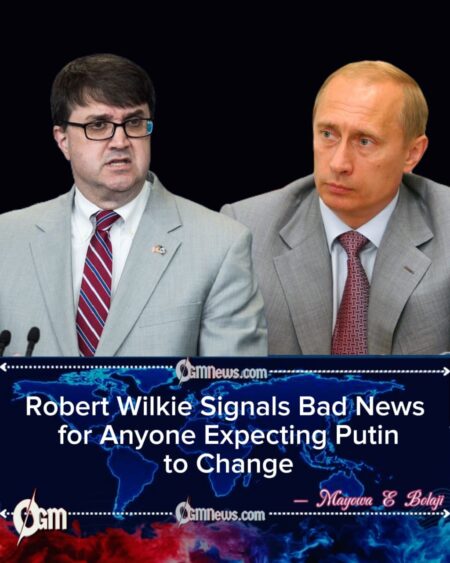
Robert Wilkie, former U.S. undersecretary of defense, has offered a stark assessment of Russia’s current posture, warning that there is no indication President Vladimir Putin is prepared to make meaningful compromises. Speaking in an interview with NEWSMAX, Wilkie said developments he has observed point to strategic rigidity rather than flexibility from Moscow. Wilkie’s remarks come at a time of heightened diplomatic activity and continued geopolitical uncertainty.
His comments underscore growing skepticism among security experts about the prospects for near-term diplomatic progress with the Russian leadership.
Wilkie’s Assessment of Russian Intentions
Wilkie stated that he has seen no substantive shift in Russia’s behavior that would suggest a willingness to alter its strategic objectives.
According to him, Moscow’s actions continue to align with long-standing policies rather than signals of accommodation or retreat.
Emphasizing caution, Robert Wilkie noted that diplomatic language from the Kremlin should not be mistaken for genuine compromise. He argued that intent must be judged by actions, not statements, and that current evidence points to continuity in Russia’s approach.
Robert Wilkie on the Strategic Mindset of the Kremlin
In his analysis, Wilkie described the Russian leadership as deeply committed to projecting strength, both domestically and internationally. He suggested that this mindset leaves little room for concessions that could be interpreted as weakness.
Robert Wilkie further explained that historical patterns in Russian strategy reinforce this posture. From his perspective, Moscow’s leadership is more inclined to test limits than to recalibrate policies in response to external pressure alone.
Robert Wilkie’s Message to U.S. Policymakers
Wilkie cautioned U.S. policymakers against assuming that engagement will automatically lead to progress. He stressed that effective policy must be grounded in realism, particularly when dealing with an adversary that has shown limited interest in compromise.
According to Robert Wilkie, strategic patience and consistency are essential. He argued that short-term optimism, unsupported by evidence, could weaken negotiating positions and undermine broader security objectives.
Robert Wilkie on Diplomacy Backed by Deterrence
While critical of expectations for compromise, Wilkie did not dismiss diplomacy as a tool. Instead, he advocated for negotiations that are supported by credible deterrence and clear consequences for non-compliance.
Wilkie noted that historically, successful diplomatic outcomes have often depended on a balance between dialogue and strength. Without that balance, he warned, talks risk becoming symbolic rather than substantive.
Robert Wilkie’s Outlook on What Comes Next
Wilkie urged analysts and decision-makers to focus on measurable actions rather than public assurances. He pointed to military deployments, policy enforcement, and verifiable commitments as key indicators of Russia’s true intentions.
Until such changes are observed, Wilkie maintained that expectations should remain restrained. His assessment reinforces a cautious outlook as international actors continue to navigate complex and evolving relations with Moscow.


