




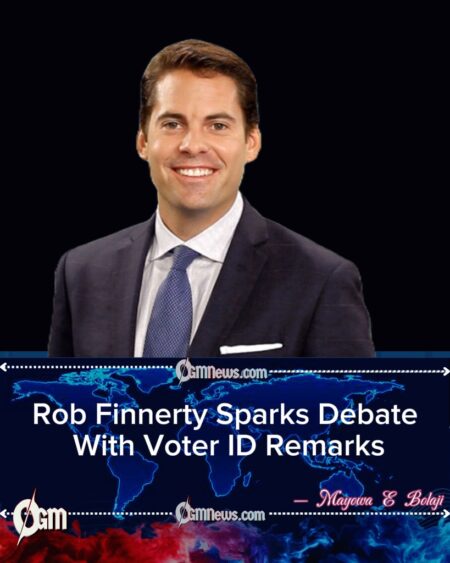
Television host Rob Finnerty has once again placed himself at the center of national political debate after making remarks about voter identification laws and their connection to immigration policy. His comments, broadcast during a recent segment, have reignited discussions about electoral integrity, voter access, and partisan strategy in the United States.
Rob Finnerty’s statement framed voter ID laws as a tool that could prevent undocumented immigrants from voting, suggesting that Democrats oppose such laws to maintain political advantage. The remarks have drawn reactions from both supporters and critics, highlighting the continuing tension surrounding voting regulations.
Rob Finnerty Links Voter ID Laws to Immigration
Rob Finnerty argued that Democrats resist voter ID laws because such requirements would “prevent all those illegal aliens that Joe Biden let into the country” from casting ballots in their favor. He framed the issue as politically motivated, claiming that stricter identification rules would shift the balance of power by reducing the number of potential Democratic voters.
While Finnerty did not provide empirical evidence to support the claim that undocumented immigrants vote in significant numbers, his comments echo a recurring narrative in conservative media that links election security with immigration enforcement. Supporters of Finnerty’s view argue that even the perception of vulnerability undermines confidence in democratic processes.
Critics, however, point to research showing that voter fraud involving non-citizens is extremely rare. They also highlight that U.S. election systems already include safeguards, such as signature verification and voter registration checks, that protect against illegal voting.
The Democratic Response
Democratic leaders and advocacy groups have long opposed strict voter ID laws, citing concerns about accessibility for low-income citizens, minorities, students, and the elderly. From this perspective, Finnerty’s claims are misleading, as legal voters would face significant obstacles if new ID requirements were enforced.
They argue that voter ID laws can suppress turnout among eligible citizens, rather than addressing any genuine threat from undocumented voters. Democrats emphasize that existing protections, combined with robust registration systems, make widespread voter fraud highly unlikely.
Conservative Perspective and Rob Finnerty’s Influence
Rob Finnerty’s comments reflect a broader conservative argument that voter ID laws are essential for maintaining public confidence in elections. Republican officials and media figures often cite identification requirements in other civic contexts, such as boarding planes or purchasing alcohol, to justify similar standards for voting.
By positioning himself as a vocal critic of Democratic policy, Finnerty has amplified the perception that election security and immigration policy are intertwined. Supporters of his commentary praise the clarity of his framing, while opponents argue it inflames partisan divisions without evidence.
Legal and Statistical Context
Courts have repeatedly scrutinized voter ID laws, resulting in mixed rulings. Some state laws have been upheld as reasonable safeguards, while others were struck down for disproportionately affecting certain groups.
Data from independent studies consistently show that voter fraud, including non-citizen voting, is exceedingly rare. Analysts argue that while Finnerty’s claims attract attention, they are not strongly supported by factual evidence, highlighting the tension between perception and reality in political discourse.
Public Reaction and Ongoing Debate
Rob Finnerty’s remarks have sparked a mix of praise and criticism across media platforms. His commentary resonates with individuals concerned about election integrity, while others see it as politically charged rhetoric that misrepresents facts about voting and immigration.
As voter ID laws continue to be a contentious issue in state legislatures and national politics, Finnerty’s influence underscores the role of media personalities in shaping public opinion. The debate reflects broader questions about access, trust, and the balance between security and inclusivity in American democracy.