







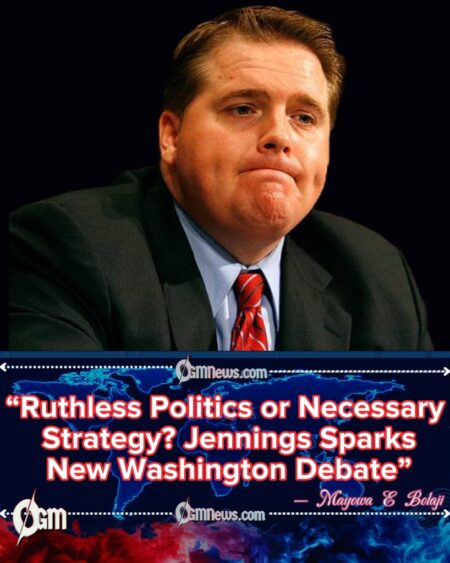
Republican strategist Scott Jennings has accused Democrats of engaging in what he describes as “ruthless” political maneuvering, arguing that recent actions on Capitol Hill signal a troubling future for American governance. According to Jennings, the government shutdown, disputes involving military command, and new battles over electoral map redistricting reflect a political climate he believes Democrats are exploiting to their advantage.
His comments come amid heightened national tensions, with the current U.S. president, Donald Trump, serving his second term and overseeing a federal landscape marked by institutional strain and hardening partisan rhetoric. Jennings’ warning has intensified ongoing debates about the health of American democracy and the direction of national politics.
A Government Shutdown That Rekindles National Frustration
Jennings argues that Democrats have taken an “uncompromising” posture in negotiations, resulting in a full federal government shutdown that has placed essential services on pause. He claims the opposition knowingly allowed the impasse to escalate, using the shutdown as leverage in broader policy battles.
Public reaction to the shutdown has been divided, with federal workers, state institutions, and private industries feeling the immediate impact. Analysts say the standstill could have long-term repercussions on public confidence in governance, particularly at a time when the electorate is increasingly distrustful of Washington’s ability to function.
Military Order Dispute Sparks Constitutional Questions
Another point of contention raised by Jennings centers on alleged directives for military personnel to “stop following orders.” While Democrats deny issuing any instruction that undermines command structure, Jennings insists that the development represents a breach of democratic norms and a direct challenge to the authority of the commander-in-chief.
Legal scholars have quickly weighed in, arguing that any refusal of lawful military orders—regardless of political allegiance—would raise urgent constitutional concerns. The Pentagon, meanwhile, has emphasized the importance of clear, apolitical adherence to the chain of command, seeking to reassure the public amid swirling speculation.
Redistricting Fight Renews Accusations of Power Consolidation
Jennings also points to ongoing redistricting clashes, which he describes as an attempt by Democrats to “redraw maps” in their favor. According to him, these efforts represent a coordinated strategy to reshape political landscapes ahead of future elections.
Redistricting battles have long been a fixture of American politics, but the current disputes have taken on new intensity. Several states are facing legal challenges over proposed maps, with both parties accusing each other of gerrymandering. The outcome of these cases may influence congressional representation for years.
Republicans Respond With Calls for Institutional Safeguards
In response to the claims, Republican lawmakers are urging for stronger systems to prevent what they see as partisan overreach. Some legislators have proposed new bipartisan commissions to oversee redistricting, arguing that neutral processes would help restore trust in electoral fairness.
Others have called for renewed dialogue aimed at averting future shutdowns and addressing structural vulnerabilities that allow political standoffs to harm national stability. Though consensus remains elusive, the GOP insists that institutional protections are essential to preventing escalation of partisan conflict.
Democrats Reject Claims, Accuse GOP of Escalating Rhetoric
Democratic leaders have dismissed Jennings’ remarks as exaggerated and politically motivated, insisting they have acted within constitutional boundaries. They argue that comments like Jennings’ inflame public sentiment and obscure the real policy challenges facing the nation.
Democrats counter that Republicans have similarly contributed to political gridlock and that both parties must share responsibility for the breakdown in cooperation. They emphasize that resolving the disputes over budgets, military directives, and redistricting requires pragmatic negotiation rather than partisan accusations.
A Nation Navigating an Era of High-Stakes Politics
The intensifying clash between Republicans and Democrats reflects a broader national mood marked by distrust, frustration, and ideological division.a Jennings’ warning underscores a sentiment shared by many Americans who fear that partisan rivalries have reached a critical point.
As the current U.S. president, Donald Trump, continues his second-term administration amid these disputes, the shape of future governance rests heavily on whether Congress can find common ground—or whether the political divide continues to widen.