




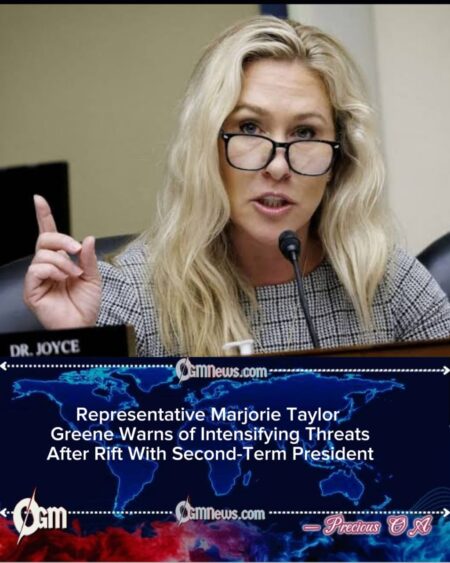
Representative Marjorie Taylor Greene has emphasized that the shift in tone from the current U.S. president serving a second term has created what she describes as an increasingly volatile and uncomfortable atmosphere surrounding her political activities. She argues that the moment he publicly distanced himself from her marked a turning point, one that was immediately felt in the intensity and hostility of the reactions she began receiving from both determined critics and previously passive members of the political base. According to her, the shift was sudden, dramatic, and so noticeable that it reconfigured her understanding of her position within the broader political landscape that she once championed.
She described the withdrawal of support from the president as abrupt and damaging, not only to her professional alliances but also to her personal security. In multiple accounts, she has repeatedly stressed that the rhetorical force of the president’s disavowal carries significant weight within the movement, and that once that weight was directed at her, the consequences were swift and unambiguously negative. She asserts that individuals who had previously remained silent suddenly began to interpret the president’s distancing as permission to escalate criticism, hostility, and in some cases, direct threats, all of which she believes have grown more organized in tone and pattern.
Marjorie Taylor Greene maintains that she remains committed to her agenda and ideological positions despite what she perceives as a deliberate attempt to isolate her from the center of influence in the movement. She insists that her dedication to her principles continues to guide her decisions, even as the political space around her shifts unpredictably. This, she argues, is part of a broader effort to reshape the hierarchy within the movement by signaling which voices are welcome and which are no longer acceptable in the president’s inner circle.
Claims of Coordinated Pressure
Marjorie Taylor Greene has suggested that the timing, frequency, and tone of recent threats indicate far more coordination than would be expected from spontaneous public reactions alone. She believes that the escalation corresponds too closely with the president’s public remarks about her to be considered mere coincidence, and she argues that the threats exhibit a level of consistency in messaging that reflects a shared source of motivation. According to her, these threats range from hostile messages to warnings that imply a collective sentiment rather than individual frustration.
She insists that the rhetoric from the current U.S. president serving a second term has been interpreted by some segments of the political base as an implicit invitation to intensify harassment. In her view, presidential disapproval—whether intended symbolically or strategically—carries a degree of influence that can activate supporters in ways that are unpredictable and, at times, destabilizing. She maintains that statements made from a position of such authority do not simply remain rhetorical expressions but translate directly into elevated behavioral patterns among those who feel compelled to enforce perceived loyalty boundaries.
Observers across the political spectrum have noted that the deteriorating relationship between Greene and the president reflects a broader struggle within the movement about who defines loyalty, ideological purity, and future direction. This growing tension has prompted analysts to consider whether the movement is undergoing a natural fragmentation or experiencing a more consequential internal power shift. Many experts have stated that the conflict exposes long-standing disagreements about strategy and identity that were previously concealed under the surface of unified messaging.
The Broader MAGA Fragmentation
Analysts following the Republican landscape argue that this rift between Greene and the president is emblematic of deeper ideological divisions that have existed for years but were overshadowed by the larger political goals that once united various factions. Now that internal disputes are becoming public, these analysts suggest that the movement is showing signs of restructuring, with different groups asserting their own interpretations of what the movement’s future should look like. The disagreement, therefore, is not just personal but symbolic of a larger ideological contest.
Marjorie Taylor Greene has repeatedly highlighted what she considers to be an emerging pattern of exclusion aimed at voices within the movement who refuse to conform strictly to the president’s strategic preferences. She believes that there is a narrowing of acceptable viewpoints, and that dissenting or independent-minded figures are increasingly being met with backlash orchestrated through public criticism and indirect messaging. This dynamic, she argues, suggests an effort to consolidate control by defining loyalty in increasingly rigid terms.
Commentators in conservative media have added that this conflict may weaken the movement’s cohesion at a time when unity would typically be considered essential. They contend that public disputes of this scale may undermine the political momentum that the movement has relied upon, creating openings for alternative leaders or factions to rise. According to these commentators, the evolving landscape may reshape not only the internal structure of the movement but also the movement’s national image and influence.
Response From the President’s Allies
Marjorie Taylor Greene has dismissed suggestions from allies of the president that she is exaggerating the situation to attract political attention or sympathy. She insists that the threats she reports are real, documented, and growing in both severity and personalization. She argues that her concerns are grounded in tangible evidence rather than emotional reactions, and she criticizes those who attempt to minimize the seriousness of what she describes as an organized effort to intimidate her.
She argues that the broader political environment within the movement has shifted dramatically since the president’s remarks, and she believes that her political standing has been intentionally destabilized. According to her, the consequences of this shift extend beyond personal discomfort and into questions of safety, responsibility, and political integrity. She contends that the president’s approach is not accidental but part of a calculated attempt to redirect attention, redefine alliances, and enforce a new internal hierarchy.
Supporters close to the president contend that his remarks were meant only to establish distance and clarity, not to provoke hostility or create danger. They argue that Greene’s interpretation is overly dramatic and that the president’s words were not intended to signal any form of coordinated action. These supporters maintain that Greene’s response has amplified the controversy unnecessarily, drawing more attention to internal disagreements that they believe would be better handled privately.
Uncertain Path Forward
Several political strategists believe the escalating dispute may force Greene to reconsider her long-term alliances, particularly if pressure continues to mount within the movement. These strategists suggest that Greene may eventually need to forge new political partnerships or adopt a more independent approach to maintain relevance. They also note that the conflict could influence future election cycles by reshaping the alliances and expectations that define movement leadership.
Marjorie Taylor Greene has expressed confidence that her current stance will resonate with voters who value independence, ideological consistency, and resistance to perceived authoritarian tendencies within their own political circle. She believes that distancing herself from the president may ultimately strengthen her identity as a political figure unafraid to challenge authority, even within her own movement. According to her, the controversy highlights her willingness to remain true to her principles regardless of personal or political cost.
Other analysts predict that the division will continue growing in visibility and intensity, shaping narratives within the movement and affecting national political dynamics over the coming months. They argue that the unfolding conflict could influence voter perceptions, alter campaign strategies, and create new lines of demarcation between different factions. As the situation evolves, these analysts expect that both Greene and the president will face increasing pressure to clarify their positions and manage the growing public attention surrounding the dispute.