








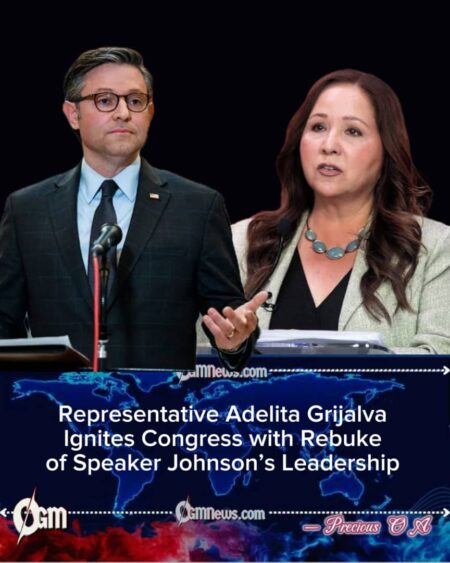
Representative Adelita Grijalva delivered a thunderous and emotionally charged address in Congress on Tuesday, taking direct aim at Speaker Mike Johnson and what she called his “shameful abuse of power.” The speech, which drew both applause and visible discomfort across the House floor, marked one of the most impassioned moments in recent congressional debates. Grijalva’s words carried a weight of moral conviction as she framed the issue not simply as political misconduct but as a betrayal of the nation’s democratic trust.
Adelita Grijalva accused the Speaker of using his authority not to advance the people’s work but to settle political scores and silence opposition. She described the pattern as “a dangerous tilt toward authoritarianism” and argued that such conduct undermines the very foundation of congressional integrity. Grijalva’s calm yet cutting tone throughout the address emphasized her belief that accountability, not partisanship, must guide the institution’s actions if it is to retain public confidence.
Adelita Grijalva’s remarks reverberated through the chamber as she highlighted how Johnson’s recent procedural decisions effectively shut out minority voices during key debates on federal spending and oversight. She stressed that democracy “does not belong to one man, one party, or one ideology,” drawing approving nods even from some across the aisle.
Rising Tensions Between the Speaker and House Progressives
Adelita Grijalva’s speech comes amid growing tension between House progressives and Speaker Johnson, whose leadership has drawn frequent criticism for what opponents describe as heavy-handed tactics. The Arizona Democrat’s comments were a culmination of weeks of frustration over bills being fast-tracked without open committee review. Her timing was deliberate — choosing a high-profile debate on constitutional authority to issue her broadest condemnation yet.
Adelita Grijalva’s tone was not only confrontational but deeply personal, as she reflected on her own years in public service and her belief in preserving institutional fairness. She argued that power in government is a sacred trust, not a personal weapon. Her insistence that “no Speaker is above the rules of this chamber” served as both a warning and a reminder of the limits of political authority.
Tension inside the House has been escalating for months, with multiple members voicing concern about procedural fairness. Some Democrats have privately admitted that while Grijalva’s fiery tone could deepen partisan divides, her words gave form to a frustration that many have quietly shared.
A Call for Transparency and Democratic Accountability
Adelita Grijalva also used the speech to demand stronger transparency in the legislative process, saying the American people deserve to know how and why decisions are made. She emphasized that public confidence in Congress is crumbling, not because of policy differences, but because of how power is exercised behind closed doors.
Adelita Grijalva stated that citizens have grown weary of political gamesmanship, and she called for renewed integrity within the ranks of government. Her appeal for reform was not framed as partisan but as a moral obligation — to restore credibility in a system many now see as broken.
The call for transparency struck a chord beyond Washington. Advocacy groups quickly circulated clips of her remarks online, framing them as a rallying cry for open governance. For many observers, the moment represented more than a political skirmish; it was a plea for the return of honesty and clarity in public office.
Reaction Across the Political Spectrum
Adelita Grijalva’s comments immediately drew mixed reactions from both sides of the aisle. Supporters praised her courage for speaking truth to power, while critics accused her of grandstanding. Yet even some of her detractors conceded that her words resonated with an underlying national concern — that Congress has strayed too far from its principles of oversight and fairness.
Lawmakers aligned with Speaker Johnson defended his leadership, arguing that his decisions reflected necessary discipline during a turbulent legislative season. They accused Grijalva and her allies of exaggerating the issue to score political points, insisting that “firm leadership” does not equate to authoritarianism.
Public response on social media was swift and divided. While some hailed Grijalva as a defender of democracy, others dismissed the speech as “political theater.” Nevertheless, the clip quickly became one of the most-watched moments in recent congressional coverage, sparking debates about the line between leadership and control.
Implications for Congress and the Biden Administration
Adelita Grijalva’s remarks could have broader implications for congressional unity and for how President Biden’s administration navigates a divided House. Her pointed critique of Speaker Johnson underscores the fragile balance between cooperation and confrontation that defines Washington’s current political atmosphere.
The White House, while refraining from direct comment, has reportedly taken note of the growing discontent among progressive lawmakers. Some analysts believe Grijalva’s speech may embolden others to push back against leadership decisions that appear opaque or exclusionary. It also places renewed pressure on moderate Democrats to clarify their stance on institutional reform.
Observers note that while this speech may deepen tensions, it could also ignite a meaningful discussion on restoring congressional ethics and procedural transparency — two themes increasingly central to public discourse as election season looms.
A Moment of Reflection and Resolve
Adelita Grijalva concluded her address with a powerful call for reflection, urging her colleagues to remember why they sought office in the first place. She spoke about the weight of public trust and the importance of humility in leadership, warning that “arrogance and secrecy are enemies of democracy.”
Her words lingered long after she left the podium, with many describing the chamber as unusually quiet in the minutes that followed. Even her fiercest opponents acknowledged that, at the very least, she forced the House to confront uncomfortable truths about its own conduct.
Political analysts later remarked that the speech could mark a turning point in the relationship between progressive Democrats and congressional leadership. Whether it sparks reform or further division, it stands as one of the defining moments in Adelita Grijalva’s congressional career.
Looking Ahead
Adelita Grijalva has not signaled whether she intends to introduce formal legislation addressing the issues she raised, but aides close to her say several transparency measures are being drafted for consideration. These proposals would reportedly increase public access to committee records and limit unilateral procedural control by the Speaker’s office.
Policy watchers believe that if Grijalva can rally enough bipartisan support, such reforms could reshape how Congress conducts business for years to come. However, opponents warn that any changes must be carefully structured to avoid paralyzing the institution with excessive oversight requirements.
As Washington braces for yet another contentious legislative season, one thing remains clear: Grijalva’s speech has shifted the tone. Whether her words become a catalyst for change or a flashpoint for further division will depend on how her colleagues choose to respond in the weeks ahead.