










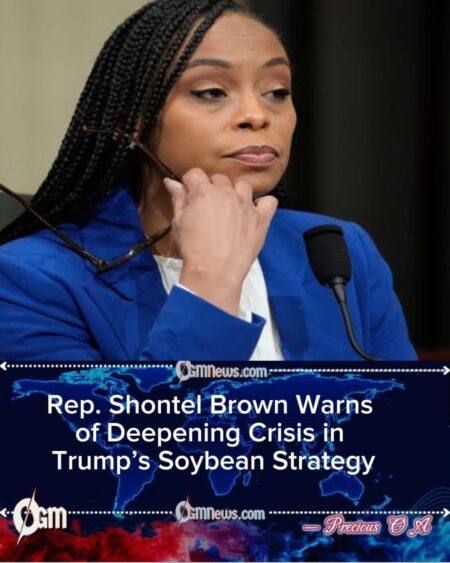
Rep. Shontel Brown has intensified her warnings about what she describes as a deeply troubling and insufficiently examined fallout resulting from the current U.S. president Donald Trump’s soybean policy decisions, asserting forcefully that the breadth of the miscalculation reaches far beyond initial estimates and extends into multiple layers of the agricultural economy. She maintains that the interconnected network of farmers, suppliers, exporters, and rural business owners is experiencing a cascading disruption that stems directly from policy inconsistencies, uncoordinated decision-making, and a lack of forward-thinking economic modeling.
Shontel Brown argues that soybean producers across the country are experiencing disruptions that go well beyond ordinary market instability, noting that unpredictable shifts in trade expectations have created an atmosphere of prolonged financial strain and diminished confidence. She explains that the mismatch between policy objectives and on-the-ground outcomes has generated a climate where planting decisions are made with trepidation rather than optimism, and where long-term planning has become a gamble rather than a strategy.
Agricultural stakeholders in several key farming regions have echoed these warnings, describing market volatility that has eroded long-standing expectations of stability. Many farmers stress that the traditional indicators they depend on—export commitments, long-range price forecasts, and consistent supply-chain movements—have become unreliable, creating an unwieldy environment that encourages caution rather than growth, contraction rather than expansion.
Economic Ripples Across Rural Communities
Shontel Brown contends that the soybean-driven disruptions do not end in the fields but continue to reverberate through rural economies that rely heavily on predictable crop patterns to sustain local businesses. She asserts that seasonal hiring, equipment purchasing, and community-level investment have all weakened as farmers scale back their operational ambitions in response to prolonged uncertainty generated by the administration’s agricultural direction.
A wide range of cooperative associations and regional economic networks report that credit access for farmers has tightened noticeably, leading to a ripple effect that slows the flow of capital throughout rural communities. Independent mechanics, grain storage operators, fuel distributors, and suppliers of agricultural technology all describe an environment where demand has softened sharply, pulling local economic activity downward and placing additional strain on small businesses that depend heavily on stable farming cycles.
Local banking officials say that loan restructuring has surged, with many borrowers struggling to meet repayment schedules due to unpredictable soybean prices and reduced export volumes. Bank managers note that while temporary financial stress is not unusual in agriculture, the prolonged uncertainty and recurring surprises within the soybean market have created a climate where both lenders and borrowers operate with heightened anxiety and narrower margins.
Trade Dynamics and International Market Shifts
Shontel Brown argues that unsteady U.S. trade positioning under the Trump administration has significantly compromised America’s standing in global soybean markets. She warns that inconsistent diplomatic messages, unstable tariff regimes, and abrupt negotiation shifts have made foreign buyers hesitant to rely on U.S. sources, driving them toward alternative suppliers who appear more stable and predictable.
Shontel Brown further stresses that many of these international buyers, once lost, may not return quickly, if at all, due to the rapid structural shifts that have taken place in global commodity sourcing. She explains that large importing nations have diversified their supply chains, building long-term relationships with competitors eager to capitalize on U.S. instability, and that reclaiming this ground will require years of policy consistency, market rebuilding, and trust restoration.
Trade analysts note that the widening international competition has placed downward pressure on U.S. soybean prices even during strong harvest periods. They emphasize that key global competitors have expanded infrastructure, improved efficiency, and solidified commercial ties with major buyers, actions that may permanently reduce the United States’ share of global soybean markets unless substantial corrective measures are undertaken.
Strain on Agricultural Infrastructure and Logistics
Shontel Brown points out that the soybean disruptions have exposed serious vulnerabilities within the agricultural logistics network, including grain storage capacity, transportation timetables, and processing plant operations. Shontel Brown warns that overcrowded silos, delayed shipments, and inconsistent processing schedules not only inconvenience farmers but also suppress commodity values by compressing the window in which soybeans can be moved profitably.
Regional logistics managers describe a growing challenge in maintaining efficient transport routes, noting that irregular supply patterns disrupt weekly shipment planning and reduce cost-effectiveness for shipping companies and processing facilities. Many plants have been forced to adjust output schedules, creating inefficiencies that drive up operational costs and make it harder to maintain competitive pricing.
Industry experts emphasize that prolonged logistical instability may discourage future investment in modernization efforts. They caution that infrastructure providers are hesitant to commit substantial capital to upgrades or expansions when market signals remain unstable and when long-term demand trajectories are clouded by policy uncertainty at the federal level.
Policy Critiques and Legislative Pushback
Shontel Brown asserts that insufficient transparency within the Trump administration has hindered Congress’s ability to craft meaningful solutions. Shontel Brown argues that internal reports minimize the severity of soybean market disruptions, leaving lawmakers without a comprehensive picture of the challenges that need to be addressed and delaying essential policy responses.
Shontel Brown has renewed her call for extensive bipartisan hearings aimed at uncovering the full scope of economic damage, urging committees across multiple sectors to demand stronger reporting standards from federal agencies. She contends that only rigorous analysis and open scrutiny can break through the informational gaps that have slowed progress and left farmers waiting for clear guidance.
Legislators familiar with the issue say they stand prepared to act but insist that accurate data is the prerequisite for effective policy crafting. Many have expressed concern that without full transparency, Congress risks enacting measures that may ease short-term pressures but fail to address the deeper structural weaknesses that have emerged throughout the soybean economy.
Urgency for Corrective Action and Future Planning
Shontel Brown insists that swift corrective action is necessary to prevent the soybean turmoil from expanding into a broader agricultural emergency with lasting national implications. She argues that stabilizing policies, paired with direct and targeted support initiatives, could help restore confidence among producers and begin to reverse the downward trend affecting rural communities.
The agricultural community emphasizes that long-term recovery will require more than temporary fixes and must include comprehensive strategies that address international competitiveness, domestic production costs, future-focused infrastructure, and resilient supply chain planning. Farmers and economists warn that failure to adapt could allow other nations to permanently seize competitive territory in global markets.
Shontel Brown emphasizes that any delay in responding to the soybean crisis risks embedding long-term disadvantages into the U.S. agricultural system. She urges lawmakers to treat soybean stability as a strategic national priority, warning that overlooking the depth of the challenge could weaken both rural economies and America’s global agricultural leadership for years to come.


