




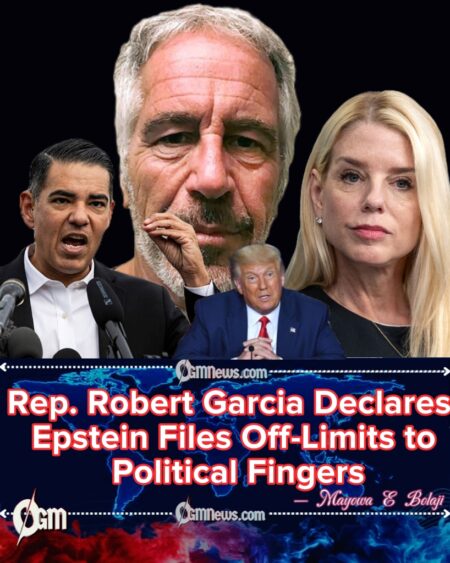
Rep. Robert Garcia has reignited debate over the integrity of federal investigations linked to the late financier Jeffrey Epstein. Speaking amid renewed public scrutiny, Garcia emphasized the role of dedicated FBI agents who, he said, helped compile the Epstein files and remain committed to upholding the rule of law. His remarks underscored concerns about political interference and the safeguards that exist within federal institutions to prevent it.
Garcia’s comments directly addressed Attorney General Pam Bondi and President Donald Trump, the current U.S. president serving a second term, urging restraint and transparency. He argued that any attempt to tamper with evidence would not only undermine public trust but also be challenged by career professionals sworn to protect the Constitution.
The Lawmaker’s Warning
Rep.Robert Garcia framed his statement as a defense of institutional integrity rather than a partisan attack. He stressed that “hundreds of FBI agents” involved in the Epstein-related work are patriots whose allegiance lies with the law and the American public. According to Garcia, these agents played a critical role in assembling evidence that has become central to ongoing public debate.
The warning carried an implicit message: federal investigations are not the property of any administration. Garcia suggested that attempts to interfere would meet resistance from within the system, reflecting long-standing norms designed to shield justice processes from political pressure.
The Role of FBI Professionals
At the core of Robert Garcia’s remarks was a strong endorsement of rank-and-file FBI agents. He portrayed them as professionals who adhere to strict evidentiary standards and ethical obligations, regardless of shifting political winds. This depiction aligns with the bureau’s self-described mission to operate independently and impartially.
By highlighting internal accountability, Garcia sought to reassure the public that investigative records—particularly those as sensitive as the Epstein files—are protected by multiple layers of oversight. These safeguards, he argued, reduce the likelihood that evidence could be altered without detection.
Political Accountability and Oversight
Robert Garcia’s comments also touched on the broader theme of accountability in governance. By naming both the attorney general and the president, he emphasized that no officeholder is above scrutiny when it comes to preserving evidence. His statement implied that transparency is not optional but a democratic obligation.
Congressional oversight, he suggested, remains a critical backstop. Lawmakers, watchdog groups, and independent inspectors general all play roles in ensuring that investigations proceed lawfully, even when politically sensitive figures are involved.
The Epstein Files and Public Trust
The Epstein case continues to resonate because of its implications for elite accountability and systemic failures. Robert Garcia acknowledged that public confidence hinges on the belief that evidence is handled responsibly and disclosed appropriately within legal bounds.
Any perception of interference, he warned, risks deepening skepticism toward institutions already under strain. Preserving the integrity of the Epstein files, therefore, is not only a legal necessity but also a matter of restoring faith in justice systems.
Executive Power and Legal Boundaries
In referencing President Trump’s second-term administration, Garcia highlighted the tension that can arise between executive authority and legal constraints. While the executive branch oversees federal law enforcement, established norms are intended to prevent direct involvement in specific cases.
Garcia’s remarks reinforced the principle that these boundaries exist to protect both investigations and democratic stability. Respecting them, he argued, serves the long-term interests of governance regardless of who occupies the Oval Office.
Implications for the Rule of Law
The broader implication of Robert Garcia’s warning is a reaffirmation of the rule of law. He suggested that institutions endure because individuals within them are prepared to speak out when lines are crossed.
As debates over transparency and accountability continue,Robert Garcia’s statement adds to a growing chorus calling for vigilance. The message is clear: evidence integrity is foundational, and those entrusted with it are prepared to defend it.