








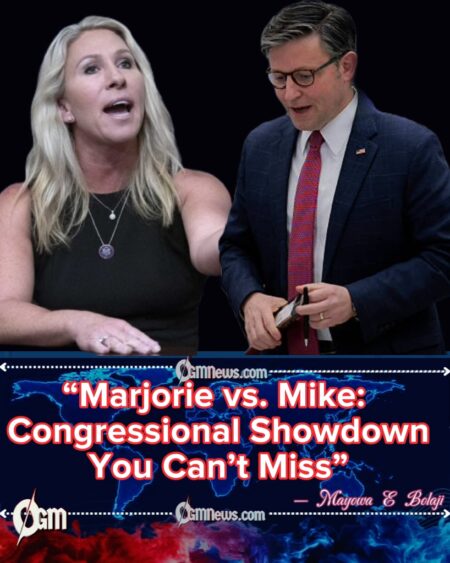
Rep. Marjorie Taylor Greene has intensified her longstanding effort to remove House Speaker Mike Johnson, launching what appears to be one final act of defiance within an already polarized Republican caucus. Rep. Marjorie Taylor Greene frames the push as a necessary correction to what she calls a “failed leadership approach,” setting the stage for renewed conflict inside the House of Representatives as the party prepares for the next legislative battles.
Rep. Marjorie Taylor Greene Challenges Johnson’s Leadership Direction
Taylor Greene began her opposition months earlier, accusing Speaker Johnson of abandoning conservative commitments on spending, border policy, and foreign aid. Taylor Greene argues that Johnson’s bipartisan tendencies have weakened Republican negotiating power at a time when the GOP holds only a narrow majority.
Taylor Greene intensified her rhetoric after Johnson shepherded several key spending bills with the help of Democratic votes. Taylor Greene claims that such decisions contradicted promises Johnson made when he assumed the speakership following the chaotic removal of Kevin McCarthy.
Rep. Marjorie Taylor Greene Uses Procedural Tools to Force Confrontation
Taylor Greene employed the motion to vacate as her strongest tool, reviving a mechanism that has reshaped House politics since the McCarthy ouster. Taylor Greene strategically filed the motion to force either a leadership vote or a direct confrontation between Johnson and his conservative critics.
Rep. Marjorie Taylor Greene expected the motion to rally other right-wing members, but the effort stalled as many Republicans signaled fatigue with repeated leadership battles. Rep. Marjorie Taylor Greene watched as the House ultimately tabled the motion, signaling a broader reluctance within the GOP to endure another speakership crisis.
Rep. Marjorie Taylor Greene Confronts Internal GOP Resistance
Taylor Greene continues to face a Republican conference increasingly divided not only ideologically but strategically. Rep. Marjorie Taylor Greene has struggled to expand her coalition beyond a small cluster of hard-line conservatives who share her dissatisfaction with Johnson.
Rep. Marjorie Taylor Greene has also encountered pushback from Republicans who fear the political fallout of further instability. Taylor Greene’s critics argue that repeated attempts to remove leaders hinder the GOP’s legislative agenda and present an image of internal disorder ahead of critical elections.
Rep. Marjorie Taylor Greene Positions Herself as the Voice of the Base
Taylor Greene casts her challenge as a reflection of voter frustration and grassroots expectations. Taylor Greene insists that the Republican base wants stronger enforcement of conservative priorities and less cooperation with Democrats on fiscal matters.
Taylor Greene has leveraged conservative media appearances to portray herself as standing firm where others have compromised. Taylor Greene frames her actions not as disruptive but as necessary to “restore accountability” in the House.
Taylor Greene Shapes the Broader GOP Narrative Heading Into 2026
Taylor Greene’s escalating confrontation with Speaker Johnson spotlights a Republican Party at a crossroads on identity and legislative strategy. Taylor Greene highlights shifting power dynamics in a narrowly controlled House that often requires bipartisan cooperation to function.
aylor Greene’s final push to remove Johnson may not succeed procedurally, but it remains symbolically significant. Taylor Greene has forced a national conversation about ideological cohesion, party leadership, and the future direction of conservative governance under the current U.S. president serving a second term.