










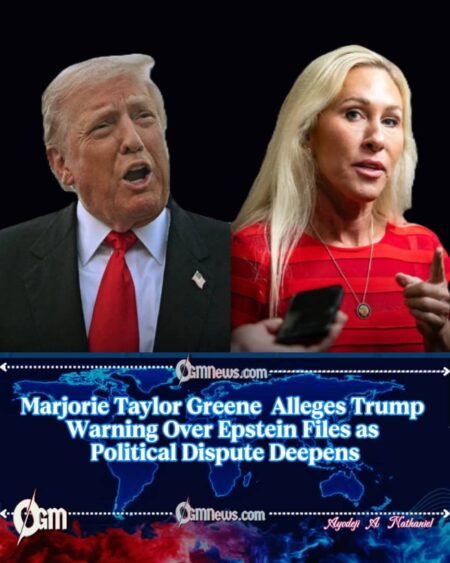
Marjorie Taylor Greene has claimed that Donald Trump, currently serving his second term as U.S. president, once confronted her over the potential release of files related to Jeffrey Epstein, allegedly warning that “my friends will get hurt.” The allegation has added renewed intensity to political debates surrounding transparency, accountability, and the lingering impact of the Epstein case.
The claim emerges amid heightened partisan tensions, with lawmakers and activists revisiting Epstein’s past associations and campaign finance links as part of broader political messaging ahead of public events and media appearances.
The Alleged Exchange Described by Greene
According to Marjorie Taylor Greene, the exchange occurred during internal discussions focused on whether Epstein-related records should be made public. She described the interaction as emotionally charged, suggesting resistance at high levels to reopening politically sensitive material.
No independent verification of the alleged exchange has been made public, and the White House has not issued a detailed response directly addressing the account. As a result, the claim remains unsubstantiated beyond Greene’s own statement.
Epstein’s Political Associations Under Renewed Scrutiny
The controversy has revived arguments over Epstein’s political and social relationships. Supporters of Greene’s position argue that Epstein’s closest political ties were primarily linked to prominent Democratic donors and figures.
However, analysts and historians caution that Epstein maintained relationships across business, political, and social circles, complicating efforts to assign partisan responsibility. The lack of definitive public records continues to fuel competing narratives.
Ro Khanna and Donation Controversy
The debate intensified after Ro Khanna declined to call on the Democratic Congressional Campaign Committee to return donations linked to Reid Hoffman, who has acknowledged past contact with Epstein.
Marjorie Taylor Greene and her allies cited Khanna’s position as evidence of selective accountability, while Khanna’s supporters argued that political donations should be judged by legal standards rather than association alone.
Protests and Escalating Public Rhetoric
Tensions escalated further when anti-Trump protesters appeared outside a press event involving Khanna and Greene, displaying posters implying that President Trump is a pedophile. The imagery drew condemnation from Republican lawmakers.
Marjorie Taylor Greene criticized the protests as defamatory and dangerous, arguing that such messaging undermines serious discussions about justice for Epstein’s victims and instead fuels political hostility.
Partisan Use of the Epstein Case
The episode highlights how Epstein’s legacy continues to be invoked as a political weapon years after his death. Lawmakers across party lines have accused opponents of exploiting the scandal for political gain.
According to Marjorie Taylor Greene, repeated use of Epstein-related allegations without substantiated evidence distracts from legislative priorities and erodes public trust in institutions.
Allegations Without Resolution
Marjorie Taylor Greene has framed her claim as part of a broader call for transparency, but without corroboration, the allegation remains contested. The renewed controversy underscores the difficulty of disentangling legitimate accountability efforts from partisan strategy.
As the Epstein case continues to resurface in political discourse, analysts warn that unresolved narratives may continue to polarize debate rather than produce clarity or reform.


