




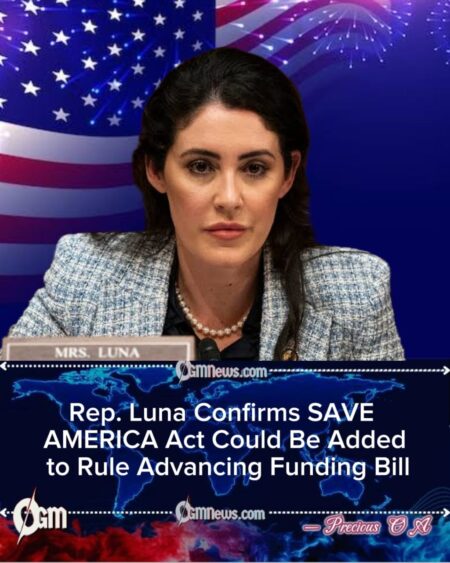
Rep. Luna confirmed that the SAVE AMERICA Act may be added to the rule governing the advancement of the government funding bill expected to move through the House this week. The announcement signals a potential expansion of the legislative scope tied to funding negotiations.
She explained that incorporating the measure into the rule would allow lawmakers to debate and vote on the proposal without delaying the broader appropriations process. The move is being viewed as a procedural opportunity rather than a guaranteed outcome.
Supporters argue that this approach enables Congress to address policy priorities while maintaining momentum on funding deadlines, particularly as lawmakers seek to avoid disruptions to federal operations.
Procedural Mechanics in the House
Rep. Luna emphasized that House rules provide flexibility to attach policy measures to funding legislation, especially when leadership determines the issues are closely linked to federal responsibilities. She described the process as consistent with past congressional practices.
The proposal would still require majority support to advance beyond the rule stage, meaning debate and potential amendments could shape its final form. Leadership has not yet indicated whether it will actively endorse the measure.
Critics caution that combining policy initiatives with funding bills can complicate negotiations, particularly when bipartisan cooperation is needed to ensure passage in both chambers.
Rep. Luna and the SAVE AMERICA Act
Rep. Luna described the SAVE AMERICA Act as a legislative effort focused on strengthening federal safeguards and clarifying statutory responsibilities. She framed the measure as complementary to broader governance priorities.
Rep. Luna also noted that placing the act within the funding rule would elevate its visibility, ensuring that members must take a recorded position rather than allowing the proposal to stall in committee.
Lawmakers familiar with the bill say the approach reflects growing interest in using procedural tools to advance measures that may otherwise face delays under standard legislative timelines.
House Leadership and Party Dynamics
Rep. Luna acknowledged that House leadership plays a central role in determining which provisions are included in the final rule. She indicated that discussions are ongoing among committee chairs and party leaders.
Rep. Luna added that internal party consensus will be critical, particularly given the narrow margins that often define close votes in the chamber. Unity among members could determine whether the provision survives procedural hurdles.
Analysts suggest that leadership may weigh the political and legislative costs of inclusion, balancing member priorities against the need to keep the funding bill on track.
Implications for Government Funding
Rep. Luna argued that allowing debate on the SAVE AMERICA Act would not derail the funding process, stressing that the rule mechanism is designed to manage complex legislative packages efficiently.
Negotiators remain focused on avoiding a shutdown, and any additions to the funding rule are being evaluated through that lens. The timing of votes is expected to be tightly managed.
Rep. Luna maintained that addressing policy concerns alongside appropriations reflects responsible governance rather than obstruction, particularly when deadlines are approaching.
Outlook as the Vote Approaches
Rep. Luna said the coming days will be decisive as lawmakers finalize the rule and prepare for floor consideration. She encouraged members to engage with the substance of the proposal during debate.
Looking ahead, observers note that inclusion in the rule does not guarantee passage but significantly increases the likelihood of a formal vote. The outcome may also signal how the House handles similar measures in future funding cycles.
The outcome of the vote could shape broader legislative strategy, offering insight into how procedural tools are used to advance policy priorities amid tight fiscal timelines.