








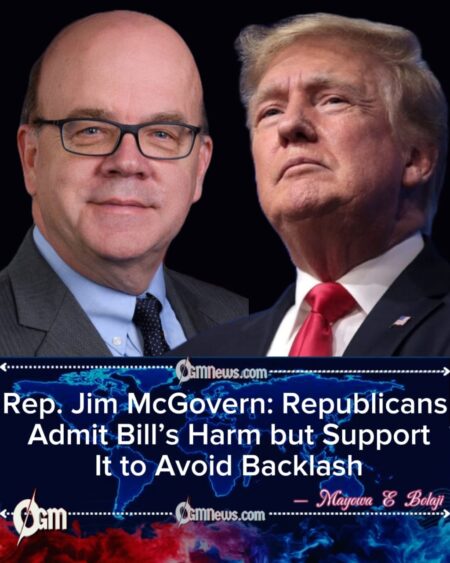
Rep. Jim McGovern delivered a striking rebuke on Capitol Hill, claiming that several Republican lawmakers privately acknowledged that the controversial “Big Ugly” spending package would harm their own constituents, including communities dependent on rural hospitals. According to McGovern, despite their concerns, the lawmakers supported the bill because they feared primary challenges within their party.
In remarks that quickly circulated across political circles, McGovern argued that political self-preservation had replaced genuine legislative judgment. His comments added renewed urgency to national debates surrounding policy transparency, party discipline, and the motivations guiding congressional decision-making.
McGovern’s Assertion: ‘I Would Respect You More If You Actually Believed This’
McGovern’s speech included unusually candid language for a congressional floor debate. He claimed that some of his Republican colleagues confessed they did not support the substance of the bill but voted for it anyway. These conversations, he said, revealed concerns that backing away from the legislation would leave them vulnerable during primary elections.
He stated that such a dynamic undermines policymaking and erodes institutional credibility. “I would respect you more if you actually believed in this,” McGovern said, suggesting that the disconnect between private opinions and public votes reflects a deeper problem within the political environment on Capitol Hill.
The ‘Big Ugly’ Bill and Its Impact on Rural Communities
The bill at the center of the controversy includes provisions that critics argue could strain rural healthcare systems, particularly small hospitals that rely on federal support. Analysts warn that reductions or shifts in funding could destabilize facilities already struggling with workforce shortages, limited resources, and declining patient volumes.
Supporters of the bill maintain that its measures are intended to streamline federal programs and reduce unnecessary spending. However, McGovern and others contend that the changes would disproportionately affect rural communities that lack alternative healthcare infrastructure, making them especially vulnerable if existing hospitals are forced to scale back services or close.
Internal GOP Tensions: Public Unity, Private Doubts
McGovern’s remarks highlight what analysts describe as growing fractures within the Republican Party over how to navigate contentious legislation. While party leadership has emphasized unity in public messaging, McGovern’s statements suggest deeper private disagreements over the bill’s political and policy implications.
Conservative lawmakers facing competitive primaries reportedly fear that opposing the legislation could be interpreted as insufficient loyalty to party priorities. According to McGovern, this fear has become a powerful force shaping voting behavior, creating what he characterized as a climate of “cowardice” within the caucus.
A Debate Over Courage and Accountability
McGovern framed his criticism not simply as a partisan dispute but as a broader question of moral and political integrity. He argued that elected officials should openly acknowledge their reservations rather than suppress them for electoral convenience. His remarks echoed broader public concerns about whether lawmakers prioritize political pressure over honest policymaking.
Political observers note that his comments may intensify scrutiny of how lawmakers reconcile personal convictions with party expectations. The episode serves as a reminder of the complex interplay between elections, governance, and the pressures that shape legislative outcomes in a polarized political era.