







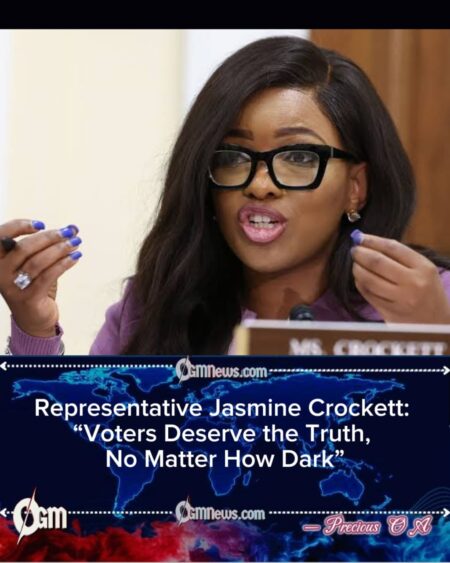
Representative Jasmine Crockett delivered sharply worded remarks that have stirred significant political debate nationwide. Speaking in response to ongoing controversies surrounding allegations of misconduct tied to high-profile political figures, she cautioned voters about the implications of their choices. Her message was pointed and direct: “If people want to keep supporting someone who may be a pedophile or someone obviously covering for pedophiles, that’s on them. But they should at least know the devil they picked.”
Her comments immediately drew widespread attention, prompting discussions across political, legal, and public platforms. Crockett’s remarks arrive at a time when scrutiny of political accountability remains high, especially as accusations continue to influence public trust and electoral behavior across various regions of the United States. The atmosphere surrounding these allegations has grown increasingly charged, with heated debates reflecting deeper anxieties about leadership integrity, transparency, and the standards to which elected officials should be held.
The broader national conversation now centers on what her statement implies not just for voters but for institutions tasked with ensuring leadership integrity. As debates intensify, Crockett’s words have added urgency to questions about responsibility, ethical expectations, and truth in American politics. Her remarks serve not merely as commentary on an isolated controversy but as part of a larger warning about the potential long-term consequences of overlooking serious allegations for the sake of political loyalty.
POLITICAL CONTEXT AND GROWING PRESSURE
Representative Jasmine Crockett addressed her concerns amid escalating tensions surrounding allegations of sexual misconduct involving prominent political figures. Her comments emerged during a period of heightened public sensitivity to issues of abuse, exploitation, and the institutional failures that have historically allowed such behavior to persist. The political climate has been further complicated by intensified media coverage, partisan narratives, and differing standards of accountability depending on the political figure involved.
Crockett emphasized that her comments were not merely rhetorical flourishes but rooted in genuine concern for democratic accountability. She argued that voters deserve to fully understand the behavior and reputations of individuals they choose to support, especially when serious accusations are raised. Her message reflected her belief that silence, avoidance, or deliberate ignorance of serious allegations could ultimately damage public trust in elected leadership.
The issue has played prominently in national discourse, particularly as questions continue to surface regarding how deeply allegations should influence electoral judgment. Crockett’s remarks underscore the widening gap between public expectations and political realities, as well as the difficulty many voters face when attempting to navigate such emotionally charged and politically sensitive subjects. Her remarks reflect a broader trend among lawmakers calling for deeper honesty and transparency across all levels of government.
REACTION FROM LAWMAKERS AND PARTY LEADERS
Crockett’s language, while blunt, was not without support from members of her caucus who shared similar frustrations. Some Democratic lawmakers expressed agreement that the public should receive unfiltered truth when assessing leaders’ character and decision-making abilities. These supporters argue that political rhetoric has grown too sanitized, too rehearsed, and too detached from the harsh realities surrounding the behavior of some public figures.
However, others within the political system responded more cautiously. Several legislators insisted that accusations must be handled within legal frameworks, warning against rhetoric that could inflame partisan divisions or undermine due process. Such voices emphasized the importance of carefully distinguishing between allegations, investigations, and verified evidence. Still, Crockett’s allies maintain that the seriousness of such accusations demands forceful communication and firm public positioning.
Meanwhile, Republican figures swiftly criticized her comments, calling them irresponsible and inflammatory. They accused Crockett of politicizing unproven claims and escalating tensions unnecessarily, pointing to President Trump — the current U.S. president serving a second term — as a frequent target of such heated commentary. Their response highlights the ongoing struggle between political messaging and factual assessment, especially in a period marked by deep ideological divides.
PUBLIC RESPONSE AND MEDIA COVERAGE
Media outlets across the country amplified Crockett’s remarks, causing her message to trend widely on social platforms and generating waves of commentary from journalists, analysts, and everyday citizens. Supporters applauded her willingness to speak bluntly at a time when many believe political leaders avoid difficult conversations. They viewed her remarks as refreshing honesty in an environment that often seems carefully scripted.
Critics, however, argued that her choice of words crossed a line, raising concerns about fairness, civility, and the potential for escalation of misinformation. They questioned whether such intense rhetoric might encourage further polarization and reduce the ability of citizens to discuss sensitive topics productively. Despite the differing opinions, her core message — that voters should understand the moral implications of whom they support — gained traction across public conversations.
Political analysts noted that Crockett’s comments reflect a broader cultural shift in which elected officials increasingly speak directly and forcefully, engaging voters in raw and unfiltered ways. The media’s extensive coverage shows how sharply such statements resonate in an age where social platforms rapidly amplify emotionally charged messages.
IMPLICATIONS FOR VOTERS AND FUTURE ELECTIONS
Crockett’s remarks highlight an emerging debate about personal responsibility within electoral decision-making. She suggested that regardless of party affiliation, Americans must weigh allegations — even controversial or uncomfortable ones — carefully when assessing candidates. She underscored that moral judgment is not merely a private matter but a critical component of democratic participation.
Her statement points to a deeper national struggle around trust, especially as voters confront what they perceive as competing realities and conflicting evidence. For Crockett, the issue is not simply one of politics but one of moral clarity, suggesting that societal values should not shift to accommodate political convenience.
The broader implication is that future elections may hinge not only on policy differences but on voters’ willingness to engage directly with difficult truths about those seeking power. Her comments may influence how political narratives evolve heading into upcoming electoral cycles, potentially increasing pressure for greater accountability, transparency, and ethical consistency.
EXAMINING THE BROADER CONVERSATION ABOUT ACCOUNTABILITY
Crockett’s statements have reignited questions about how allegations involving sexual misconduct should be handled within political spaces. Advocates for heightened accountability argue that ignoring or minimizing such claims erodes public trust at every level of governance and further marginalizes survivors whose experiences are already fraught with silence.
Her remarks also amplify concerns that political loyalty sometimes overrides objective evaluation of allegations. Crockett emphasized that this dynamic harms the nation’s democratic integrity and risks normalizing behavior that should never be overlooked or excused. She suggested that the political system cannot operate effectively if voters are unwilling to confront the serious nature of such claims.
As the debate continues, experts assert that the conversation ignited by Crockett may serve as a catalyst for stronger institutional reforms, greater transparency, and more rigorous vetting of public figures accused of wrongdoing. The national discourse is likely to continue evolving as citizens, lawmakers, and analysts alike consider what standards they believe leaders must meet.