








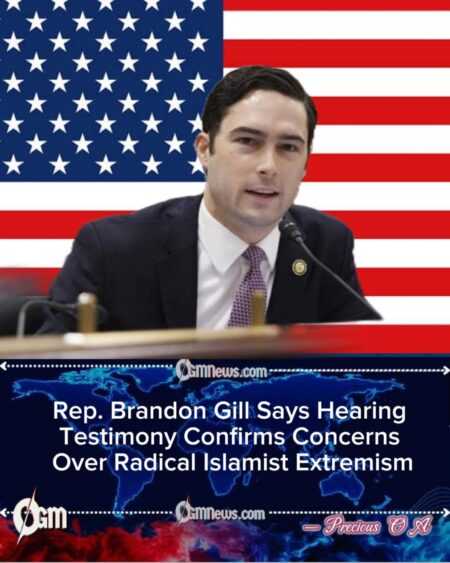
Rep. Brandon Gill said during a contentious congressional hearing that even a Democrat-invited witness declined to dispute his assertion that radical Islam represents what he described as an “alien ideology that seeks to dominate American life.” His remarks quickly drew national attention, intensifying an already polarizing debate over national security, religious freedom, and political rhetoric.
Rep. Brandon Gill argued that the focus of his comments was specifically on extremist movements, not the broader Muslim faith. He maintained that radical Islamist ideologies, in his view, conflict with constitutional principles and democratic governance. Supporters say he was emphasizing concerns about extremism rather than religion itself.
Rep. Brandon Gill also pointed to global examples of militant groups that claim religious justification for violence, stating that lawmakers have a responsibility to confront ideologies that threaten public safety. He framed his comments as part of a broader effort to prioritize national security and ideological transparency.
Debate Over Language and National Security
The hearing exchange unfolded during a broader discussion on counterterrorism and domestic safety. Lawmakers from both parties questioned witnesses about how the United States should address extremist threats while protecting civil liberties.
One Democratic member challenged the tone of the discussion, cautioning that sweeping language could risk stigmatizing entire communities. Civil rights advocates have long warned that rhetoric conflating extremism with a religion can fuel misunderstanding and discrimination.
Rep. Brandon Gill responded by reiterating that his criticism was directed at radical elements and not peaceful practitioners of Islam. He insisted that failing to name extremist ideologies directly would weaken policy responses and obscure the nature of certain security threats.
Witness Testimony Sparks Controversy
During the hearing, a Democratic witness was asked whether radical Islamist movements pose ideological challenges to American values. The witness acknowledged that extremist groups promote doctrines incompatible with constitutional democracy but emphasized the importance of distinguishing those groups from the broader Muslim population.
Rep. Brandon Gill seized on that acknowledgment, asserting that it validated his concerns. He argued that bipartisan recognition of extremist threats demonstrates the seriousness of the issue, even if lawmakers disagree on framing.
Critics countered that the nuance of the witness’s remarks was overshadowed by the charged phrasing used in the exchange. They contend that precise language is essential when addressing matters involving religion and national identity.
Rep. Brandon Gill and the Broader Policy Clash
The exchange reflects a deeper divide in Congress over how to discuss extremism. Some lawmakers favor direct and forceful rhetoric to highlight ideological threats, while others advocate for language that carefully separates extremist violence from religious belief.
Rep. Brandon Gill has positioned himself among those who believe clarity requires bluntness. He argues that extremist doctrines should be identified explicitly to avoid ambiguity in policy debates and security planning.
Observers note that such rhetoric often resonates strongly with certain voter bases while drawing sharp criticism from advocacy groups concerned about religious freedom and equal protection under the law.
Balancing Security and Religious Freedom
National security experts frequently stress that combating violent extremism requires cooperation with diverse communities, including Muslim Americans who overwhelmingly reject extremist ideologies. Maintaining that trust is widely viewed as critical to effective prevention efforts.
Rep. Brandon Gill acknowledged during the hearing that the overwhelming majority of Muslim Americans are law-abiding citizens who contribute positively to society. However, he maintained that ideological extremism should not be shielded from scrutiny due to fears of controversy.
Legal scholars point out that the First Amendment protects religious expression while allowing government action against criminal conduct. The tension between safeguarding liberty and addressing threats remains a recurring theme in policy discussions.
Political and Public Reaction
Reactions to the hearing comments were swift. Some conservative commentators praised the congressman for what they described as candid recognition of ideological extremism. They argue that avoiding uncomfortable terminology weakens public understanding of security risks.
Rep. Brandon Gill defended his remarks in subsequent interviews, stating that confronting radical ideologies is not an attack on religion but a defense of constitutional governance. He emphasized that policy debates should not shy away from difficult conversations.
Opponents, meanwhile, warned that rhetoric perceived as broad or inflammatory can deepen divisions and alienate communities whose cooperation is essential in countering extremism. As the debate continues, the exchange highlights the delicate balance lawmakers must navigate when addressing national security, religious identity, and the principles of pluralism in American public life.