









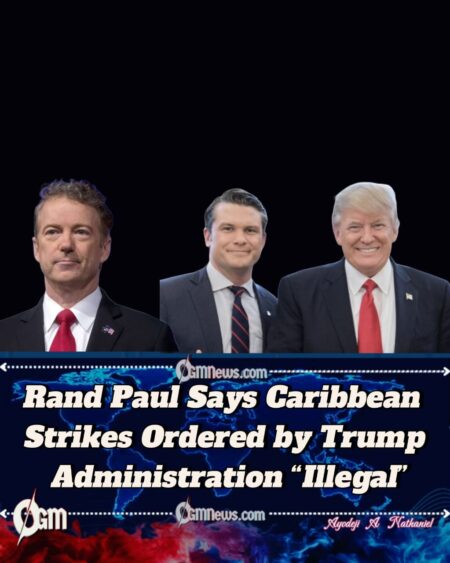
Rand Paul has publicly challenged the legality of the two recent U.S. military strikes in the Caribbean ordered by the current U.S. president serving a second term, as well as by Defense Secretary Pete Hegseth. In a pointed statement, Paul declared, “I think both strikes are actually illegal,” accusing the administration of overstepping its constitutional authority.
Paul’s remarks represent one of the most forceful rebukes from within the Republican Party regarding the administration’s expanding military posture in the region. His criticism underscores growing intra-party concern about executive overreach, particularly in matters involving unilateral military action.
Rand Paul Questions Legal Basis for Military Action
Rand Paul argued that the president lacks congressional authorization for offensive force outside active war zones, pointing to what he describes as “clear constitutional limits.” He maintained that Article I of the Constitution places war-making powers squarely with Congress, and that emergency justifications offered by the administration do not meet the legal threshold.
Paul emphasized his long-standing position that any U.S. strikes,regardless of target,must be backed by explicit legislative approval. He warned that sidestepping this requirement risks setting precedents that allow unchecked presidential authority in future crises.
Rand Paul Challenges Justification Provided by Trump Administration
Rand Paul directly questioned the administration’s rationale, which officials framed as necessary to disrupt transnational criminal networks and protect U.S. national security. He argued that such explanations, while serious, still require congressional debate, authorization, and oversight.
Paul insisted that allowing the president to act unilaterally,no matter how urgent the threat is portrayed, undermines core constitutional safeguards. He added that bipartisan concern is likely to grow if the White House continues expanding its definition of permissible executive action.
Rand Paul Notes Implications for U.S. Foreign Policy
Rand Paul warned that unilateral strikes risk deepening diplomatic tensions in the Caribbean, especially among nations that have historically resisted U.S. military presence in their territorial zones. He argued that such actions may generate regional backlash, complicating cooperative efforts on security, migration, and economic partnerships.
Paul also suggested that bypassing Congress could weaken U.S. credibility abroad, as allies may interpret unilateral action as a shift away from rule-bound international engagement. He called for a comprehensive reassessment of the administration’s strategic posture in the region.
Rand Paul Signals Continued Push for Congressional Oversight
Paul stated that he intends to push for hearings, briefings, and legislative reviews to scrutinize the administration’s actions. He argued that Congress must reassert its constitutional role to prevent what he views as creeping executive militarization.
Paul concluded that while protecting national security is paramount, it must never come at the expense of constitutional balance. He urged his colleagues,regardless of the party to support stronger guardrails that compel the executive branch to justify military force before acting.


