










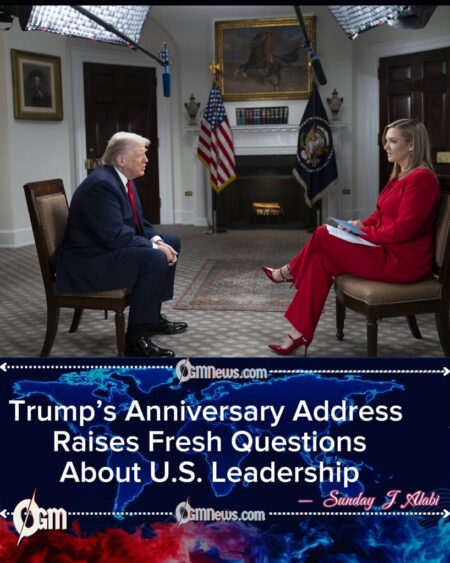
United States President Donald Trump, currently serving a second term in office, marked the first anniversary of his return to the White House with a lengthy and closely watched appearance in the press briefing room, an event intended to showcase his administration’s achievements. Instead, the extended session drew global attention for its meandering delivery, sharp rhetorical turns, and remarks that reignited international anxiety about the direction of U.S. leadership and the future of key global alliances.
As journalists crowded into the briefing room and allies followed closely from abroad, the president Trump moved between policy claims, personal recollections, and off-topic asides. The performance, lasting more than ninety minutes, underscored both Trump’s continued grip on the political spotlight and the unease felt by critics and partners who see his style of governance as unpredictable at a time of mounting global tensions.
A Press Briefing Meant to Celebrate Trump Administration a Year in Office
President Trump entered the briefing room with the stated aim of highlighting what he described as the major accomplishments of his first year back in power. Reading from prepared notes, he cited economic initiatives, executive orders, and foreign policy moves, presenting them as evidence of decisive leadership and rapid action.
However, the structure of the address quickly loosened. The list of achievements was frequently interrupted by digressions, repeated claims, and anecdotes unrelated to policy. While supporters viewed the session as an unfiltered display of confidence, others interpreted it as lacking coherence and focus.
For many observers, the contrast between the formal setting and the informal, at times rambling delivery shaped the broader reaction. Rather than a clear summary of progress, the briefing became a prolonged performance that left key policy questions only partially addressed.
Personal Anecdotes and Frequent Digressions
Throughout the session, Trump repeatedly drifted into personal stories, including childhood memories from Queens, New York, and reflections on his early interests. One such anecdote involved his experiences playing baseball near a building he later learned was a mental health facility, a story he returned to more than once.
These moments, while familiar to audiences accustomed to Trump’s improvisational speaking style, stood in stark contrast to the gravity of the occasion. The president moved quickly from nostalgic recollections to sweeping political statements, often without clear transitions.
For critics, the digressions reinforced concerns about discipline and message control. Supporters, however, argued that the president’s conversational approach demonstrated authenticity and a willingness to speak without rigid scripting.
Claims of Achievement and Contested Narratives
Central to the briefing was Trump’s insistence that his administration had delivered historic results in a short period. He repeated claims of ending multiple long-running conflicts, restoring American strength, and reversing policies he has long criticized.
Several of these assertions echoed earlier statements that remain disputed by experts and political opponents, including references to past elections and characterizations of ongoing global conflicts. The repetition of such claims, delivered in a steady monotone, gave the session a circular quality.
While the White House framed the remarks as a record of success, analysts noted the absence of detailed evidence or clarification on how some of the stated outcomes were achieved. The gap between assertion and explanation added to the sense of uncertainty surrounding the address.
Immigration, Law Enforcement, and Mental Health Rhetoric
Immigration and public safety emerged as recurring themes, with the president displaying images of individuals he described as criminal offenders and linking immigration enforcement to broader social order. He spoke approvingly of executive actions aimed at expanding detention and reviving large-scale mental health institutions.
Trump also commented on a recent fatal shooting involving immigration authorities, describing it as tragic while adding personal details about the victim’s family that shifted the focus back to his political base. The juxtaposition of sympathy and political framing drew mixed reactions.
Human rights advocates expressed concern over the language used to describe migrants and mental illness, warning that such rhetoric risks stigmatization. The administration, however, maintains that firm policies are necessary to ensure public safety.
Global Alliances, NATO, and the Greenland Question
Internationally, the briefing heightened concerns about the future of long-standing alliances, particularly the North Atlantic Treaty Organization (NATO). Trump reiterated his skepticism about multilateral commitments and suggested that major changes could be forthcoming.
When questioned about U.S. intentions toward Greenland, the president offered a vague response, declining to rule out assertive measures while insisting that any outcome would ultimately benefit all parties. The lack of clarity unsettled European leaders already wary of strained transatlantic relations.
Analysts noted that such ambiguity plays into the strategic interests of rival powers seeking to weaken Western unity. The president’s remarks, while not announcing specific actions, reinforced perceptions of unpredictability in U.S. foreign policy.
Nobel Prize Frustrations and Reflections One Year On
Trump also returned to a familiar grievance: his belief that his foreign policy achievements deserved recognition from the Nobel Peace Prize committee. He criticized Norway’s role in the process, framing the issue as evidence of lost international prestige.
The comments, delivered with visible irritation, contrasted sharply with the optimistic tone Trump struck at his inauguration, when he proclaimed the dawn of a new “golden age” for America. One year later, the repetition and combative edge of his remarks suggested a presidency still driven by personal validation as much as policy goals.
For observers at home and abroad, the anniversary briefing offered little reassurance. Instead, it reinforced the central question shaping global debate: how much of the world’s security and stability now rests on the temperament and instincts of a single leader.


