










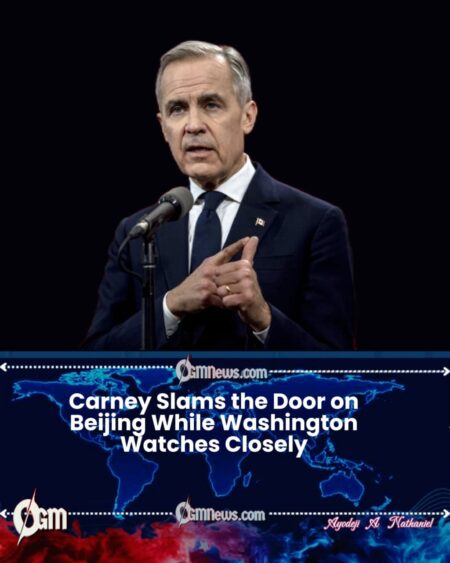
Prime Minister Mark Carney has publicly dismissed reports of a potential trade deal between Canada and China, stating unequivocally that his government has “no intention of doing that with China.” His remarks followed warnings from U.S. President Donald Trump, the current U.S. president serving a second term, who reportedly threatened to impose tariffs as high as 100 percent on Canadian goods should Ottawa deepen certain economic ties with Beijing.
The exchange has placed Canada’s foreign and trade policy under renewed scrutiny, highlighting the delicate balance Ottawa must maintain between safeguarding its economic interests, managing relations with its largest trading partner, and navigating an increasingly polarized global trade environment.
Prime Minister Mark Carney’s Public Response
Prime Minister Carney’s statement was delivered as a direct rebuttal to claims circulating in political and media circles about Canada pursuing a new or expanded deal with China. By firmly denying such intentions, Carney sought to clarify Canada’s position and contain speculation that could unsettle markets or strain diplomatic relations.
The language used by the prime minister suggested an effort to project decisiveness and stability. Rather than signaling a dramatic policy shift, his comments emphasized continuity and caution, reinforcing the message that Canada’s trade decisions will be guided by national interests and existing strategic considerations.
U.S. Pressure and the Tariff Threat
President Trump’s reported threat of 100 percent tariffs represents a significant escalation in trade rhetoric. Such measures, if enacted, would have sweeping consequences for Canadian exporters, particularly in manufacturing, agriculture, and energy sectors that rely heavily on access to the U.S. market.
Even without immediate implementation, the warning itself carries substantial weight. Trade experts note that the United States’ economic leverage often compels rapid responses from its partners, especially when supply chains and cross-border industries are tightly integrated, as they are between Canada and the U.S.
Canada’s Complex Relationship With China
Canada’s economic relationship with China has long been marked by both opportunity and tension. While China represents a major global market for commodities and consumer goods, bilateral relations have been strained by diplomatic disputes, security concerns, and differing political systems.
Carney’s remarks indicate a cautious approach that prioritizes risk management over expansion. Rather than fully disengaging from China, Canada appears focused on limiting exposure at a time when geopolitical rivalries are intensifying and alliances are under pressure.
Diplomatic Signaling and Alliance Management
Public statements such as Carney’s often serve a diplomatic function beyond their literal meaning. By distancing Canada from a potential China deal, Ottawa may be signaling alignment with Washington while attempting to prevent further escalation from the White House.
This approach reflects a broader strategy of alliance management, in which Canada seeks to preserve stable relations with the United States while avoiding actions that could be perceived as undermining shared economic or security priorities.
Domestic and International Reactions
Reaction to the developments has been mixed. Supporters of a strong U.S.–Canada trade relationship argue that Carney’s response was pragmatic and necessary to protect Canadian jobs and industries. Critics, however, caution that appearing to retreat under pressure could limit Canada’s strategic autonomy and negotiating leverage.
Internationally, the episode has been viewed as another example of how U.S. trade policy continues to shape global economic behavior. Allies and competitors alike are closely watching how Canada navigates these pressures, particularly as similar dynamics play out across Europe and Asia.
Implications for Canada’s Trade Strategy
The situation underscores the challenges facing Canada’s broader trade strategy in an era of economic nationalism and great-power competition. Diversification away from reliance on a single market remains a long-term goal, yet immediate realities often constrain policy choices.
For now, Carney’s clear denial appears aimed at stabilizing relations and buying time. Whether Canada revisits its approach to China or doubles down on existing partnerships will depend on future developments in U.S. trade policy and the evolving global economic landscape.


