










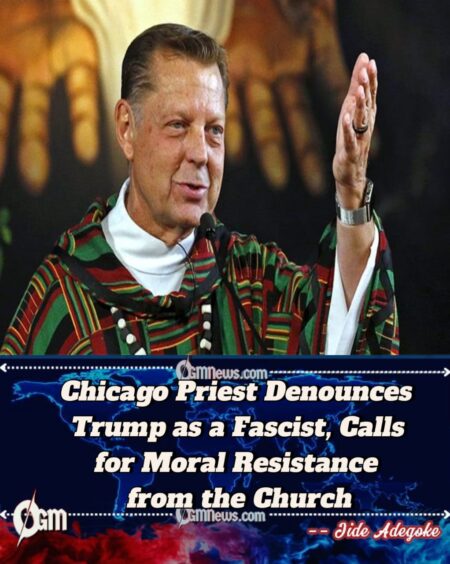
Outspoken Chicago priest, Reverend Michael Pfleger, has launched a scathing critique of President Donald Trump, describing him as a “dictator in the White House” and a “fascist who thrives on bullying, threatening, and intimidating.” Pfleger’s fiery remarks, delivered during a Sunday address and later amplified across social media, have reignited national debate over Trump’s leadership style as he continues his second term in office.
The Catholic priest, Michael known for his social activism and vocal stance on justice issues, accused the president of fostering division and fear while undermining democratic values. His comments come at a time when political tension in the United States remains high, with church leaders increasingly stepping into the national discourse on morality and governance.
“We Got a Dictator in the White House” — Pfleger’s Fiery Words Stir Controversy
“We got a dictator in the White House,” Pfleger declared before a crowded congregation, his voice rising with conviction. “He’s a fascist who works on bullying, threatening, and intimidating Pope Leo’s hometown.” The priest’s statement, referencing the late Pope Leo XIII’s roots in Italy—a symbolic nod to faith and justice—appeared to frame Trump’s leadership as antithetical to moral and democratic principles.
Observers say Pfleger’s comparison to fascism reflects growing concerns among religious and civil-rights leaders about the erosion of democratic norms. His message underscored fears that the president’s rhetoric and political maneuvers resemble authoritarian patterns, particularly his frequent attacks on critics, the press, and judicial institutions.
While supporters of President Trump have dismissed the remarks as partisan and inflammatory, many of Pfleger’s parishioners and social activists praised him for speaking truth to power. “He’s saying what many Americans are afraid to say aloud,” said one Chicago resident in attendance.
Priest Michael Pfleger’s History of Speaking Out Against Injustice
Father Michael Pfleger, the long-serving pastor of St. Sabina Catholic Church on Chicago’s South Side, is no stranger to controversy. For decades, he has blended faith with activism—marching against gun violence, systemic racism, and political corruption. His criticism of President Trump is consistent with his history of challenging authority figures whom he believes perpetuate inequality and injustice.
In his Sunday homily, Pfleger called on Americans, especially people of faith, to resist “the normalization of hate and intimidation.” He emphasized that silence in the face of wrongdoing equates to complicity. “We cannot pray for peace while voting for policies that spread fear,” he warned.
As reactions continue to pour in nationwide, Pfleger’s remarks highlight the enduring tension between faith leaders and political power. Whether viewed as prophetic or provocative, his voice remains one of the most unflinching in America’s moral landscape.
Political and Public Reactions: Divided Responses to Pfleger’s Remarks
Reactions to Pfleger’s comments were swift and polarized. Trump supporters condemned the priest for using the pulpit to advance what they described as “anti-presidential rhetoric,” arguing that religious figures should remain neutral in political debates. Conservative commentators accused Pfleger of undermining the church’s role as a unifying institution.
Conversely, several civil-rights organizations and progressive faith leaders defended the priest, asserting that moral responsibility often demands challenging unjust authority. “Religious silence in the face of oppression is itself a political act,” one activist noted on social media, echoing Pfleger’s central message.
As the controversy unfolds, it underscores the broader clash between religion and politics in modern America—where faith leaders continue to grapple with their role in confronting power in turbulent times.


