










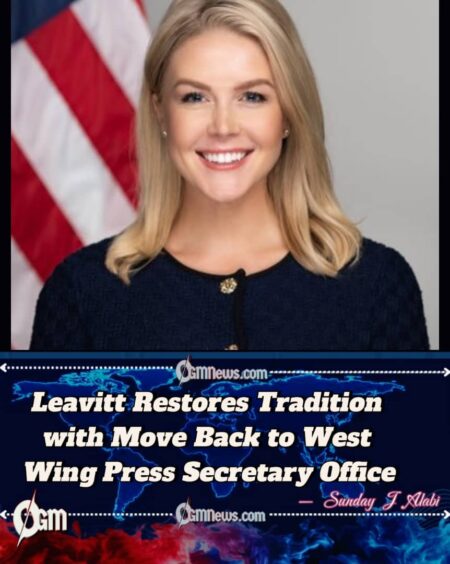
Karoline Leavitt, the White House press secretary, has returned to the traditional office reserved for her role, regaining one of the most prominent spaces in the West Wing. The office, complete with a fireplace and overlooking the White House’s north driveway, has long been seen as a marker of influence within the administration.
For the first months of President Trump’s second term, the office was occupied by Taylor Budowich, deputy chief of staff for communications and cabinet affairs, until his departure from the administration this week. With Budowich’s exit, Leavitt has moved into the office, aligning with precedent set during the president’s first term, when press secretaries such as Sean Spicer, Sarah Huckabee Sanders, Stephanie Grisham, and Kayleigh McEnany all held the space.
Leavitt’s Expanding Role in the Administration
Leavitt, 28, already noted as the youngest person to serve as White House press secretary, will take on additional responsibilities previously managed by Budowich. According to two administration sources, she will share those duties with Steven Cheung, the White House communications director. Budowich’s position remains unfilled as of now, raising questions about whether the role will be restructured or reassigned.
Leavitt’s appointment to the high-profile role followed her service as press secretary for President Trump’s 2024 re-election campaign, as well as earlier experience in the White House press office during his first term. Her reassignment to the larger, traditional office further solidifies her position as a central figure in the administration’s communications strategy.
Symbolism of Space in Washington Power Structures
Office allocation in the West Wing has long carried symbolic weight, reflecting both proximity to the Oval Office and the level of influence within the administration. The press secretary’s traditional office sits just down the hall from the president, offering both visibility and access.
By reclaiming the space, Leavitt restores a sense of continuity to a role closely tied to both tradition and public visibility. White House officials declined to comment on the office reshuffle, but the move underscores how physical space in Washington continues to reflect power and status in the heart of government.


