










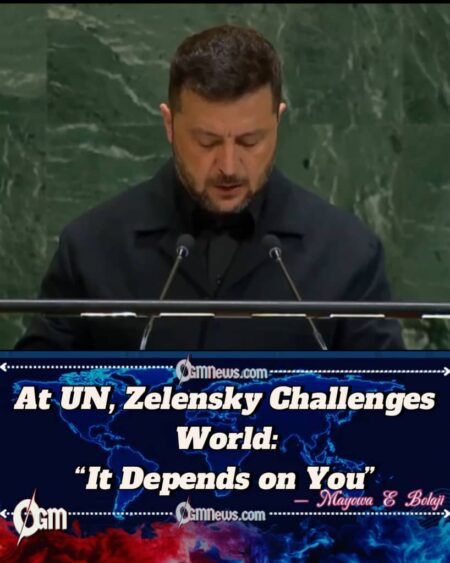
President Volodymyr Zelensky of Ukraine delivered a forceful and disciplined address before the United Nations General Assembly, drawing praise for a tone that many observers described as more presidential than that of other world leaders, including U.S. President Donald Trump.
Zelensky’s central message was clear: the war in Ukraine is not a distant or isolated conflict but a crisis with implications for the entire international community. “War has already reached too many people to pretend it has nothing to do with you,” Zelensky declared. “So it depends on you.” His words underscored the urgent need for collective action, rejecting the notion that nations can remain neutral or detached from the violence spreading across borders.
The Ukrainian president’s delivery was measured and firm, steering clear of rhetorical excess while appealing to shared responsibility among member states. Analysts said the speech reflected both moral clarity and strategic awareness, aimed at strengthening Ukraine’s global alliances while pressing for greater involvement from hesitant nations.
Contrast With Global Leaders
Zelensky’s address drew attention not only for its content but also for its contrast with speeches delivered by other leaders. Commentators noted that his remarks combined discipline and conviction, offering what some described as a “no-nonsense” alternative to the populist or combative rhetoric that has often defined international forums in recent years.
While President Trump, in his second term, has consistently emphasized sovereignty and national interest above collective responsibility, Zelensky highlighted the dangers of isolationism. His call for cooperation carried an implicit rebuke to leaders who downplay the global stakes of the conflict.
Zelensky’s performance was widely shared on international media platforms and praised by diplomats who saw it as a reminder of the human costs of war and the need for sustained commitment to peace.
Implications for Ukraine and the World
For Ukraine, Zelensky’s appearance at the UN reinforced his role not just as a wartime leader but as a statesman shaping global debate. His ability to articulate Ukraine’s struggle as part of a broader international concern signals a continued effort to prevent fatigue among allies and to strengthen diplomatic and military support.
For the broader international community, the speech posed a challenge. By framing the war as a test of global responsibility, Zelensky pressed nations to reassess their positions. The appeal resonated strongly among European allies, though questions remain about how it will influence countries in the Global South and beyond.
Ultimately, Zelensky’s intervention was more than a plea for aid—it was an assertion that the outcome of the war will shape the credibility of global governance itself.


