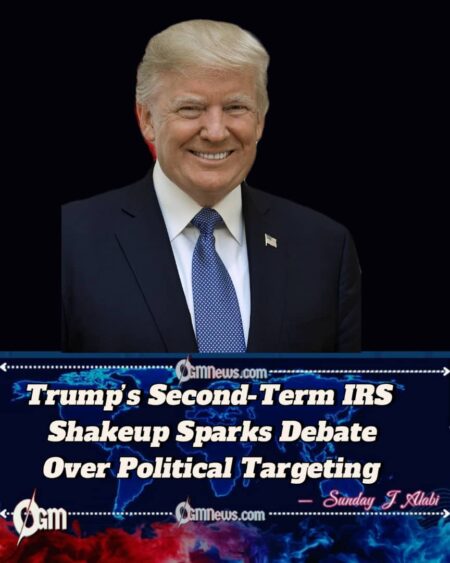
President Donald Trump, now serving his second term, has initiated what the White House describes as a sweeping overhaul of the Internal Revenue Service (IRS). The plan, led by interim IRS Commissioner Scott Bessent, aims to identify and investigate wealthy Democratic donors believed to be financing “politically motivated unrest” across the country.
Bessent has appointed senior advisor Gary Shapley to compile a list of high-profile figures for potential criminal inquiry. Among those reportedly under consideration is billionaire philanthropist George Soros, whose Open Society Foundation remains one of the world’s largest backers of progressive causes. Sources close to the Trump administration have indicated that the restructuring will expand the use of the Racketeer Influenced and Corrupt Organizations (RICO) Act — traditionally applied against organized crime — to include those allegedly funding violent or subversive political activity.
During a cabinet meeting earlier this month, President Trump endorsed the initiative, describing the move as “a step toward accountability.” He added, “Scott will do that. That’s easy for Scott,” reinforcing his confidence in Bessent’s ability to execute the plan.
Congressional Support and the RICO Push
The president Trump’s initiative is receiving strong backing from Republican allies in Congress. Senator Ted Cruz has introduced legislation that would authorize the Department of Justice to apply RICO provisions to individuals and organizations financing the recent “No Kings” protests, which the Trump administration alleges are being supported by Soros-linked networks.
“Follow the money. Cut off the money,” Cruz told Fox News host Sean Hannity. “There’s considerable evidence that George Soros and his network are funding these rallies, which may well turn into riots.” The bill seeks to expand federal authority to pursue financiers of civil unrest, marking one of the most aggressive applications of RICO in modern times.
Critics, however, argue that such measures blur the line between legitimate political activism and criminal conduct. Legal scholars warn that using RICO against political donors could raise constitutional questions concerning free speech and association. Still, the White House insists the move is necessary to “protect the integrity of the democratic process” and curb what it calls “coordinated, violent political interference.”
IRS Turmoil and Trump Administrative Shifts
The overhaul comes amid deepening uncertainty within the IRS itself. The agency has furloughed nearly half its workforce amid the ongoing government shutdown, leaving fewer than 40,000 employees on active duty. Earlier this year, mass layoffs under the Department of Government Efficiency (DOGE), overseen by Elon Musk, reduced IRS staffing from about 100,000 to 75,000 workers.
The president Trump’s decision to dismiss former IRS Commissioner Billy Long in August added further disruption. Long’s removal reportedly followed a dispute with the Treasury Department and the Department of Homeland Security over whether taxpayer data could be used to help immigration authorities locate undocumented immigrants. While the White House maintains that the move was long planned, internal sources described growing tension between Long and Trump administration officials over the agency’s independence and cooperation with law enforcement.
In an apparent effort to project stability, Long was later nominated as U.S. ambassador to Iceland. However, his departure has underscored what many describe as a climate of volatility at the top of the nation’s tax agency — a concern that could complicate the president Trump’s efforts to reshape the IRS into what supporters call “a politically accountable enforcement body.”
Soros and the Broader Political Landscape
George Soros, 95, and his son Alex remain central figures in the president Trump’s rhetoric against what he calls “left-wing oligarchy.” Soros’ Fund for Policy Reform reportedly donated $60 million to Democratic causes in 2024, ranking among the top dozen political donors nationwide. The Open Society Foundation, however, has denied any involvement in political violence, calling such allegations “baseless and dangerous.”
The debate over the IRS’s direction is expected to intensify as the Trump administration continues its reshuffle. Supporters of the president Trump hail the move as a long-overdue correction to what they describe as decades of partisan bias within the tax agency. Opponents, meanwhile, warn that using the IRS to pursue political adversaries risks turning one of the nation’s most powerful institutions into an instrument of retribution.
For now, President Trump’s message remains clear: the restructuring of the IRS will not only redefine federal tax enforcement but could also reshape the balance of political influence in Washington for years to come