


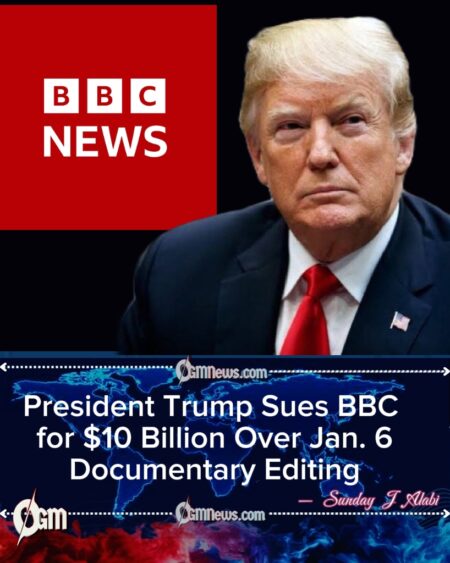
President Donald Trump, the current U.S. president serving a second term, has filed a sweeping $10 billion defamation lawsuit against the British Broadcasting Corporation (BBC), accusing the global media organization of deliberately misrepresenting his January 6, 2021 speech in a documentary aired shortly before the 2024 U.S. election. The legal action alleges that selective editing in the BBC’s Panorama program created a false and damaging portrayal of the president’s words and intent, particularly regarding the events that led to the Capitol riot.
Filed in the U.S. District Court for the Southern District of Florida, the lawsuit marks one of the most consequential legal confrontations between a sitting American president and an international public broadcaster, raising complex questions about journalistic standards, jurisdiction, and the boundaries of press freedom.
Details of the Lawsuit and Financial Claims
The lawsuit contains two counts: defamation and violation of Florida’s Deceptive and Unfair Trade Practices Act. President Trump’s legal team is seeking $5 billion in damages for each count, totaling $10 billion, arguing that the alleged misconduct caused significant reputational and political harm.
According to the 33-page complaint, the BBC’s actions went beyond editorial judgment and amounted to a “false, defamatory, deceptive, disparaging, inflammatory, and malicious depiction” of the president. The filing asserts that the documentary presented a distorted narrative that could mislead viewers about the president’s conduct and intentions on January 6.
Allegations of Selective Editing and Misrepresentation
Central to the lawsuit is the claim that the BBC intentionally spliced together two excerpts from President Trump’s Ellipse speech that were delivered approximately 55 minutes apart. The complaint alleges that this editing choice falsely suggested continuity and intent that did not exist.
Mr. Trump’s legal team argues that the BBC omitted key portions of the speech, including statements in which the president urged supporters to act peacefully. By excluding those remarks, the lawsuit contends, the documentary created the impression that the president was encouraging violence at the Capitol, a claim the president strongly disputes.
Internal Concerns and Editorial Oversight at the BBC
The lawsuit further alleges that concerns about the documentary’s editing were raised internally at the BBC prior to broadcast but were ignored. These claims reference reporting by The Telegraph, which suggested that warnings from within the organization did not result in corrective action.
The controversy ultimately led to significant leadership consequences within the BBC. Following public scrutiny and internal review, BBC Director-General Tim Davie and Head of News Deborah Turness resigned, underscoring the seriousness with which the broadcaster viewed the fallout from the documentary’s production and reception.
BBC’s Response and Legal Defense
In November, the BBC issued an apology to President Trump over the episode but declined to offer financial compensation. The broadcaster stated that it “strongly disagree[s]” with the assertion that its actions amounted to defamation and maintained that there was no intention to mislead viewers.
In correspondence with President Trump’s legal team, a lawyer for the BBC argued that the president cannot meet the high legal threshold required for defamation claims involving public figures in the United States. Specifically, the attorney asserted that there was no evidence of “actual malice,” meaning intentional or reckless publication of false information. The BBC has also challenged the Florida court’s jurisdiction, noting that the documentary was not broadcast on U.S. television.
Jurisdictional Disputes and the Role of Streaming Platforms
President Trump’s lawsuit counters the jurisdictional argument by stating that the Panorama documentary was available to U.S. audiences through the BritBox streaming service, thereby establishing sufficient connection to Florida and the United States more broadly.
Despite the BBC’s apology, the complaint argues that the broadcaster has shown “no actual remorse” or implemented meaningful institutional reforms to prevent similar editorial controversies in the future. The filing portrays the apology as inadequate and largely symbolic, rather than a substantive acknowledgment of wrongdoing.
Legal and Constitutional Challenges Ahead
Legal experts have expressed skepticism about the lawsuit’s prospects. U.K.-based attorney Mark Stephens previously noted that defamation claims face significant legal hurdles, particularly when the plaintiff is the president of the United States, widely regarded as the ultimate public figure.
Stephens emphasized that criticism of a sitting president is afforded broad protection under the First Amendment. He also noted that U.S. courts may examine whether the “sting” of the documentary was substantially true, pointing to prior judicial findings that have scrutinized the president’s rhetoric surrounding January 6. Even so, President Trump has forcefully rejected such interpretations, stating that he used “beautiful words” on that day and accusing the BBC of “putting words in my mouth.”