










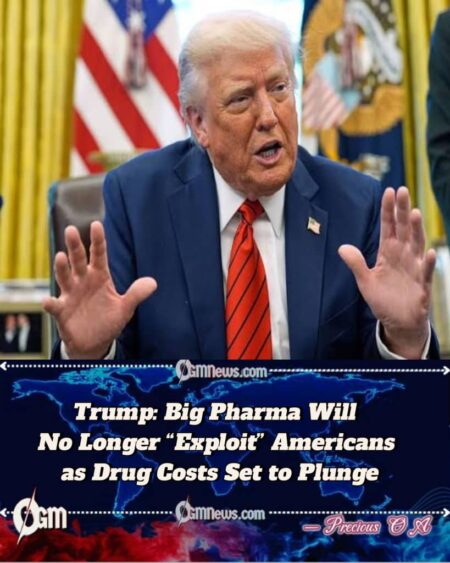
U.S. President Donald Trump has pledged an unprecedented reduction in the cost of medicines, declaring that prices will drop by “300%, 500%, and even more than that.” The statement came during a policy address at the White House, where the president outlined his administration’s ongoing effort to reform the healthcare system and bring relief to millions of Americans struggling with high prescription drug costs.
He emphasized that his administration would no longer tolerate what he described as “pharmaceutical exploitation.” He pointed to decades of unchecked price hikes by drug manufacturers, arguing that the American people have been forced to pay inflated prices for medications that cost a fraction of the price in other countries. “For too long, drug companies have taken advantage of hardworking Americans,” he said. “We are changing that—once and for all.”
The promise comes amid growing national concern over healthcare affordability, especially for senior citizens and low-income families. Rising drug prices have been a persistent issue in U.S. politics, with critics blaming a mix of monopolistic patent practices, middlemen, and limited competition for the high costs. The comments suggest a renewed determination to tackle the issue head-on through executive authority and new legislation.
The announcement sparked widespread reactions across political, medical, and economic sectors. While some hailed the pledge as a long-awaited reform, others questioned whether such drastic reductions could be achieved without destabilizing the pharmaceutical industry or discouraging innovation.
Industry Reactions and Public Response
President Trump’s remarks have sent ripples throughout the pharmaceutical industry, which has traditionally resisted government-led interventions in pricing. Executives from major drug firms have responded cautiously, warning that while price cuts are desirable for consumers, such a steep reduction — in the range of 300% to 500% — could threaten the financial viability of research and development programs. “We want affordability,” one executive said, “but we must also protect the ability to innovate and discover new treatments.”
President Trump’s supporters in the healthcare sector argue that such claims are exaggerated and that pharmaceutical companies have long operated with excessive profit margins. They insist that the real challenge is transparency — ensuring that patients and governments know how prices are set and where the money goes. Public health advocates welcomed the statement, describing it as a long-overdue confrontation with what they see as corporate greed. “If the administration follows through,” one advocate said, “it could transform the healthcare landscape for millions of Americans who are forced to choose between their medicine and their rent.”
President Trump’s critics, on the other hand, have accused the administration of using bold figures for political gain without offering detailed plans. Some lawmakers noted that promising “300% or 500% reductions” could create confusion, given that the current system involves multiple stakeholders — from manufacturers to insurers and distributors. They urged the White House to present a clear, evidence-based policy framework to back its claims and prevent unrealistic public expectations.
Despite the skepticism, there is a general consensus that the statement has reignited an important national debate. Healthcare affordability remains one of the top issues for American voters, and any substantial progress on this front could have far-reaching political and economic consequences.
Next Steps and Policy Implementation
President Trump has indicated that the administration is developing a series of executive orders aimed at restructuring how drug prices are negotiated and regulated. Among the strategies under consideration are stronger federal negotiations with pharmaceutical companies, tighter oversight of patent laws to prevent price monopolies, and expanded approval of generic and biosimilar drugs to increase competition.
President Trump also reiterated his commitment to removing middlemen — pharmacy benefit managers and wholesalers — who often drive up costs through hidden markups. He criticized the current system as “a maze of corruption and bureaucracy” and promised that upcoming reforms would ensure transparency from production to pharmacy shelves. The White House, according to insiders, is also studying global pricing models, where governments cap or negotiate drug prices directly, ensuring that citizens are not charged excessively for essential treatments.
President Trump’s plan, while ambitious, faces a complex path forward. The pharmaceutical industry wields significant lobbying power, and any major restructuring of drug pricing would require congressional support, regulatory coordination, and international trade adjustments. Health economists caution that while the figures may be symbolic, the intent behind them reflects a serious effort to push for affordability and accountability.
If implemented effectively, analysts believe the proposals could not only lower prices domestically but also reshape global pharmaceutical trade. Other nations, particularly those in Europe and Asia, could adopt similar measures, creating a ripple effect across the global market. However, critics warn that cutting prices too drastically without balancing supply and research incentives could lead to shortages or reduced investment in innovation.
Still, he remains confident. “We’re not going to let Big Pharma rip off the American people any longer,” he declared. “This administration will make sure that our citizens pay the lowest drug prices in the world — not the highest.”
As the debate continues, the coming months will be critical in determining whether these bold words evolve into tangible policy or remain another political promise in the long history of America’s healthcare struggle. For now, millions of Americans are watching — hopeful that this time, change might finally come


