










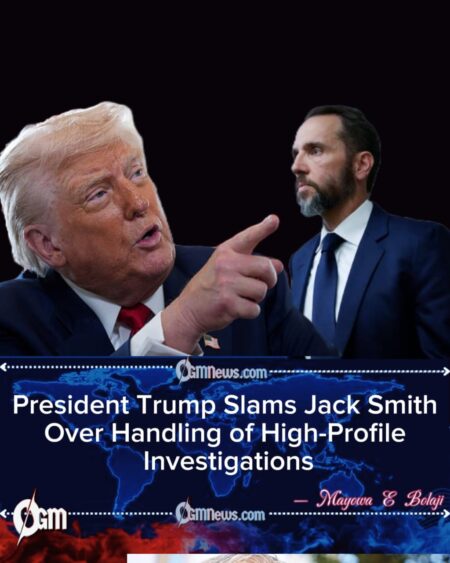
President Donald Trump, currently serving his second term as U.S. president, has publicly criticized former Special Counsel Jack Smith following Smith’s appearance before Congress, using his Truth Social platform to accuse the prosecutor of professional failures, politically motivated prosecutions, and entrenched bias. The remarks, issued during and after the testimony, have added a new layer of tension to an already polarized debate over the conduct and legacy of high-profile federal investigations involving the president.
Trump’s comments came as lawmakers questioned Smith about his role, decision-making processes, and adherence to prosecutorial standards while serving as special counsel. While Smith refrained from responding directly to the president’s accusations, the exchange has intensified scrutiny of the intersection between politics, prosecutions, and public trust in the justice system.
Background to the Congressional Testimony
Jack Smith appeared before Congress as part of an oversight effort examining the actions and outcomes of his tenure as special counsel. Lawmakers from both parties used the hearing to probe how investigative priorities were set, what internal safeguards guided prosecutorial discretion, and whether political considerations influenced charging decisions.
The testimony followed months of public debate over Smith’s work, with supporters describing it as a necessary application of the rule of law and critics questioning its scope and timing. Against this backdrop, the hearing was widely viewed as a significant moment for clarifying unresolved concerns surrounding the investigations.
President Trump’s Truth Social Response
As the hearing unfolded, President Trump took to Truth Social to issue a series of sharply worded posts criticizing Smith’s record. The president accused the former special counsel of presiding over what he described as failed investigations and engaging in prosecutions that he characterized as unfair and selectively applied.
Trump further alleged that Smith’s actions were driven by political bias rather than legal merit, arguing that the investigations reflected broader institutional hostility toward his administration. The posts reiterated long-standing claims by the president that elements within the justice system have been weaponized against him.
Allegations of Bias and Past Failures
Central to President Trump’s critique was the assertion that Smith’s prosecutorial history demonstrates a pattern of overreach and unsuccessful outcomes. Trump contended that prior cases handled by Smith did not withstand legal scrutiny, framing this as evidence of flawed judgment and questionable motives.
While these allegations have circulated previously in political discourse, Smith has consistently maintained that his work adhered to established legal standards. During the hearing, he emphasized the importance of independence and professionalism, underscoring that prosecutorial decisions were based on evidence and the law, not political considerations.
Lawmakers’ Reactions and Lines of Questioning
Members of Congress offered varied reactions to both Smith’s testimony and the president’s public criticism. Some lawmakers echoed concerns about accountability and transparency, pressing Smith to explain internal decision-making processes and safeguards against bias.
Others defended the former special counsel, warning against politicizing prosecutorial oversight and arguing that public attacks on legal officials risk undermining confidence in democratic institutions. The contrasting approaches highlighted deep partisan divides over the appropriate balance between oversight and independence.
Implications for the Justice System
The exchange between President Trump and Jack Smith has renewed broader questions about the role of special counsels and the perception of impartiality within the justice system.
Legal analysts note that high-profile public disputes can shape public opinion, regardless of the legal merits of the underlying cases.
At the same time, the episode underscores the challenges faced by prosecutors operating in politically charged environments. Ensuring transparency while maintaining independence remains a central concern for institutions tasked with enforcing the law amid intense public scrutiny.
Looking Ahead
As congressional oversight continues, attention is likely to remain focused on the findings and potential recommendations emerging from the hearings. While no immediate legislative action has been announced, lawmakers have signaled that further reviews may follow.
For President Trump, the Truth Social posts reaffirm his combative stance toward investigations involving his conduct, while for Jack Smith, the testimony represents another chapter in a closely examined public career. The broader implications of this confrontation are expected to reverberate through ongoing debates about accountability, governance, and the rule of law in the United States.


