










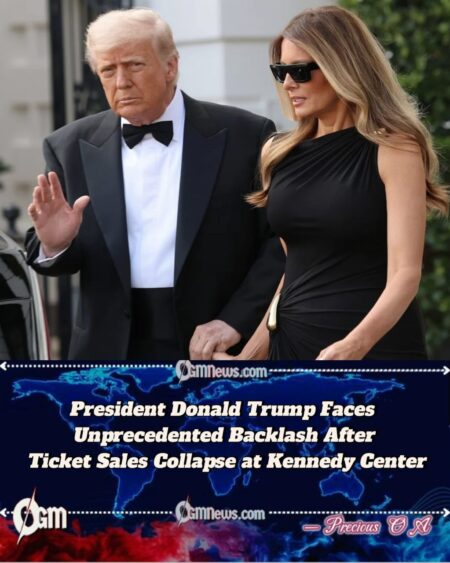
President Donald Trump has found himself at the center of an unfolding national controversy following his highly publicized and widely debated takeover of the prestigious John F. Kennedy Center for the Performing Arts, an institution that has long been regarded as one of the crown jewels of American cultural life. What was originally presented as a bold, visionary plan to “revitalize American culture” and ensure that the arts reflect the pride and patriotism of the United States has, according to many critics and observers, rapidly devolved into a public relations nightmare and a national embarrassment.
Since Donald Trump’s team assumed operational control, ticket sales have plummeted dramatically, leaving audiences smaller than anyone could have anticipated and prompting widespread concern about the center’s future.
Critics argue that the Kennedy Center, which historically hosted performances that drew audiences from across the country and even internationally, is now experiencing a staggering decline in attendance. Internal reports suggest that ticket sales for major performances have dropped by nearly 70%, leaving tens of thousands of seats conspicuously empty in venues that were once celebrated for their sell-out performances. The symbolic emptiness of these grand auditoriums, once filled with music, theater, and dance, has been likened to a public metaphor for what some believe is the mismanagement of a cherished American institution. Observers suggest that the dramatic downturn is not only financial but also reputational, reflecting poorly on the center and on the administration overseeing it.
Observers note that the politicization of the Kennedy Center has become one of the most contentious aspects of the current administration’s involvement. For decades, the center prided itself on being a neutral, nonpartisan haven for the arts, where creativity and artistic freedom were respected above political agendas. Today, performers, patrons, and cultural leaders express frustration and alarm at what they describe as the transformation of a revered space for artistic expression into “a stage for political messaging.” Some long-time supporters have described the environment as increasingly hostile to creative voices that do not align with the administration’s narrative or vision, prompting concerns about whether the center can remain relevant and respected in both domestic and international artistic communities.
Supporters claim that the replacement of long-standing management officials with loyal appointees is intended to usher in a “new era of patriotic cultural pride,” ensuring that American art reflects national values and historical achievements. According to statements released by the White House, the administration envisions a Kennedy Center that celebrates national heritage and promotes productions showcasing American greatness. However, many industry insiders caution that this approach risks alienating the very audiences and performers whose engagement is essential to the center’s continued success. While some applaud the president’s boldness and commitment to patriotic themes, many others argue that prioritizing ideology over artistry could irreparably damage the center’s reputation.
President Donald Trump now faces mounting pressure from cultural experts, economists, and political commentators to address the precipitous decline in ticket revenue. Analysts warn that if attendance does not recover swiftly, the financial stability of one of America’s most prestigious performing arts institutions could be threatened. The combination of empty halls, public scrutiny, and negative media coverage has created a crisis that extends beyond simple ticket sales, touching on broader questions about governance, artistic freedom, and the role of political influence in national cultural institutions.
Cultural Community in Shock and Dismay
President Donald Trump has triggered widespread alarm and indignation across the American arts community, a sector that has long been sensitive to changes in funding, programming, and administration. Since the reorganization, a number of performers, musicians, and directors have begun withdrawing from scheduled events, citing limitations on artistic expression and ideological constraints imposed by the new management. These departures have left schedules fragmented and audiences uncertain about the future of the center’s programming, amplifying concerns about long-term viability.
Veteran producers argue that the destruction of what was once a strictly nonpartisan approach to programming represents a fundamental shift in the cultural landscape. According to these experts, prioritizing political loyalty over artistic quality risks eroding the center’s credibility and diminishing the overall diversity of performances. They contend that the imposition of partisan oversight undermines the center’s historic mission to provide a platform for all forms of artistic expression, regardless of political alignment, and threatens to transform a nationally celebrated institution into a niche venue catering to a narrow ideological audience.
Many patrons have expressed their frustration through the suspension of financial contributions and withdrawal from long-standing donor programs. Cultural enthusiasts who have supported the Kennedy Center for decades now report feeling alienated, as they perceive the administration’s policies to be more about political messaging than the cultivation of high-quality performances. The exodus of donors and supporters has been particularly concerning for financial planners within the center, who rely heavily on contributions to maintain the programming standards and operational stability of the institution.
Artists report that numerous works dealing with socially sensitive topics—ranging from racial justice to gender equality and political satire—have been quietly removed from the lineup, leaving only performances that align with the administration’s stated vision of patriotic and celebratory American art. Choreographers, playwrights, and musicians have expressed the belief that these restrictions amount to censorship, stifling creativity, and silencing voices that historically made the Kennedy Center a beacon of innovation and cultural dialogue. These developments have prompted some performers to issue public statements criticizing the administration’s interference, further intensifying the national debate over artistic freedom.
President Donald Trump now presides over a Kennedy Center struggling to fill even its historically smallest venues. Despite efforts to introduce discounted ticket programs, promotional campaigns, and new scheduling initiatives designed to boost attendance, the visible emptiness of auditoriums has become a potent symbol of the administration’s miscalculation. The combination of empty seats, public disapproval, and critical media coverage has transformed the Kennedy Center from a symbol of cultural pride into a cautionary example of what can happen when political ambition intersects with artistic institutions.
Political Fallout and the Road Ahead
President Donald Trump has ignited a political firestorm as lawmakers on both sides of the aisle begin to scrutinize his administration’s involvement in the Kennedy Center. Critics argue that direct political control over programming decisions and administrative appointments undermines the center’s historical independence and threatens to compromise the broader mission of fostering artistic excellence. The controversy has fueled debates about the appropriate balance between government oversight and institutional autonomy in cultural organizations, with many insisting that the Kennedy Center must retain its nonpartisan character to remain credible.
A bipartisan arts caucus in Congress has announced plans to conduct a thorough review of the administration’s directives, examining the impact on programming, staffing, and financial management. Lawmakers have expressed concerns that without external oversight, the Kennedy Center risks losing not only its domestic prestige but also its international reputation as a hub of high-quality performances. Advocacy groups, cultural foundations, and former Kennedy Center officials have voiced support for the investigation, emphasizing the need to safeguard artistic freedom and ensure that the center remains a space for creativity rather than political messaging.
White House statements continue to defend the president’s approach, characterizing the backlash as “elitist outrage” and asserting that “American art must reflect patriotism and national pride, not political correctness or foreign influences.” Supporters of the president insist that the current turbulence is only a temporary setback that will ultimately give rise to a stronger, more ideologically aligned cultural institution. However, many analysts remain skeptical, noting that public perception and attendance trends indicate a deeper, more systemic problem that cannot be resolved through ideological framing alone.
Cultural analysts warn that the damage inflicted upon the Kennedy Center may be both immediate and long-term. Beyond the financial losses caused by empty seats and declining ticket sales, the center’s credibility as a national cultural landmark is at risk. Observers argue that the current turmoil reflects a broader societal divide, illustrating how deeply politics and culture have become intertwined in contemporary American life. They caution that without careful recalibration, the Kennedy Center may emerge from this crisis diminished, with long-lasting consequences for its role in promoting cultural dialogue and artistic excellence.
President Donald Trump now stands at a critical juncture, balancing the pursuit of his artistic vision with the urgent need to restore public confidence and institutional stability. Whether the Kennedy Center can recover from this unprecedented combination of financial, cultural, and political challenges remains uncertain, but the unfolding events have already ensured that the center’s future will be closely scrutinized by performers, patrons, lawmakers, and the broader American public alike. The once-celebrated venue, now a flashpoint for national debate, continues to symbolize the tensions between political ambition and the enduring values of artistic freedom and cultural excellence.


