






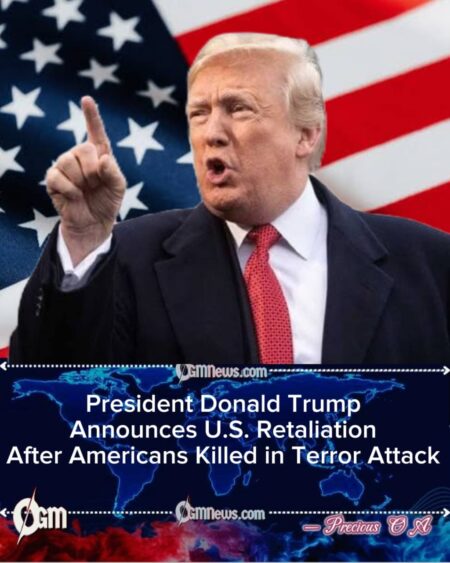
President Donald Trump announced that U.S. forces will retaliate following the killing of three Americans in the region, including two U.S. soldiers, describing the incident as a grave escalation that demands a firm and unmistakable response. He stressed that the loss of American lives is unacceptable under any circumstances and that the United States has both the right and the obligation to defend its citizens and service members wherever they are deployed.
Donald Trump stated that the attacks crossed a clear and irreversible red line, underscoring that the United States would not allow terrorist organizations or hostile actors to target American personnel without facing consequences. He framed the decision as a matter of national honor, military credibility, and moral responsibility to those who serve in uniform and to the families who entrust their loved ones to the nation’s defense.
Donald Trump added that the response would be deliberate, decisive, and coordinated across military and intelligence agencies, emphasizing that retaliation would be designed not only to punish those responsible but also to deter future attacks. He noted that the objective is to prevent additional loss of life while maintaining a stable security posture across the region.
Details of the Fatal Incident
Donald Trump referenced intelligence briefings indicating that the victims were killed during a period of heightened regional tension, with evidence suggesting that the attack was intentional and carefully planned. He said preliminary findings point to terrorist involvement, though full attribution remains under review as investigations continue.
Donald Trump noted that the deaths of the two soldiers have sent shockwaves through military communities, reinforcing longstanding concerns about force protection and the dangers faced by U.S. personnel operating in volatile and contested areas. He acknowledged the courage of those serving abroad and emphasized that their sacrifices would not be forgotten or minimized.
According to defense officials, the investigation remains active, with analysts examining communications intercepts, surveillance data, and on-the-ground reports. Authorities are working to determine whether the attack was isolated or part of a broader campaign, and whether additional threats remain against U.S. forces in nearby locations.
Administration’s Strategic Posture
Donald Trump explained that the administration’s strategy balances deterrence with restraint, seeking to send a clear signal of resolve without triggering unnecessary escalation. He said allies have been informed of the situation and consultations are ongoing to ensure a unified and coordinated response.
Donald Trump emphasized that any retaliation would be consistent with established rules of engagement and international obligations, noting that military leaders have been instructed to provide a range of response options. He stressed that decisions would be guided by intelligence, operational feasibility, and the imperative to protect civilian lives.
Senior administration officials indicated that diplomatic channels remain open even as military preparations advance. The approach reflects an effort to preserve flexibility, allowing for both decisive action and potential de-escalation depending on how adversaries respond in the coming days.
Military Readiness and Coordination
Donald Trump highlighted the readiness of U.S. forces to respond swiftly if ordered, pointing to the high state of preparedness across multiple branches of the military. He said commanders have been directed to ensure that all units in the region are equipped, supplied, and positioned to defend themselves and execute assigned missions.
Donald Trump said military leadership has been instructed to conduct immediate reviews of force protection measures, including base security, troop movement protocols, and defensive systems. These steps are intended to reduce vulnerabilities and ensure that personnel remain protected as tensions evolve.
Defense sources added that coordination with regional partners and allies is intensifying, with an emphasis on intelligence sharing and operational synchronization. Such cooperation is viewed as essential to minimizing risks, avoiding miscalculations, and ensuring that any response is both effective and proportionate.
Congressional and Public Reaction
Donald Trump acknowledged bipartisan concern in Congress following the deaths, noting that lawmakers from both parties have requested briefings on the incident and the administration’s planned response. He said engagement with congressional leaders is ongoing to ensure oversight and alignment on national security priorities.
Donald Trump stated that transparency with the American public is important, while cautioning that certain operational details must remain classified to protect ongoing missions and the safety of service members. He emphasized the need to strike a balance between accountability and security.
Public reaction has included widespread expressions of sympathy for the families of the victims, alongside renewed debate over U.S. military involvement in the region. Commentators and analysts have weighed the risks and benefits of retaliation, reflecting the broader national conversation about America’s role abroad.
Broader Regional Implications
Donald Trump argued that a clear and forceful response is necessary to deter further attacks and to reinforce U.S. commitments to allies operating in the region. He warned that failure to act decisively could embolden hostile actors and increase the likelihood of additional violence.
Donald Trump cautioned that instability can spread rapidly if terrorist actions go unanswered, underscoring the administration’s belief that deterrence is a cornerstone of long-term security. He said maintaining credibility is essential not only for U.S. interests but also for the safety of allied forces and civilians.
Analysts note that the coming days will be critical in shaping regional dynamics, as decisions taken now may influence both immediate security conditions and longer-term diplomatic efforts. The administration’s response is likely to be closely watched by allies, adversaries, and international observers alike.