







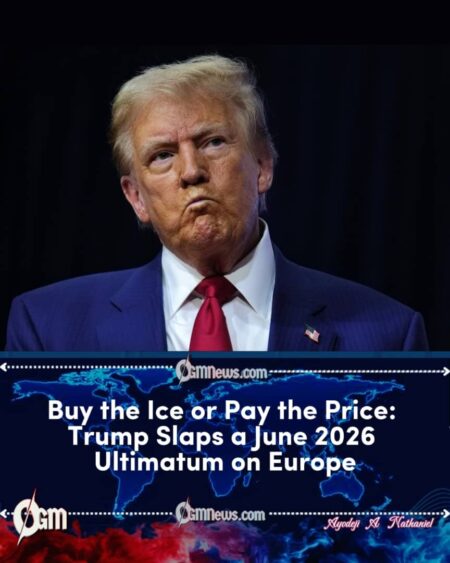
President Donald Trump, serving a second term as the current U.S. president, has warned European governments that the United States will raise tariffs on selected European goods to 25 percent if Greenland is not sold to Washington by June 1, 2026. The announcement sets a clear deadline and introduces a new layer of tension into transatlantic relations, blending trade policy with long-standing strategic interest in the Arctic territory.
The warning has prompted immediate diplomatic reactions across Europe, where officials maintain that Greenland’s future is governed by law and self-determination rather than external economic pressure. As markets and policymakers assess the implications, the statement has widened debate over the appropriate limits of trade leverage in international negotiations.
President Donald Trump and the Strategic Importance of Greenland
The U.S. administration has consistently described Greenland as a strategically vital territory because of its Arctic location, proximity to emerging shipping routes, and access to critical minerals. Security planners argue that stronger U.S. involvement would enhance regional defense capabilities and secure long-term geopolitical interests.
Supporters of this view contend that Arctic competition is intensifying and requires decisive positioning. In articulating this position, President Donald Trump has framed the issue as one of national security rather than a conventional diplomatic or commercial negotiation.
At the same time, critics note that strategic cooperation with Greenland and Denmark already exists, questioning whether sovereignty changes are necessary to achieve security objectives.
Trade Leverage Under President Donald Trump
The proposed tariff increase to 25 percent represents a significant escalation in trade pressure. If implemented, it could affect a wide range of European exports, potentially disrupting established supply chains and increasing costs for businesses and consumers on both sides of the Atlantic.
Trade analysts caution that such measures would likely trigger retaliatory responses from the European Union, raising the risk of a broader trade dispute. Even without immediate action, the announcement has introduced uncertainty into markets sensitive to policy shifts.
President Donald Trump has repeatedly defended tariffs as an effective negotiating tool, arguing that economic pressure can accelerate diplomatic engagement and produce favorable outcomes.
European Legal Position and Sovereignty Concerns
European leaders have responded by emphasizing that Greenland is an autonomous territory within the Kingdom of Denmark and that its status cannot be altered without the consent of its population. Officials in Copenhagen and Brussels have reiterated that the island is not for sale under existing legal frameworks.
The emphasis on sovereignty reflects broader European concerns about precedent, particularly the use of trade measures to influence territorial questions. Legal experts note that international law strongly protects self-determination, limiting the scope for external pressure.
As a result, European governments are publicly rejecting the premise of the demand while privately preparing for potential economic fallout.
Diplomatic and Economic Implications for Europe
The tariff warning has forced European policymakers to consider contingency plans, including possible countermeasures and legal challenges through international trade institutions. Industries with heavy exposure to the U.S. market are closely monitoring developments.
Economists warn that a tariff increase of this scale could contribute to higher prices and reduced competitiveness, compounding existing global economic uncertainties. The broader concern is that trade policy may increasingly be used to pursue non-trade objectives.
Within this context, President Donald Trump’s position is expected to remain a focal point of transatlantic diplomacy as the 2026 deadline approaches.
The Road to June 2026
With more than a year remaining before the stated deadline, diplomatic engagement is expected to intensify. Both sides face strategic calculations over whether dialogue can ease tensions or whether confrontation will become unavoidable.
Observers note that the outcome will likely shape not only U.S.–European trade relations but also norms governing the use of economic power in geopolitical disputes. The coming months may therefore prove decisive.
As negotiations continue, President Donald Trump’s warning has set the framework for a debate that extends beyond Greenland to the future balance of trade, security, and diplomacy between long-standing allies.