









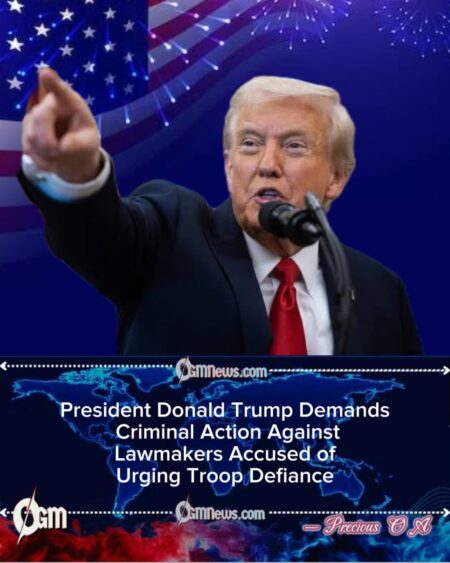
President Donald Trump emphasized that members of Congress have a constitutional obligation to reinforce national unity, insisting that no elected official should ever encourage any branch of the armed services to question or disregard presidential directives. He described the statements made by Elissa Slotkin, Mark Kelly, Jason Crow, and others as profoundly dangerous, warning that such public remarks create confusion within the chain of command at a time when stability and cohesion remain essential to the nation’s military posture.
Donald Trump reiterated that the attempt to persuade service members to resist orders—particularly in moments of heightened geopolitical sensitivity—could be interpreted as a deliberate attempt to sow discord. He added that this type of rhetoric does not merely constitute political criticism but crosses into what he characterized as a direct challenge to the authority of the commander-in-chief. According to him, this warrants legal scrutiny and potentially significant criminal consequences.
Donald Trump defended his stance by stressing that the military depends on discipline, clarity, and unbroken hierarchy for its effectiveness. He argued that encouraging troops to evaluate which orders they should or should not follow undermines centuries-old military norms. He insisted that without strict adherence to lawful directives, operational readiness and national security could be compromised on a wide scale.
Donald Trump: Reactions From Capitol Hill and National Security Experts
Donald Trump’s remarks provoked immediate and strong reactions across Capitol Hill, with Democratic lawmakers condemning his call for arrests as alarming and authoritarian. They argued that the ability to question presidential actions is fundamental to legislative oversight and that criminalizing speech would fundamentally erode the balance of power intended by the Constitution. Many insisted that the comments made by the named lawmakers were grounded in concerns about potentially unlawful military directives.
Donald Trump’s statements also drew criticism from civil liberties groups, several of which warned that prosecuting elected officials for political dissent would set a precedent with far-reaching implications. They expressed concern that such actions could discourage legislators from speaking openly about national security matters, particularly if they believe the president may be overstepping legal boundaries. These organizations emphasized that free expression within government is essential for transparent and accountable governance.
Donald Trump’s legal opponents within the national security community added that challenges to military directives should be processed through established oversight mechanisms, including classified briefings, hearings, and formal inquiries. They argued that disagreements over defense policy must be resolved within the constitutional framework, not through threats of arrest. According to these experts, using criminal prosecution as a political tool risks weakening the democratic norms that protect the integrity of both the military and the legislative branch.
Donald Trump: Military Community Responds With Mixed Emotions
Some service members and veterans agreed with the president’s perspective, asserting that political influence over military obedience could erode discipline in ways that are not immediately visible but become destructive over time. They argued that even indirect political messaging can pressure troops into hesitating when receiving commands, which could lead to fatal consequences in real-world operations.
Others within the armed forces expressed serious concern about the growing politicization of military matters. They warned that the military has historically been most effective when it maintains distance from partisan conflict. They fear that strong political statements from either branch of government risk dragging the armed forces into ideological battles that compromise their neutrality, professionalism, and public image.
Several analysts pointed out that the U.S. military has long trained service members to refuse only unlawful orders—not lawful ones—and asserted that lawmakers urging clarity on this principle is not necessarily equivalent to advocating defiance. They cautioned that the public must understand the difference between lawful refusal and political disobedience, noting that the two concepts are often conflated.
Donald Trump: Constitutional Debate Over Authority and Free Speech
Legal experts emphasized that the U.S. Constitution establishes a delicate balance between the president’s role as commander-in-chief and Congress’s responsibility to oversee military affairs. They argued that both branches have legitimate authority in matters of national defense, making conflict between them almost inevitable during contentious political periods.
Critics argued that lawmakers possess the right—and at times the obligation—to alert the public and the armed forces when they believe a presidential directive may violate constitutional limits. They reiterated that historically, American military leaders have been expected to question unlawful commands, and public guidance on this issue does not automatically translate into rebellion.
Supporters of the president countered that congressional concerns must be raised through institutional channels, not public statements that could cause confusion or undermine discipline. They insisted that if lawmakers believe the president is issuing unlawful orders, there are formal processes for investigation, oversight, and accountability that do not involve speaking directly to troops through public media.
White House Defends the President’s Position
White House officials clarified that the president’s comments were not meant to suppress political speech but rather to address what they described as a clear threat to national cohesion. They maintained that the administration is deeply concerned about the possibility of elected officials encouraging a pattern of selective obedience among service members, which could weaken defense readiness.
Administration spokespeople stated that the president’s team is actively reviewing whether the remarks made by the lawmakers constitute a violation of federal laws governing military conduct, including provisions related to incitement of insubordination. They emphasized that this review aims to protect the constitutional structure governing the armed forces.
White House aides added that the president’s commitment to protecting the chain of command remains unwavering. They stressed that no democratic system can function if political figures undermine the authority of the executive branch in matters of national defense, arguing that decisive action may be necessary to prevent long-term institutional damage.
Nationwide Debate Likely to Intensify
Observers across the political spectrum acknowledged that the controversy is likely to dominate national conversation for weeks to come. Legal scholars, political strategists, and constitutional experts expect contentious hearings, extended debates, and possibly legal battles as Congress responds formally to the president’s accusations.
Political analysts predicted that the arguments emerging from this dispute may reshape future legislative guidelines on how lawmakers can publicly address concerns about military orders. They also noted that this clash could influence upcoming elections, especially for lawmakers directly implicated in the president’s statements.
The confrontation represents one of the most significant conflicts between the executive and legislative branches during the president’s second term. Many expect the debate to evolve into a defining moment in discussions about civil-military relations, democratic accountability, and the scope of presidential power.


