



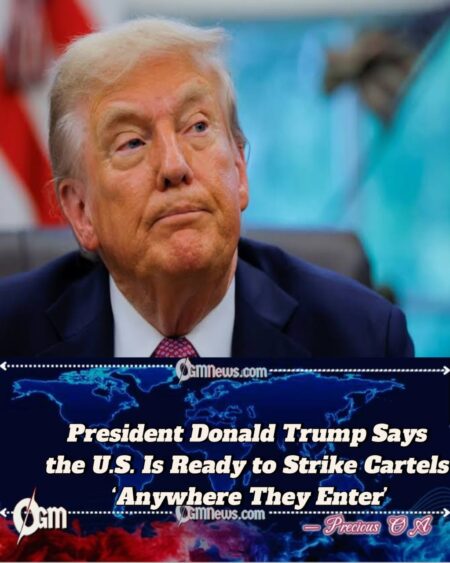
U.S. President Donald Trump has announced that he is fully prepared to authorize military strikes against drug cartels attempting to infiltrate the United States by land, signaling a major escalation in the nation’s counter-narcotics strategy. Speaking from the White House on Tuesday, President Donald Trump declared that his administration would no longer restrict its operations to maritime routes or offshore interdictions but would now take “decisive land-based action” to protect American borders and communities.
Donald Trump described this policy as a “necessary evolution” of America’s anti-cartel efforts, arguing that criminal organizations have become increasingly sophisticated in exploiting weak points along the southern border. “For too long, these groups have believed they could move freely across our land borders without consequence,” he said. “Those days are over. We will strike them wherever they attempt to breach our sovereignty — by land, by air, or by sea.”
The president stated that both the Department of Defense and the Department of Homeland Security are currently finalizing operational plans to identify and neutralize cartel activity within U.S. territory and at critical border zones. According to him, the initiative would involve increased surveillance, intelligence-sharing, and a robust ground response from U.S. military assets working in tandem with federal law enforcement.
Donald Trump also revealed that discussions are underway with Mexican authorities to strengthen cooperation in intelligence-gathering and tactical coordination. He emphasized that while Mexico remains a vital partner, the U.S. would not hesitate to act unilaterally if American lives were at risk. “We respect Mexico’s sovereignty,” he said, “but our first and highest duty is to defend the sovereignty of the United States.”
Analysts believe this announcement marks one of the boldest national security measures of Trump’s second term. By expanding the scope of counter-narcotics operations to include land-based military responses, the administration appears determined to treat cartel incursions not merely as criminal acts but as direct security threats requiring a wartime posture.
A Broader Military Doctrine to Combat Cartel Aggression
Donald Trump’s latest directive represents a significant departure from past counter-cartel strategies, which primarily relied on naval patrols, intelligence operations, and international cooperation to intercept narcotics shipments before reaching U.S. shores. His new approach introduces the possibility of rapid-response land strikes within proximity of the border — a move that could redefine America’s domestic defense strategy.
According to administration sources, the Pentagon is preparing specialized task forces equipped with advanced surveillance drones, precision-guided munitions, and ground support units capable of intercepting cartel convoys before they reach populated areas. These units would likely operate under a new joint command structure involving the U.S. Northern Command and Border Patrol tactical teams.
Donald Trump emphasized that this initiative is defensive rather than offensive in nature, asserting that cartels have evolved into “transnational terrorist organizations” that pose an immediate threat to national security. “We’re not just dealing with smugglers,” he said. “We’re dealing with heavily armed groups that use violence, intimidation, and corruption to poison our communities and destroy American lives.”
Donald Trump also noted that the United States has spent billions combating drug trafficking through traditional enforcement methods, with limited results. He argued that a military deterrent would deliver a stronger message to cartel leaders who have long dismissed U.S. border patrol operations as insufficiently forceful.
Military analysts have described the move as a revival of the “forward defense” doctrine — a strategy that focuses on confronting threats before they reach American soil. If fully implemented, the plan would represent one of the most assertive domestic security initiatives in modern history, granting the military greater authority to operate near civilian zones under carefully defined rules of engagement.
Reactions, Implications, and International Response
Donald Trump’s announcement has sparked a wave of reactions across political and international circles. Republican lawmakers have largely praised the move, calling it a “long overdue stance against organized crime.” Senate Majority Leader John Barrasso commended the president’s resolve, saying, “This administration has proven once again that it prioritizes American safety above politics.”
Governors of several southern border states — including Texas, Arizona, and New Mexico — also voiced strong support, citing the devastating impact of cartel operations on local economies and public safety. “We’ve seen communities torn apart by drugs and violence,” said Texas Governor Greg Abbott. “This kind of decisive federal action is exactly what we need.”
However, the plan has faced criticism from Democrats and human rights organizations, who warned that using the military in domestic operations could blur constitutional lines and risk unnecessary escalation. Senator Chris Murphy cautioned that “deploying the U.S. military against non-state actors near our borders sets a troubling precedent and could endanger innocent civilians.”
Mexico’s government issued a cautious response through its foreign ministry, reaffirming its commitment to bilateral cooperation while warning against unilateral U.S. military actions. “We share the United States’ desire to dismantle organized crime,” the statement read, “but such efforts must always respect international law and the sovereignty of both nations.”
Donald Trump reiterated that his administration would continue diplomatic engagement but insisted that America’s defense cannot depend on foreign approval. “We’re always ready to work with our neighbors,” he said, “but when our families, our towns, and our borders are under attack, America will defend itself — swiftly, powerfully, and without hesitation.”
Donald Trump’s declaration underscores his unwavering commitment to border security and national defense. As preparations for potential land-based operations continue, the United States and its neighbors will be closely watching to see how far the president is willing to go in this new and assertive phase of America’s war against cartel infiltration.