










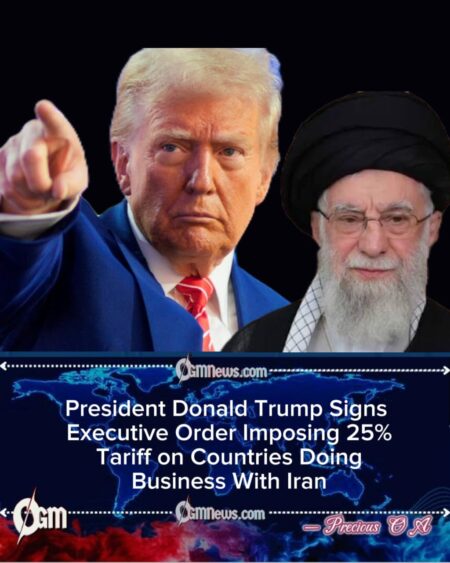
President Donald Trump signed an executive order imposing a 25 percent tariff on any country that continues to do business with Iran, marking a significant escalation in the administration’s use of trade policy as a tool of foreign pressure. The order was framed as part of a broader effort to curb Tehran’s economic reach and limit revenues that U.S. officials say could support destabilizing activities in the Middle East.
The executive order directs federal agencies to identify nations, companies, and sectors that maintain commercial ties with Iran, particularly in energy, shipping, finance, and industrial goods. Once identified, imports from those countries into the United States would face a blanket 25 percent tariff, regardless of whether the specific goods are directly linked to Iranian trade.
Administration officials described the move as a clear signal that Washington intends to enforce its Iran policy not only through sanctions on Tehran itself, but also by holding third-party actors accountable. The order emphasizes deterrence, arguing that higher trade costs will discourage governments and firms from maintaining economic relationships with Iran.
Scope and Mechanics of the Tariff
President Donald Trump outlined that the tariff would apply broadly, covering both goods and, where legally permissible, certain service-related transactions tied to trade. The administration indicated that exemptions would be limited and granted only in cases deemed vital to U.S. national security or humanitarian interests.
President Donald Trump also emphasized that the policy is designed to be straightforward to administer, avoiding complex carve-outs that could be exploited. Customs and trade authorities would rely on interagency intelligence and reporting to determine which countries fall under the order’s provisions.
Analysts note that the measure effectively extends secondary sanctions into the tariff realm, blending trade enforcement with traditional sanctions policy. By doing so, the administration seeks to increase compliance through market pressure rather than relying solely on financial penalties or legal action.
International Reaction to President Donald Trump’s Order
President Donald Trump acknowledged that the order would generate pushback from allies and trading partners, but argued that the stakes justified the approach. He reiterated that the United States views Iran’s economic isolation as a core component of its broader security strategy.
The decision prompted cautious responses from several governments that maintain limited trade with Iran, particularly in Europe and Asia. Officials in those regions signaled they would review the order’s details before determining their response, noting concerns about potential disruptions to global trade flows.
Some countries indicated they may seek waivers or engage in diplomatic discussions with Washington to clarify compliance requirements. Others warned that retaliatory measures could be considered if the tariffs are applied in a way they view as inconsistent with international trade norms.
Economic and Energy Market Implications
President Donald Trump defended the order against concerns that it could raise prices for American consumers, arguing that the long-term benefits of strategic pressure outweigh short-term market adjustments. He pointed to domestic production and diversified supply chains as buffers against inflationary effects.
President Donald Trump also suggested that energy markets would adapt quickly, noting that alternative suppliers could fill gaps left by reduced Iranian-linked trade. Energy analysts, however, cautioned that uncertainty surrounding enforcement could lead to short-term volatility in oil and gas prices.
Trade economists highlighted that the tariff could have uneven effects across sectors, depending on how deeply individual countries are integrated with Iranian commerce. Industries reliant on complex global supply chains may face higher compliance costs as firms reassess sourcing and partnerships.
Legal Authority and Enforcement
President Donald Trump stated that the executive order rests on existing statutory authorities related to national security, international emergencies, and trade regulation. The administration signaled confidence that the measure would withstand legal scrutiny if challenged in court.
Trade lawyers noted that while the president has broad discretion under U.S. law, the implementation details will be critical. Clear definitions of “doing business with Iran” and transparent enforcement standards will likely determine how smoothly the policy is applied.
Federal agencies are expected to issue guidance outlining reporting requirements, compliance timelines, and penalties for violations. Enforcement will rely heavily on coordination between customs officials, the Treasury Department, and intelligence agencies.
Domestic Debate and Strategic Outlook
President Donald Trump characterized the order as part of a consistent strategy to apply maximum economic pressure on Iran, arguing that sustained constraints could eventually bring Tehran back to negotiations on U.S. terms. He framed the policy as firm but reversible if objectives are met.
The policy has sparked debate within the United States, with supporters praising its clarity and resolve, while critics warn it could strain alliances and complicate global trade relationships. Some lawmakers called for congressional oversight to ensure the tariffs align with broader economic interests.
Diplomats and strategic analysts suggest the order’s ultimate impact will depend on international compliance and enforcement credibility. As countries weigh the cost of U.S. tariffs against their ties to Iran, the coming months are expected to test the effectiveness of trade-based pressure as a foreign policy instrument.


