








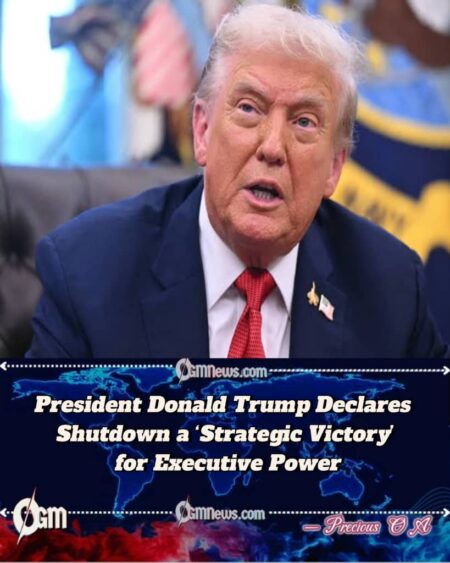
U.S. President Donald Trump has once again redefined the nation’s political landscape by framing the ongoing federal government shutdown as a strategic opportunity rather than a crisis. Known for his combative leadership style and focus on centralized authority, President Trump has described the shutdown as a tool to “cut unnecessary spending” and “reshape government functions.” Instead of viewing the halt in operations as a stalemate, he has publicly portrayed it as a moment of executive control—a chance to streamline federal agencies and reduce what he calls “wasteful bureaucracy.”
His administration has taken notable steps to redirect funds during the shutdown, protecting politically advantageous programs such as military pay and FBI salaries while allowing certain social programs to freeze. This selective funding approach has enabled the White House to prioritize agencies aligned with his agenda, further tightening control over government operations. Sources close to the administration say these decisions are deliberate, ensuring the president’s strongest political constituencies—particularly defense and law enforcement—remain unaffected while other sectors face uncertainty.
Donald Trump stated to reporters that the shutdown provided an opportunity to make changes that would otherwise face congressional resistance. “We can get rid of a lot of things we never wanted,” he declared, emphasizing that temporary suspensions could become permanent adjustments. His remarks have sparked widespread debate about whether he is intentionally using the budget crisis to advance a broader plan to consolidate power. For critics, these words were more than political bravado—they were a clear signal that the administration sees the shutdown as a tool for structural transformation.
Donald Trump’s approach, blending economic justification with political maneuvering, has transformed what was initially a funding deadlock into a deliberate restructuring of authority. While Congress remains locked in debate, the president’s assertive stance signals that this shutdown may extend beyond budgetary concerns into a redefinition of executive power itself. Observers warn that this strategy blurs the line between administrative efficiency and authoritarian centralization.
For Trump’s allies, this shutdown is not a setback but a calculated demonstration of strength, one that repositions the presidency as the dominant force in American governance. They argue that past administrations have allowed bureaucracy to swell uncontrollably and that the president is merely fulfilling his campaign promise to “drain the swamp.” To supporters, his moves represent courage and efficiency. To opponents, they represent the slow erosion of institutional checks and balances.
The Mechanics of Power: How Trump Administration is Pulling the Levers
Donald Trump’s strategy during the shutdown has revolved around selective funding, mass dismissals, and the reallocation of resources. By utilizing unspent appropriations and tariff revenues, his administration has ensured that essential personnel—particularly in defense and security—remain paid while other federal services are left in limbo. This calculated move allows the White House to maintain key support bases while simultaneously applying pressure on Congress to concede. It also highlights the administration’s ability to bypass the normal budgetary process and operate on its own priorities.
Thousands of federal employees have been furloughed indefinitely as departments deemed “non-essential” by the administration are left without funding. Legal experts warn that these dismissals, conducted without congressional consultation, blur the lines between constitutional authority and executive overreach. The move has left agencies like the Environmental Protection Agency and the Department of Education paralyzed, with projects suspended and workers uncertain about their futures. Economists estimate that if the shutdown continues for several more weeks, the combined economic loss could exceed $20 billion, with ripple effects across state governments and the private sector.
Donald Trump’s budget office, led by loyal appointees, has described the shutdown as an “unprecedented opportunity” to eliminate agencies considered redundant or politically biased. Departments that typically serve as oversight mechanisms are being weakened under the guise of fiscal responsibility. Critics argue that this mirrors the “unitary executive theory,” a constitutional interpretation giving the president near-total control over the executive branch. This theory, once considered controversial academic thought, now appears to be a working principle of the Trump administration.
His advisers defend these moves as essential to modernizing government and reducing waste, insisting that bureaucracy has long slowed progress. “We’re streamlining for the future,” one senior official reportedly said, claiming the administration was cutting through “layers of red tape.” However, the combination of selective funding and unchecked dismissals has drawn warnings from constitutional scholars who fear the erosion of the traditional balance between the executive and legislative branches. They caution that temporary shutdown powers could become permanent precedents, fundamentally altering how American democracy functions.
Donald Trump’s inner circle views these measures as part of a larger strategy to centralize control and redefine the federal structure—a move that could permanently shift the balance of power in Washington if allowed to continue unchecked. To them, the shutdown is not merely a momentary pause but a long-term recalibration of the government itself, aimed at ensuring that the president’s vision for America outlives his administration.
The Ramifications: Institutional Risk, Political Fallout, and Public Response
Donald Trump’s actions have ignited nationwide concern about the long-term implications for democratic institutions. Policy analysts warn that the president’s consolidation of power during a shutdown could set a dangerous precedent, transforming future budget impasses into tools for political dominance. Several former national security officials have described the trend as a “slow drift toward authoritarian governance,” pointing to the increasing concentration of power in the executive branch.
Republican lawmakers have largely maintained silence or voiced mild support, allowing his administration to continue reshaping federal priorities. The lack of significant opposition within his party has further emboldened his efforts, leaving the legislative branch in a weakened state. Democratic leaders, meanwhile, accuse the president of “hijacking the budget process” and turning the shutdown into a weapon against American democracy. Efforts to challenge his actions in court are already being discussed, but legal scholars note that the judiciary may be slow to intervene in what is being framed as an executive prerogative.
Public outrage has been mounting across the country. A growing protest movement known as “No Kings” has emerged, organizing thousands of demonstrations nationwide. Activists accuse the president of undermining the republic’s founding principles by using the shutdown to bypass democratic accountability. Major cities such as Washington D.C., New York, and Los Angeles have seen massive gatherings demanding an end to what they describe as “government by decree.”
Donald Trump’s critics believe that the institutional damage may outlast his presidency, as future administrations could inherit and exploit the expanded powers now being exercised. Government watchdogs warn that independent agencies and oversight offices may never fully recover if their budgets and authority are permanently reduced. This erosion of autonomy, they argue, could mark a turning point in American governance—one where power no longer flows between co-equal branches but remains concentrated in the executive.
For historians, this shutdown may ultimately be remembered not merely as a fiscal standoff, but as a pivotal moment in American political history—one in which executive ambition collided with constitutional restraint, leaving the nation to question just how much power a president should truly hold. Whether this period will be seen as reform or regression may depend not only on its outcomes but on how much the American people—and their representatives—are willing to resist or accept this new definition of presidential authority.